This is one outlet's own report from Engadget — the article as it was filed. Other outlets are covering the same event; open the full story to compare every source side by side.
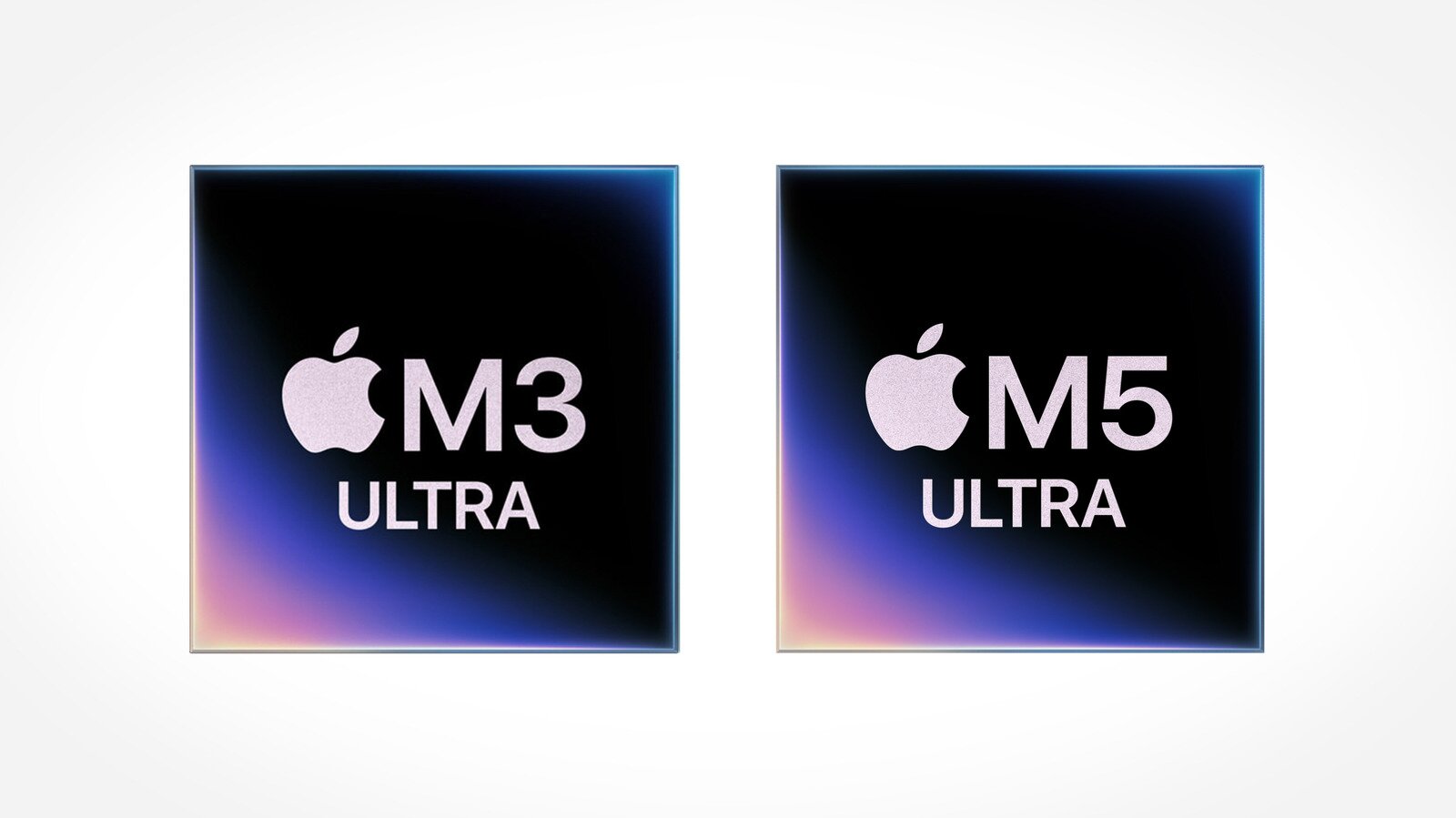
Apple Apple just launched the new M5 Ultra for the latest Mac Studio and as you'd expect, it's the fastest consumer processor the company has ever built. But how much speedier is it than its predecessor, the M3 Ultra? Let's dive in and see how Apple's latest super silicon measures up.
If you've followed Apple's Ultra chip family so far, you've probably noticed that it has skipped the M2, M4 and M6 generations and only come out as M1 Ultra, M3 Ultra and now M5 Ultra versions. The reason for that (and the delay compared to Apple's other chips) is because of the complexity — they're effectively two processors mated together using Apple's "Ultrafusion" bridge technology.
This chip fusion design has carried forward to the M5 Ultra, but there's a key change from before. The M3 Ultra married two M3 Max dies with over 10,000 high speed connections, according to Apple . However, the M5 Ultra fuses two dual-die M5 Max chips to form an all-new quad-die architecture, a first for Apple silicon. The new chip also has six times the connection density and boosts the interconnection speed to 4.4TB/s, up from the M3 Ultra's 2.5TB/s interconnection speed. These faster speeds between chip dies allows for improved efficiency and faster performance.
The M5 Ultra offers up to 36 processing cores in the top version, up from 32 before. Those include 12 super cores and 24 performance cores, compared to the M3 Ultra's 24 performance and eight "efficiency" cores. Those extra and faster cores help it deliver 25 percent faster single-threaded performance and up to 30 percent faster multithreaded performance. Along with the extra compute power, Apple also promises "industry leading energy efficiency," though it didn't provide any numbers to back that up.
Both chips support up to an incredible 512GB of unified memory. However, the M5 Ultra bumps unified memory performance by 50 percent over the M3 Ultra to 1.2TB/s, letting you "store huge datasets entirely in local memory, increase the tokens-per-second speed, and run huge LLMs with hundreds of billions of parameters entirely on device," Apple says. Given current high memory prices, though, the top 512GB configuration (coming in October)will likely cost around $15,000.
Both the M5 Ultra and M3 Ultra have 80 GPU cores, but Apple has redesigned those to improve graphics and AI performance. There's now a Neural Accelerator in each core that boosts AI compute speeds up to 4.5 times compared to the M3 Ultra. The GPU also includes Apple's latest shader core with second-generation Dynamic Caching, plus hardware-accelerated mesh shading and third-generation ray tracing, delivering up to a 40 percent speed boost compared to the M3 Ultra.
And for content creators, the M5 Ultra comes with an updated Media Engine with four ProRes encode and decode engines, along with hardware-accelerated AV1, H.264 and HEVC codecs. The boosted Media Engine speeds will allow you to play 33 streams of 8K 30 fps ProRes video at once, compared to 24 before.
It will be easy to connect fast storage, as the M5 Ultra pro supports 120Gbps Thunderbolt 5 connection speeds, just like the M3 Pro. And the new chip now supports PCIe Gen 6 internal SSD architecture (updated from PCIe Gen 5 before) that it says offers "industry-leading read and write speeds for rapid project loading, file transfers, and loading huge LLMs." That technology, previously only found in data centers, offers speeds up to 128GB/s for supported x16 lane devices. It's currently overkill, though, as the world's fastest SSD from Micron tops out at 28GB/s.
Apple gave a few examples of performance uplift compared to the M3 Ultra:
As mentioned, the Ultra processors are a generation and M-number behind Apple's other chips, so they use older process technology. The M5 Ultra uses TSMC's third-generation 3-nanometer process, while the new M6 is built using 2nm technology. However, the M5 Ultra's third-gen 3nm process is considerably more efficient and performant than the M3 Ultra, since the latter is built using TSMC's older first-gen 3nm process.
Apple's product prices have gone up across the board (thanks AI data centers) and the new Mac Studio is no exception. If you're fortunate enough to already own an M3 Ultra-powered version, you likely won't need to upgrade to the M5 Ultra unless you're a serious power user with some cash. If you're in the market for a new machine, though, get ready to cry: the M5 Ultra-powered Mac Studios with 96GB of RAM will start at $5,499, compared to $3,999 for the base 96GB M3 Ultra Mac Studio when it first launched last year — a $1,500 increase.
AIPROPX is an independent multi-source news index — we track, compare, and connect coverage from across the web into one place you won't find anywhere else.