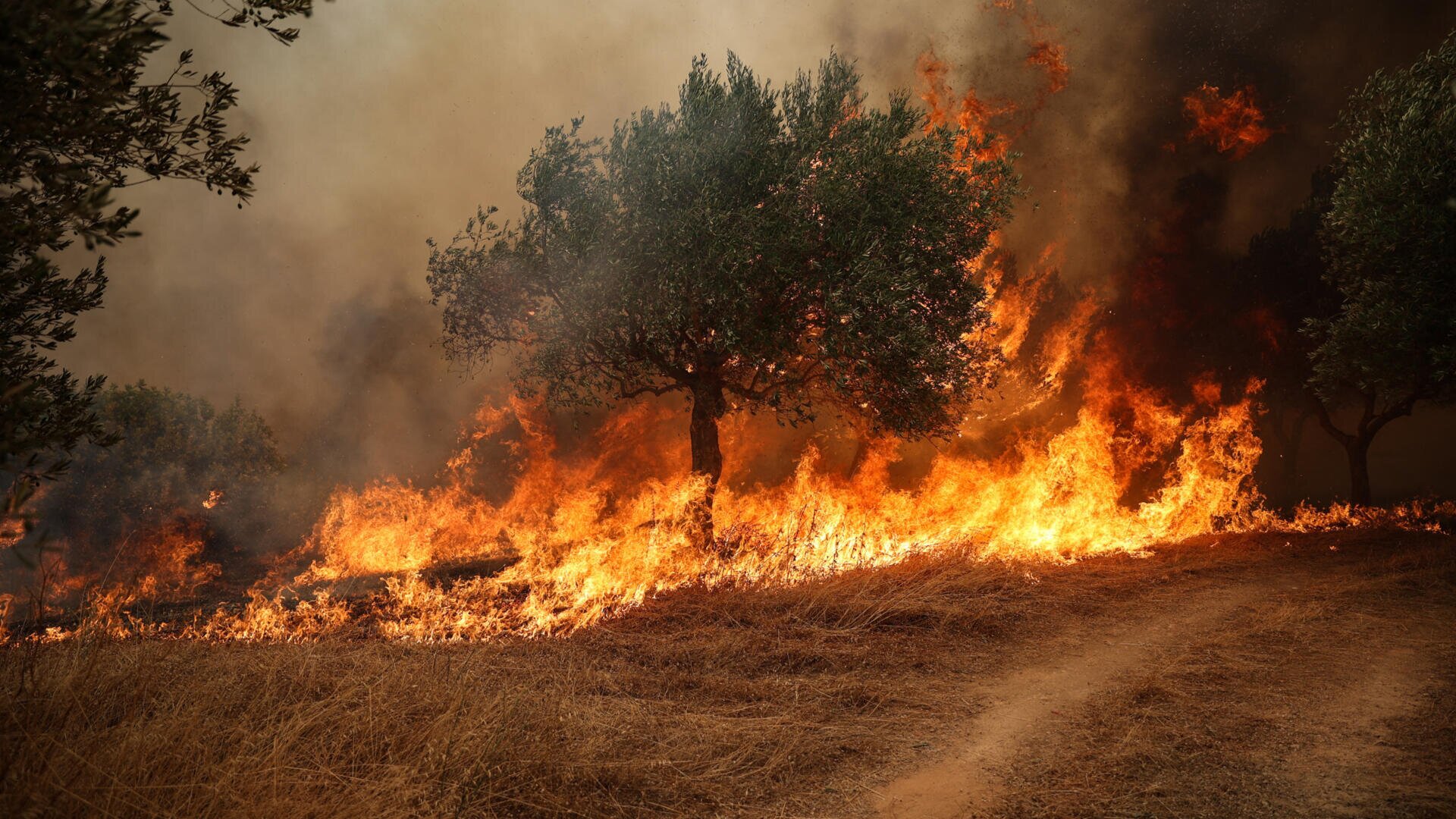
Europe's record-breaking hot and dry summer continues to take its toll on France and Greece, where firefighters fought to contain major blazes, while the UK recorded its driest July in nearly two centuries. Europe is Earth’s fastest-warming continent, heating at more than twice the global average since the 1980s, according to the European Union’s Copernicus climate service.
Issued on: 03/08/2026 - 21:50 Modified: 03/08/2026 - 21:51
By: FRANCE 24 A record-breaking hot and dry summer tightened its grip on Europe Monday, as water-dropping planes swooped over a major wildfire in Greece , firefighters in France sought to stabilize a blaze in Provence, and much of the UK recorded its driest July in nearly two centuries.
Wildfires west of Athens jumped containment lines, a day after a midair collision between two helicopters killed two crew members.
A Greek and a Danish national died and two others were hospitalised in the helicopter collision. All four were private operators chartered by the Greek firefighting service.
In France, firefighters in the region around Bordeaux guarded against potential flare-ups inside a still-burning scar four times the size of Paris .
A prolonged heat wave and lack of rainfall led to the driest July in England and Wales in nearly 200 years of recordkeeping, according to provisional statistics, the UK’s weather service said Monday.
All of Wales and more than half of England are officially in drought, the Met Office said. The dry spell was accompanied by sweltering temperatures across much of the UK, following heat waves in May and June.
Wales tied its record for its warmest mean temperature for July while England and the UK recorded their second-warmest July.
Strong winds returned to southern Greece late Monday, pushing flames into mountain home clusters, destroying farms and property, and closing a highway.
Areas surrounding Athens remain at high risk through the week with temperatures set to rise further. More than 1,000 people have been evacuated from around the seaside resort of Porto Germeno and other areas west of the capital – including more than 250 rescued by boats from beaches in the area.
To display this content from YouTube, you must enable advertisement tracking and audience measurement.
One of your browser extensions seems to be blocking the video player from loading. To watch this content, you may need to disable it on this site.
“This is a difficult fire that has troubled us,” Fire Service spokesman Yiannis Artopios said, adding that 12 water-dropping planes and 11 helicopters were operating in the area Monday.
The blaze was blamed on a faulty power line from a wind farm and led to the arrests of two contractors on charges of negligent arson.
Despite improved detection methods and expanded cooperation among European Union members, Greece and other countries along Europe's Mediterranean coast suffer devastating wildfires every summer as spells of heat wave temperatures grow longer.
Europe is Earth’s fastest-warming continent, heating at more than twice the global average since the 1980s, according to the European Union’s Copernicus climate service. Rising temperatures and prolonged drought leave vegetation drier and more combustible, allowing fires to spread faster and burn more intensely.
In France, thousands of evacuees were allowed to return home or to holiday accommodation Monday after a massive wildfire remained contained. More than 224,000 people had fled in what officials said was the country’s largest civilian evacuation outside wartime.
The wildfire burned about 420 square kilometres (162 square miles), making it France’s largest wildfire on record. Monday's return includes Cap Ferret peninsula, a tourist hot spot along the Atlantic coast, and Le Porge, the municipality hardest hit by the fire, where 183 homes were destroyed. Campsites remain closed.
A second wildfire in Provence did not flare up overnight, but was still not contained Monday as stronger winds were expected, firefighters and authorities said. About 1,500 firefighters, supported by water-dropping helicopters, continued reinforcing fire lines along the blaze that tore through about 18 square kilometres (7 square miles).
The European Forest Fire Information System said the risk of wildfire remains high across parts of the continent through August 5, including in traditionally cooler northern countries.
Firefighters in the Netherlands were battling a large blaze Monday in a forest in the southern province of Limburg, authorities said, as the country sweltered through another day of hot, dry summer weather. The national railway operator halted trains between two towns in the area due to the fire.
The Dutch air force sent two Chinook helicopters equipped with large water containers to help firefighters tackle the blaze in the Netherlands. Media reported that a campsite in the area was evacuated due to poor air quality caused by a large plume of smoke.
Page not found The content you requested does not exist or is not available anymore.