NEW YORK — I'm the kind of person who, every so often, falls into accidental daydreams about the concept of space. Usually because I'm listening to some sort of sad girl Spotify playlist, I start feeling infuriated that we may never learn the true meaning of the cosmos and become embarrassingly poetic about our isolation on Earth. I tend to ponder how strange microgravity is and begin Googling things like "what lies beyond the edge of the universe best evidence we have" and "when commercial rocket launch become same price JetBlue flight."
I'm pretty sure I've lived in these clouds ever since I got past the Freddi Fish and Microsoft Paint phase of my internet literacy — but then, a month before my 30th birthday, something huge happened. On a random Tuesday, I woke up, brushed my teeth, made myself an espresso, sauntered over to the Franklin Avenue C, and went to the International Space Station .
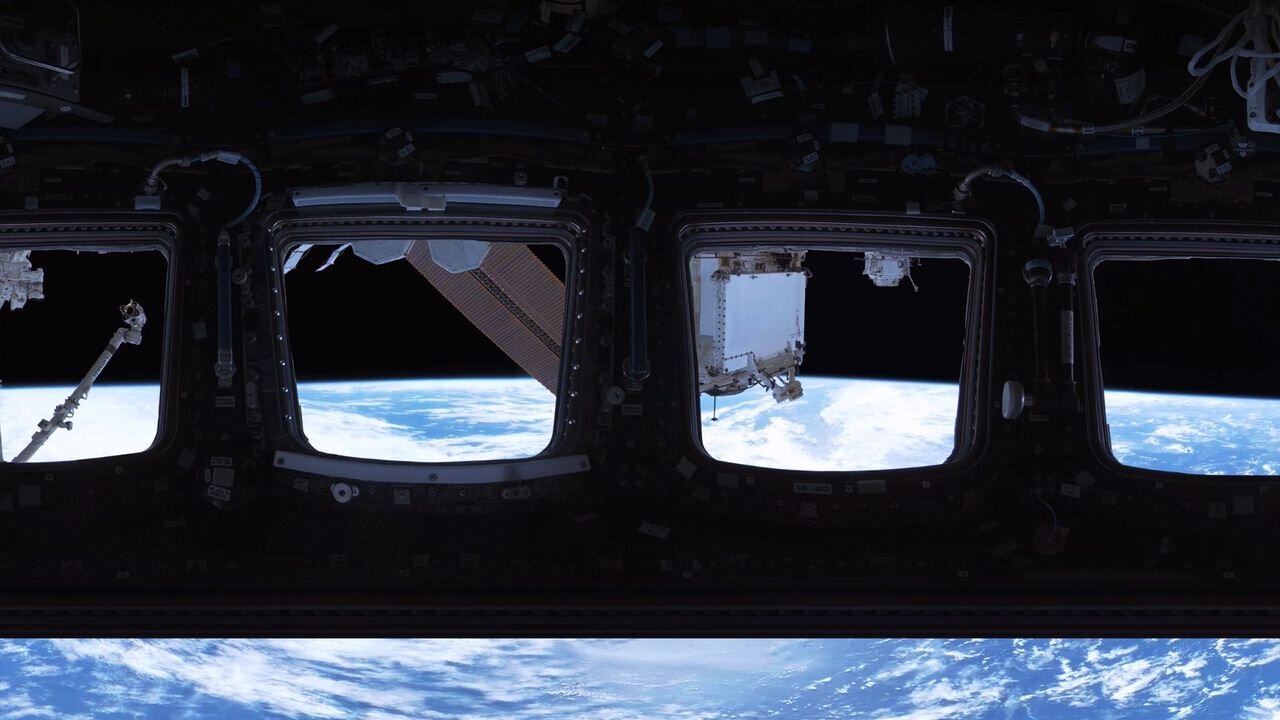
Once I got there, it was bizarre to float through the corridors and living quarters I've written about for so long as a science journalist and thought about for even longer. The walls felt lived in. The station's speed in orbit seemed a little too fast for comfort. The highly esteemed cupola — a protruding corner of the station with seven windows arranged in the shape of a daisy — was far larger than I imagined. In fact, the entire ISS was way more enormous than I can explain. Solar panels tower over you like rust-colored billboards and the station's floors threaten to collapse any second, fooling you as you gaze down at Earth . It's a little scary to be so exposed to the void of space, and that's true even when you're there in virtual reality.
Yes, unfortunately (or fortunately, depending on your caution levels) I launched to the ISS through a virtual reality experience called " Space Explorers: The ISS Experience " shown at Eclipsio in Manhattan. It's probably the closest I'll ever get to the real thing, until of course my dream of a cheap RocketBlue economy seat becomes possible. And most importantly, I'm here to tell you that if you're ever able to do the same, you should do it, too.
Here's what you'd see
The way it works is you put on some VR glasses and follow instructions in your headset to walk a certain direction or move your hands a certain way — your "hands" in the digital world look like floating yellow outlines of hands that correspond to the movements of your actual hands. To be transparent, my glasses were a bit glitchy. My digital hands were quite a bit unstable, for example, which did distract me a little bit but it was easy to get over.
Okay, once you're in the world of space, which is simply darkness, a few things happen (which I won't spoil). Eventually, a life-size structure of the International Space Station (ISS) appears. Suddenly, you're within the station. The interior of this structure isn't totally accurate to reality, to be clear. It's a gray, translucent rendering of the ISS's insides that you can explore. Still, the size is meant to be true to life.
People walking around the Eclipsio space during the show. (Image credit: Space Explorers: The ISS Experience)
Along the way, you can touch giant floating orbs that bring you a short snippet of video to watch. It is because of these snippets that I think this show is 100% worth it.
Each one corresponds to the location in which the orb sits — a cupola orb might show you a couple of astronauts floating around and looking out the window, while one near the gym equipment might bring you straight into a training session with Artemis II mission specialist Christina Koch. Perhaps you'd like to venture "outside" and float eye-level with the station's robotic arm. In your periphery to the left, a spacewalker traverses the exterior of the station. To the right, the Earth is majestic. In front of you, sunlight hitting the laboratory's worn white walls causes a realistic glare. You can't help but squint.
And the reason these snippets are outstanding is that they are made with real footage from the ISS.
A still from Space Explorers: The ISS Experience. (Image credit: Space Explorers: The ISS Experience)
A show made by astronauts
I sat down with Félix Lajeunesse, co-founder of Felix & Paul studios — the organization behind the exhibit — to learn how this was possible. What does it take to recreate the ISS with this level of detail, and this level of soul?
"It took about a year and a half to two years to just prepare for this project, and eventually cameras were sent up there in space," he said. "That was the beginning of a three year production."
More specifically, the footage you see in this VR show was filmed across six NASA expeditions and involved shipping three cameras to space — two cameras operating inside the ISS and one camera designed to function in the vacuum of space. That latter camera was attached to the Canadian robotic arm on the exterior of the station and operators on the ground could remotely control it to achieve the cinematic quality they wished. The astronauts first put it on the sliding table of the ISS's Japanese module. Then, the camera was egressed from the station and the robotic arm could pick it up.
When it came to the interior cameras, however, that's where the astronauts themselves stepped in.
"It's not a traditional camera — it's a virtual reality camera," Lajeunesse said. "So, if you're going to be around a table, for example, having coffee together in the morning, well, this camera is not going to be in the middle of the table because no one would ever be there. It will be at the same height as the rest of you around the table because in the end it's going to be replaced by a person being there with you."
"This kind of anthropomorphic idea that the camera is a person really resonated with them," he added.
A still from Space Explorers: The ISS Experience. (Image credit: Space Explorers: The ISS Experience)
In order to ensure the camera didn't interfere with the many experiments and ...