PODGORICA, Montenegro (JTA) — At the entrance to Nikšić, Montenegro’s second-largest city, a vintage fighter jet painted in the colors of the Israeli Air Force perches atop a giant concrete pedestal, as if about to take flight.
The monument, unveiled in 2024, commemorates “Operation Velvetta” — a top-secret plan that ferried 17 Supermarine Spitfire aircraft from Czechoslovakia, via what was then Yugoslavia, to Israel in 1948. The brazen scheme, carried out under the noses of British and Soviet spies, helped ensure the fledgling Jewish state’s military superiority during its War of Independence.
At the monument’s base, a bronze plaque in Serbian, English and Hebrew calls it “a permanent reminder to the unbreakable friendship of Montenegro and Israel.”
Yet lately, that friendship is being tested in ways not seen since Montenegro — the smallest of the six republics that once comprised Yugoslavia — declared its independence in 2006.
“Yes, there’s antisemitism here. It’s much better than some other places, but the situation has changed,” said Rabbi Ari Edelkopf, who heads the Religious Jewish Community of Montenegro in Podgorica, the capital.
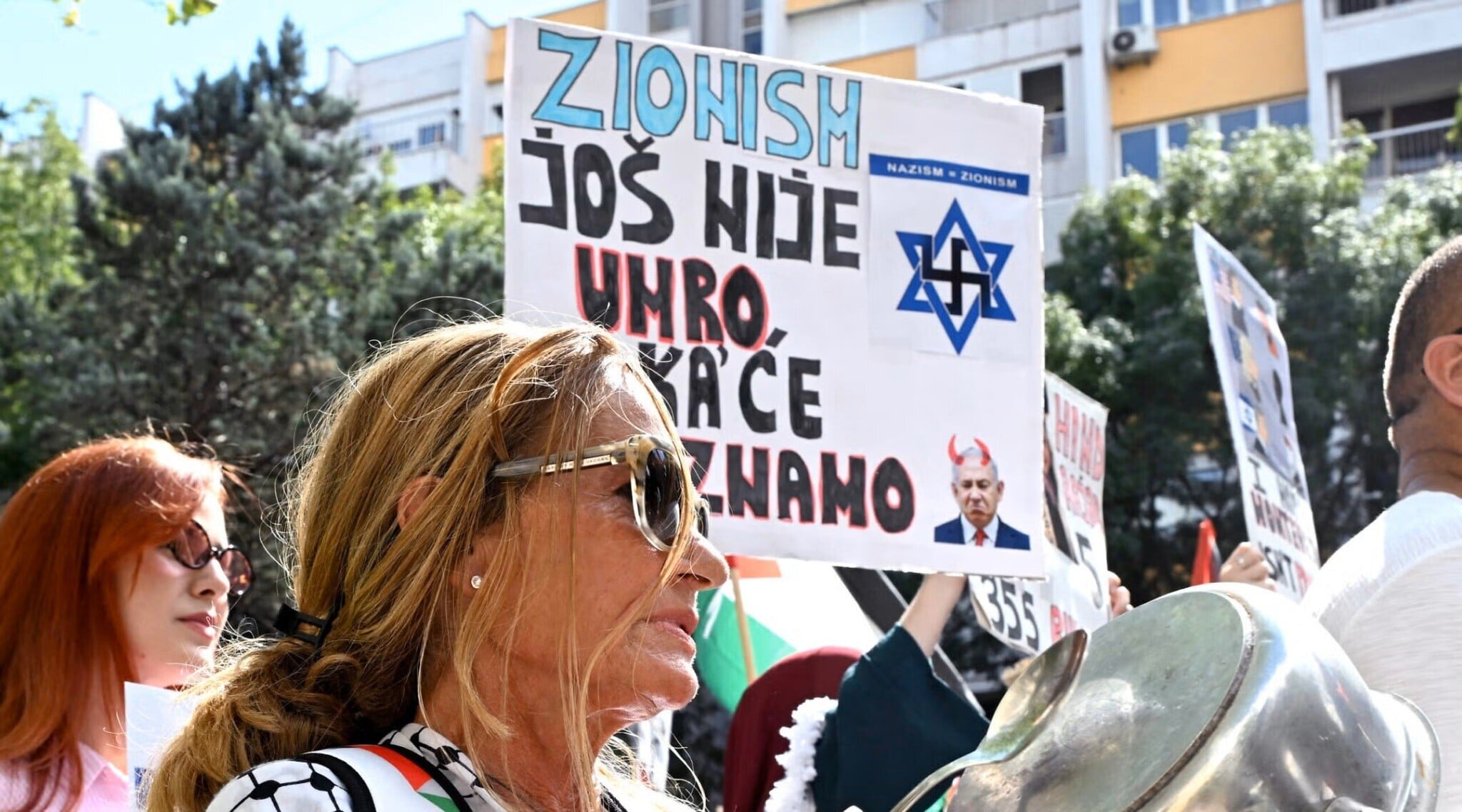
“When I came here, I never believed we’d need 24-hour security. But since October 7, we’ve had Free Gaza marches in all the major cities. My office is following every antisemitic portal here in Montenegro,” he said, using a local term for websites that report regional news. “We’re paying a lawyer to monitor all this.”
Several recent incidents involving Israeli visitors to this Connecticut-sized country of 625,000 have unnerved the local Jewish community, which numbers fewer than 1,000, even as the capital is on the verge of getting a major new Jewish cultural center set for completion this fall.
In the Adriatic beach resort of Budva, a recent violent brawl between local Montenegrins and some 20 Israeli tourists has triggered alarm among both the Jewish community and Israeli tourists.
It’s still unclear who or what provoked the incident, which took place after midnight July 12 at a beach bar where the Israelis — 12 men and eight women — had been drinking. Edelkopf said he believed the incident had begun with a personal altercation but escalated when the locals realized the tourists they were sparring with were Israeli.
According to an Israeli government alert about the incident, the locals “shouted ‘Free Palestine’ and ‘F*** Israel’” after learning about the origins of the tourists, who the alert said were not wearing indicators of their national or religious identity.
“Then they came back with a few friends and really beat the hell out of them,” said Edelkopf, a Chabad rabbi originally from Los Angeles who has lived in Montenegro for nine years.
“They put out cigarettes on their faces, and threw metal chairs and tables at them. It was horrible and very aggressive,” he said. “Most of the Israelis were injured; one of them had a broken jaw.”
The Israeli government assisted in helping the Israeli tourists expedite their flights out of Montenegro, though one member of the group remained in the country while hospitalized, according to Israel’s National Center for Combating Antisemitism, an initiative of the Diaspora ministry. The ministry’s alert said that police failed to intervene.
“I am waiting for the Montenegrin government to take action,” Edelkopf told JTA from his Podgorica synagogue, which was previously a private house. “Until now, they have not offered any official response.”
Despite the recent hostilities, the rabbi said, Montenegro has long welcomed Israeli tourists as well as residents. And Jews have been living here for millennia before Yugoslavia existed.
Ruins dating from the 4th century CE indicate a flourishing Jewish community in Kotor, not far from Budva along the Adriatic. In fact, one of the country’s most important religious sites is the presumed tomb of Shabbatai Zvi, located in nearby Ulcinj. The 17th-century Jewish false messiah died shortly after his exile there in 1673 by the Ottoman Empire, which ruled much of the present-day Balkans.
While most Montenegrins are Eastern Orthodox Christians, about 20% are Muslims of either Bosnian or Albanian origin. In 1992, after communism collapsed and Slovenia, Croatia, Bosnia and Macedonia broke away from the former Yugoslavia, the remaining two republics — Serbia and Montenegro — created the new Federal Republic of Yugoslavia.
In 2006, Montenegro declared independence following a referendum on the issue, and six years later, then-prime minister Igor Lukšić granted Judaism recognition as the country’s fourth official religion, alongside the Eastern Orthodox Church, the Catholic Church and Islam.
“The Jews are very well accepted here,” said Nikolla Camaj, vice-president of Montenegro’s parliament and one of five ethnic Albanians in the 81-member body. “Officially, we have very good relations with Israel, and people support the idea that Israel must be protected. But there’s a problem because in Montenegro we have a lot of Muslims — Albanians and Bosniaks — and they don’t like what’s happening in Palestine.”
In Podgorica, a huge mural painted on an apartment building two blocks from the municipal bus terminal depicts Gazan refugee children, a slice of watermelon symbolizing the Palestinian resistance, and the declaration “Montenegro Stands With Palestine.”
In early July, Israeli tourists visiting Plav — a resort town near Montenegro’s borders with Kosovo and Albania — were harassed by a local couple, who called the visitors “baby killers.”
“Local people are being fed articles translated from very strong anti-Israel news outlets,” the rabbi said. “The main TV channels and online portals here are filled with lies and garbage against Israel, and the people have started to believe that Israel is committing genocide.”
Even so, Israeli tourists keep coming. In 2025, according to official figures, 110,249 of them visited Montenegro — up from 73,513 the year before — most of the...