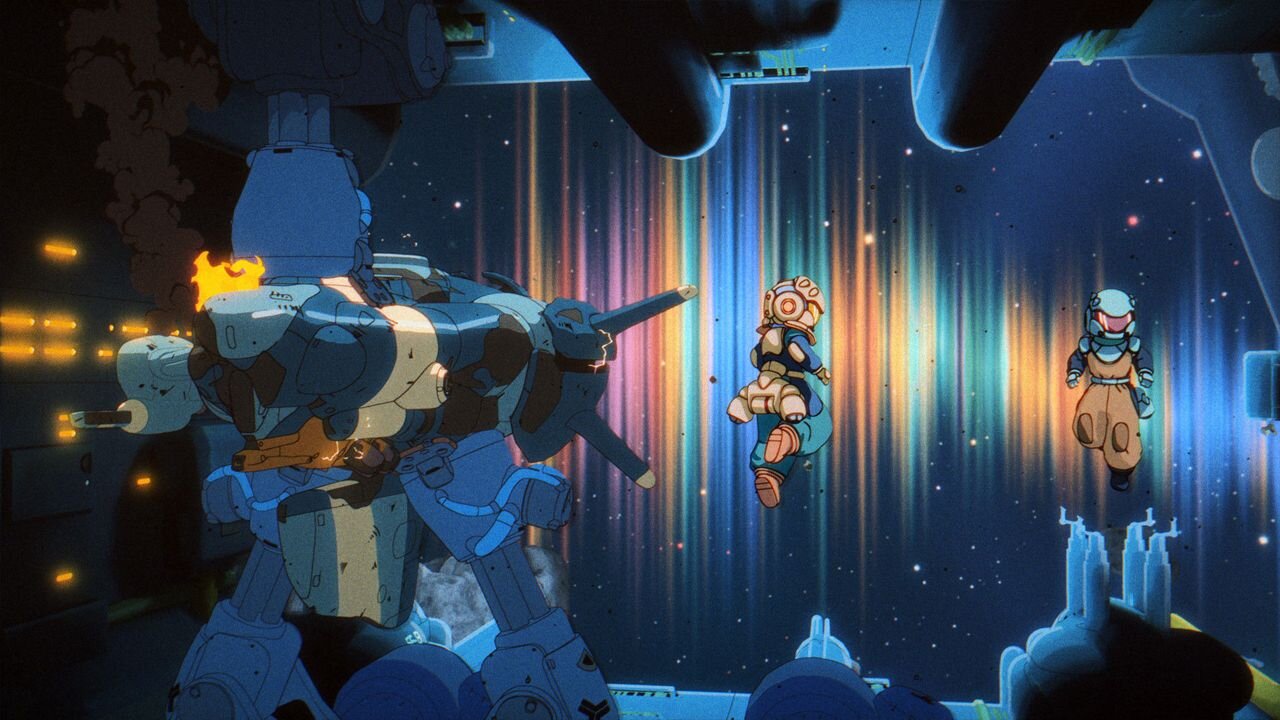
Growing up, the best Saturday morning cartoons were the ones we re-enacted with our friends on the playground. Whether it was screaming at the top of our lungs to go Super Saiyan like in Dragon Ball Z, or sleuthing around the school as Darkwing Duck.
In the years since our childhood, we’ve often bonded with both strangers and friends over memories of Saturday morning cartoons, remembering the quaint stories and characters that influenced our lives in surprisingly profound ways.
Those stories have a unifying power, and that’s at the heart of developer Shapefarm’s debut, Orbitals, which seeks to combine that rich heart with the gameplay style of Hazelight Studios’ co-op games like It Takes Two and Split Fiction. Will Orbitals be looked back on quite as fondly as those cartoons years down the road? Probably not, but this Switch 2 exclusive is a no-frills co-op smorgasbord that’s delightful from start to finish.
Editor's Note: Since Orbitals requires two players to complete, this feature is co-authored by George Yang and Hayes Madsen. Name a more iconic duo.
You play as Maki and Omura, two space explorers tasked with finding power cores to power up their home ship and prevent it from being destroyed by a cosmic storm. Orbitals is very similar to co-op games like It Takes Two and Split Fiction, both from Hazelight Studios.
Strictly a two-player game, you and a friend have to work together to solve environmental puzzles while communicating with each other. This dynamic complements the friendly camaraderie between Maki and Omura, the former of whom is a bubbly girl and the latter a more laidback, blue-skinned male humanoid with horns.
(Image credit: Shapefarm)
Perhaps what’s most remarkable about Orbitals is its sense of lightness. This is a game laser-focused on fun, evoking that through smart puzzle design, cooperation, collectibles that are all tied to fun little minigames, and more.
Experiencing Orbitals was just like marathoning an entire season worth of anime. The 80s and 90s anime art direction emphasizes thick lines and simple shading, as opposed to modern standards of meticulous detail and cinematic lighting.
This retro aesthetic permeates every facet of Orbitals. The splash screen that appears when loading up Orbitals, showing Shapefarm and publisher Kepler Interactive’s logos, is soaked in retro-futuristic bright neon like Apple’s back in the 80s. The amazing opening song, “ Accelerating Destiny ,” is sung by legendary 80s anime vocalist Mami Ayukawa. Each decision feels intentional, like a love letter to this era.
It’s an absolutely gorgeous journey through space that lasts a brisk 5 hours. There are 12 chapters lasting around 20-25 minutes, with each feeling like a separate TV episode, and we know what you're thinking; that seems like a short game. And it is.
Compared to Split Fiction, which lasted way too long, Orbitals finds itself on the other end of the spectrum. The pacing quickly picks up into the finale, making it feel a bit rushed. There's a middle ground that both games missed, which is a shame. Despite that, although hastily, Orbitals wraps itself up in a satisfying way.
Shows like Cowboy Bebop had a ragtag team of underdogs exploring the solar system, instilling lessons about loneliness and existentialism. Mobile Suit Gundam Wing had heavier ethical themes about war. These ideas flew over our heads as kids, and we were mostly occupied by the pretty lights and awesome fight scenes. But rewatching them as adults allowed us to grasp them better. Orbitals follows in these classics’ footsteps, tackling subjects like agency of choice and forgiveness.
(Image credit: Shapefarm)
Orbitals has its fair share of battles, with one player controlling the guns while the other steers the ship to take down turrets and incoming asteroids. It’s not too difficult, since each of you only has to focus on one task, but the real challenge comes from communicating.
In a few boss fights, the battles can suddenly change into a completely different format. In one instance, the pilot had to dodge enemy projectiles like a bullet-hell game, while the other player's perspective shifted inside the ship, with them putting out fires before heading back to the guns. It’s these unexpected moments that make Orbitals a blast to play.
As the designated pilot of the duo, Hayes quickly felt the burden of protection weigh upon his shoulders. He didn’t just have to get us from point A to point B, but also had to dodge enemy attacks in frenetic battles, pilot through the sudden bullet-hell segment, use a microwave to possess creatures and shift the stage, and so much more. George, on the other hand, had to quickly dispatch enemies before they depleted the ship’s HP, while also frantically navigating through lava while Hayes cooled it from underneath, creating a path to the other side of the level.
(Image credit: Shapefarm)
Despite a runtime that feels like it ends when the game is really picking up, Orbitals is an incredibly smartly designed little game. One that consistently weaves different gameplay styles and genres together into something effortlessly distinct, even though it clearly is trying to emulate the magic of It Takes Two and Split Fiction. The good news is that it largely succeeds at what it does.
The story is breezy, but punctuated by shockingly good performances and that whimsical Saturday morning cartoon feel. The main duo instantly feel like lifelong friends, with the game knowing it doesn’t need to take the time to lay out that backstory.
Equally, gameplay mechanics are briefly explained but then further explored through experimentation and context clues, rather than lengthy tutorials. Those two aspects combine into a game that, ultimately, makes every hour feel distinctly different, just like a Saturday morning cartoon.
(Image credit: Shapefarm)
It’s those differences that make Orbitals more than the sum of its parts, alongside how much the experience of the game’s two pl...