A non-profit newsroom, powered by WNYC. Gothamist Listen Live Donate News The ferry brought Manhattan to Red Hook. Now locals are riding the tourist wave. By Willow Higgins Published Aug 26, 2026 at 6:00 a.m. ET
Twitter Reddit Email Never miss a story Email address By submitting your information, you're agreeing to receive communications from New York Public Radio in accordance with our Terms . By Willow Higgins Published Aug 26, 2026 at 6:00 a.m. ET
Twitter Reddit Email We rely on your support to make local news available to all Make your contribution now and help Gothamist thrive in 2026. Donate today
Gothamist is funded by sponsors and member donations
On any given Saturday in the summer, Carolina Salguero watches the hordes of mostly young Manhattanites disembark from the New York City ferry at Atlantic Basin, a South Brooklyn inlet serving Red Hook.
Salguero is shipkeeper of the Mary A. Whalen, the rusty, 1930s-era red oil tanker permanently moored in the basin, just opposite Governor’s Island.
“I look up, I’m like, ‘Oh my god, here come another 150 of them,” Salguero said of the day-trippers.
For business owners in Red Hook, which was ravaged by Hurricane Sandy in 2012 and two major fires within the last year, the ferry is proving a difference-maker – for the arts community, entertainment, restaurants and jobs.
The historic maritime port is home to Brooklyn’s largest public housing development, and also home to trendy and expensive restaurants, hundreds of art studio spaces and the city’s only IKEA. Those who live there acknowledge they are relatively isolated – there is no subway stop nearby – but say that is also part of the neighborhood's appeal.
The ferry from Manhattan only started coming to Red Hook in 2017. After a slow start , ridership on a typical summer weekend day approached nearly a thousand last summer , almost triple the first summer’s count. Local business owners say the crowds have only grown since.
Summertime visitors are mainly Manhattanites who, thanks to ferry stops in Murray Hill, the East Village, and Wall Street, are making Red Hook a favorite summertime daycation. Those who have caught word of the jaunt say that a day in Red Hook feels like an escape to a funky beach town a world away without having to leave the city.
“It doesn't quite feel like you're in the city anymore,” said Gordon Taylor, who moved to Red Hook during the pandemic. “It feels like you're living in a small sort of seaside town just squished right up against the side of Brooklyn.”
But the boat ride itself is only the beginning of the popular pilgrimage, which includes stops at any number of Red Hook staples, both historic and new-aged, that have gone viral on social media in recent years. And while most people who live and work in the neighborhood admit that the summers can be overwhelming, they acknowledge the local economy depends on it.
Salguero runs Portside New York, a nonprofit that advocates for better urban waterways, whose headquarters is the Mary A. Whalen. She said Red Hook wasn’t always like this.
When she first moved to the neighborhood in the late 1990s, she said there was a whole lot of nothing around. The cobblestone roads were so empty, neighbors would catch up with each other through their car windows in the middle of the street.
“It was like being on a country road,” she said. If anyone drove by, you could just wave them around. There weren’t any parked cars to dodge.
It's a totally different scene this August.
Twenty-somethings, some in kitten-heel sandals, others in trucker hats, flood Van Brunt Street, which offers a straight shot from the dock to the waterfront bars. Along the way they pass local boutiques, the Red Hook Tavern – which is known for its burger and for the usual line down the block – and a museum of unlocked vintage pinball machines that you can play for a suggested donation.
Getting visitors to stray from the typical foot traffic pattern requires a creative approach: Drew Villano, who grew up in Red Hook, advertises her vintage pop-up in sidewalk chalk from the ferry port to the doors of her business, just a few blocks off the main street.
“Sexy vintage THIS WAY,” her signage reads alongside large arrows.
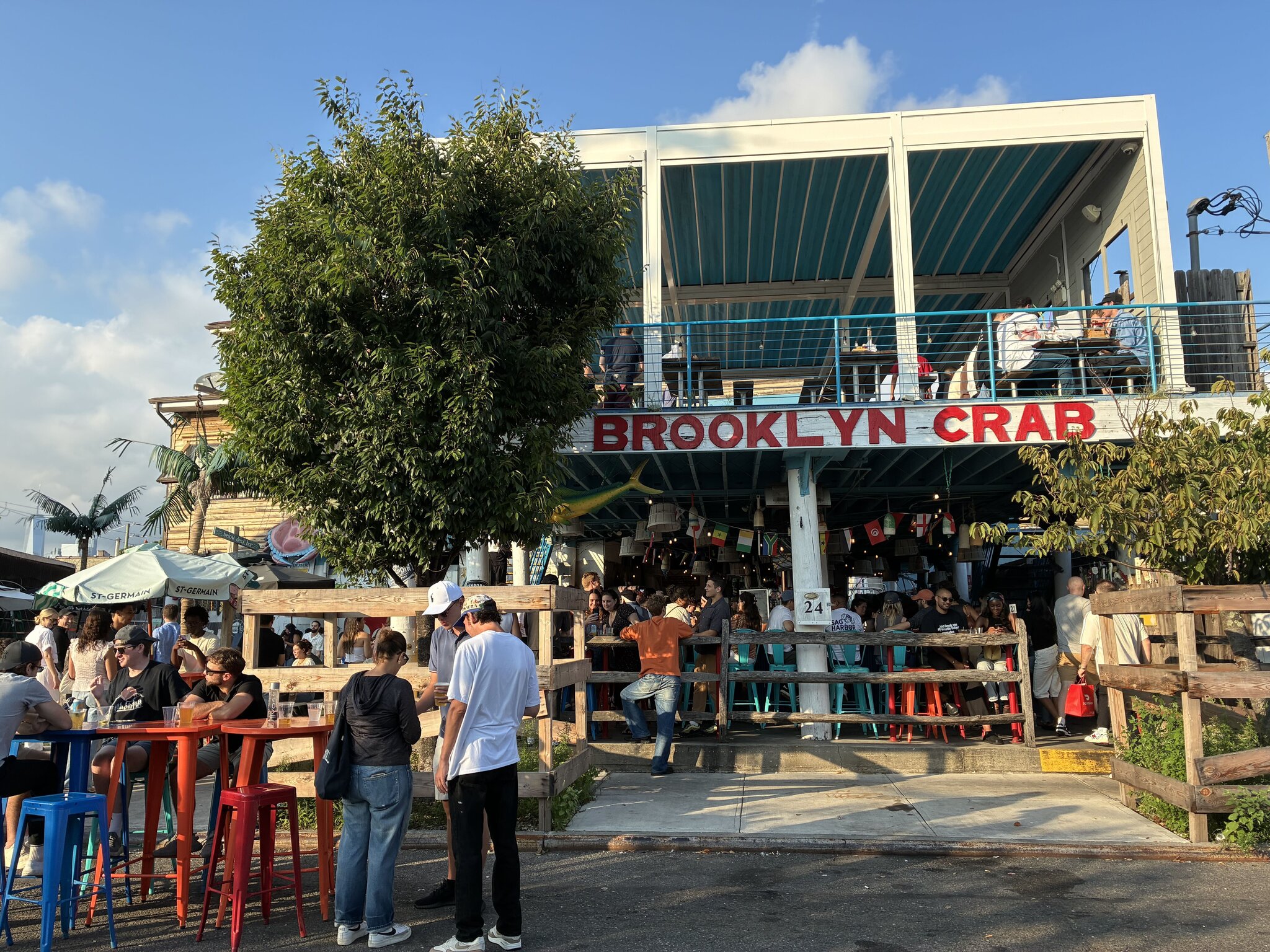
Mostly, local residents say, visitors head toward the same few bars and restaurants. Brooklyn Crab is one of them. The triple-decker crab shack was so crowded on a recent weekend that people overflowed into the street, where they played corn hole with pina coladas in hand.
“We didn't even need to look up directions to the Brooklyn Crab cause we followed all the babies in the light wash jeans and the black tank tops,” said Nadia Wilemski, who came to Red Hook via the ferry. She referred to the stereotypical “West Village girl ,” as defined by The Cut last October. (Wilemski lives in Bushwick, but traveled to Manhattan to take the ferry with her Manhattan-based friends.)
Gordon Taylor lives in Red Hook and works at the neighborhood’s Strong Rope Brewery. He acknowledged that the weekend visitors tend to wear a similar “uniform,” as if they were all dressed for vacation. It’s a sharp contrast, he said, from the Carhartts and overalls the local artists, metalworkers and woodworkers wear out and about during the week.
When a ferry lands in Red Hook, Gordon said, “you can tell that it’s like the Manhattanites coming through.”
“Everybody shows up in waves at the brewery,” he said. “You’ll see the crowds of people all walking down the alley together.”
Unlike some stories of gentrification in New York City, where long-timers are upset about their coffee costing $7, the Red Hook residents and employees who spoke to Gothamist said they’re glad to see people enjoying their slice of the city. It helps, they admit, that their local economy depends on it.
Carly Baker-Rice, who runs the Red Hook Business Alliance, said that “while it might feel like it's doing great on the weekends, the actual story is a lot more complicated.” The economy...