This is one outlet's own report from Deutsche Welle — the article as it was filed. Other outlets are covering the same event; open the full story to compare every source side by side.
Why is Israel's military presence growing in Syria?
The recent Israeli attack on a Syrian airbase is just one of many Israeli incursions into Syria. In southern Syria, locals say Israeli troops have detained them, destroyed infrastructure and set up military bases.
https://p.dw.com/p/5J6jj Advertisement It's been two years, four months, 24 days and five hours, said Syrian man Ahmad Hassan al-Din when asked how long it's been since he last saw his son.
In April 2024, Israeli soldiers took Saddam, who had just turned 17, from farmland near the Golan Heights, a part of Syria Israel has occupied since 1967.
"Saddam had gone to feed the animals early in the morning," al-Din, who's from the village of Jubata al-Khashab in the Quneitra district near Golan, told DW. "I called him on the phone, and he told me, 'Everything's fine.' But then later we saw with our own eyes how they took the boy, handcuffed and shackled."
Al-Din filmed Israeli soldiers marching his son through fields. The video, which he forwarded to DW, has previously been verified by open-source investigators at France24 and by human rights organizations.
"They said they took him because he was trespassing on the territory of the state of Israel," al-Din continued. "Even though that area is our farmland and we have a valid UN permit to work there."
To enter this buffer area, Syrian farmers and shepherds needed a special pass from the United Nations Disengagement Observer Force, or UNDOF. The latter was set up to make sure Israeli and Syrian forces kept their distance after a 1974 disengagement agreement.
Humanitarian organizations have since discovered Saddam, now 19, is likely in a prison in Israel.
DW asked the Israeli military what Saddam had been charged with and under which legal system. A spokesperson sent DW a statement similar to one previously sent to other media outlets and human rights organizations that said Israel detains Syrians that it suspects might wish it harm. The statement did not specify whether the army considered the farmer's son to be one of those individuals.
Since Saddam was taken, the Syrian teenager's story has become one of many similar accounts in this part of southern Syria .
After the fall of the country's dictatorial Assad regime in December 2024, Israel took control of the UN-patrolled demilitarized zone. Senior Israeli politicians declared the 1974 agreement void and said troops would be in the area temporarily to protect Israel from cross-border attacks.
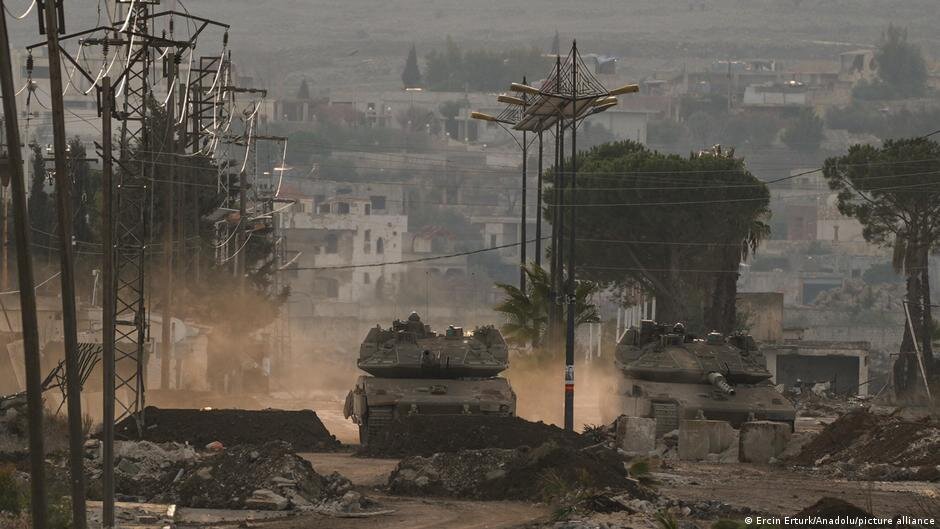
However, since then Israel's presence in Syria has become more permanent. In November 2025, UNDOF told reporters Israel had set up 10 bases in the area. From these bases, Israeli soldiers are making near-daily incursions into the Syrian provinces of Daraa and Quneitra.
"These incursions typically involve armored patrols through populated areas, followed by the establishment of temporary checkpoints on main roads, where all passing Syrian civilians are stopped, searched, questioned, and have their phones examined. In some cases, biometric data is also collected," Syrian consultancy, Karam Shaar Advisory , wrote in January.
Israeli soldiers have also raided homes, businesses and schools and fenced off farmland and water sources.
Quneitra authorities sent DW a statement claiming Israeli troops had seized more than 200 sheep, destroyed drinking water wells, razed horticultural areas and destroyed buildings.
Mousa Khalil, a resident of Quneitra, recounted how his home, a two-story building with four apartments in Hamidiyah village, was completely destroyed by Israeli troops last year.
"I am 65 years old," he told DW. "At this age, finding decent work has become extremely difficult, forcing me to accept whatever I can find to provide for my family of eight and to save money to rebuild our home."
Over the past few months, the number of these kinds of incursions has been rising, and Israeli soldiers have also been moving farther inside Syria.
The Sijil Center , based in Syria, documents Israeli violations of Syrian territory. Between August 25 and December 31, 2025, the center recorded 818 incidents, or 45 incidents per week. Since the beginning of this year, the center has counted 1,632 incursions, bringing the average to 48 incidents weekly.
The Sijil Center also documents how many Syrians have been detained by Israel and says that, since December 2024, around 200 people have been apprehended. Unlike al-Din's son, most were released within 24 hours after being interrogated.
Between 40 and 50 Syrians are thought to remain in Israeli jails, including four or five who were in custody before the change of Syrian government in 2024.
Soldiers coming across a border and detaining citizens of another country, then transferring them back to their own prisons, is clearly a breach of international law, experts say. Organizations like Amnesty International and Human Rights Watch have described Israel's actions in southern Syria as possible war crimes.
Since the fall of the previous Syrian government , Israeli politicians have insisted that southern Syria must be a "demilitarized zone."
The Israeli military previously told other news outlets that it has "apprehended individuals where there was reasonable suspicion of their involvement in terrorist activity." The army also acknowledged the construction of new military bases to prevent attacks and smuggling.
"The area is a playground for terror organizations, armed groups and militias," a senior officer told Israel's Ynet last week.
Speaking to media outlet Syria Direct , locals in Quneitra said they weren't sure whether Israel is trying to occupy their towns, or whether it is doing this to pressure the Syrian government.
Senior Syrian and Israeli politicians had been involved in talks, with mediation from the US, to potentially reactivate the 1974 disengagement agreement. But talks fell apart late in 2025 and in the intervening months, Israeli incursions into Syria increased.
In an analysis this week, Elizabeth Tsurkov, a senior non-resi...
AIPROPX is an independent multi-source news index — we track, compare, and connect coverage from across the web into one place you won't find anywhere else.