This is one outlet's own report from Live Science — the article as it was filed.
AIPROPX ReportLive Science · 1h ago
ZWO Seestar S50 Pro smart telescope review
The ZWO Seestar S50 Pro was released on Aug. 25, 2026. It's a smart telescope that ships with everything you need to get started with astronomy and solar observations, eliminating the need to buy any other accessories.
It is controlled through the Seestar app on a smartphone and offers automatic slewing and autofocused views of galaxies, nebulas, star clusters and more. That said, in our experience, it sometimes needs manual adjustment with the on-screen joystick to perfect centering.
This being the Pro version of the original S50, which released three years prior, it's more expensive; you'll be paying $450 more than the original S50, with the S50 Pro coming in at $999. For that you get double the storage capacity (128 GB instead of 64 GB) and a higher resolution (4K not Full HD). ZWO claims the Pro has an extended battery life of nine hours, though we can't test this yet because the app version responsible for this uplift from the originally stated seven hours (version 3.3.1) wasn't released during testing.
So are these upgrades enough to warrant the extra spend?
ZWO Seestar S50 Pro review
ZWO Seestar S50 Pro: Design
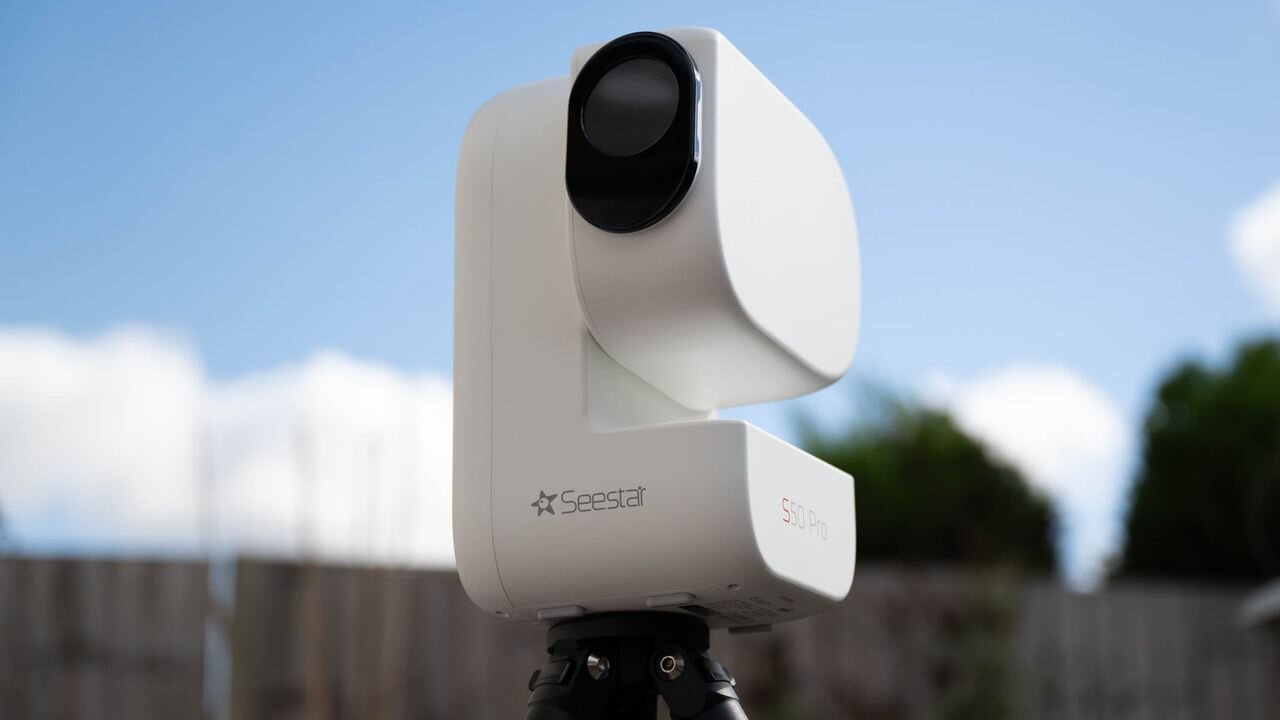
The Seestar S50 Pro comes in white with a compact mini carbon fiber tripod. Jase Parnell-Brookes
Only two buttons feature on the telescope itself, a large power button and a smaller reset button underneath. Jase Parnell-Brookes
A dual lens system mirrors the S30 Pro's design and even has the same resolution. Jase Parnell-Brookes
Lightweight and easy to carry in the case provided
Dual-lens system mirrors the S30 Pro
Simple, two-button design and an easy push-on solar filter
The Seestar S50 Pro is instantly recognizable as a smart telescope. A neat, rounded and glossy plastic casing protects the fragile but automatic optical and electrical insides that power this pocket rocket. Only two buttons are found on the entire device: a large power button on the side enveloped by a ring of light that glows when powered on, and a small reset button on the bottom of the telescope.
Specifications
Image resolution: 8.3 MP (3840 x 2160) Aperture: 50mm (1.96 inches) Focal length: 260 mm Storage : 128 GB internal Field of view: 2.8 degrees (tele) / 63 degrees (wide) Mount : Motorized alt-azimuth (EQ mode supported) Battery : 9 hours (currently untested) Weight : 6 pounds (2.72 kg)
The carry case that the S50 Pro ships in looks like black compressed polystyrene but has neat latches and a red handle that tucks away in a slot at the top, making it easy to pack — similar to a drone case. This is much better than some of the bags you can buy for smart telescopes as it feels more rigid and secure. The S50 Pro and its tripod and solar filter all ship together and are snugly held inside.
Everything feels more polished and refined in the design of the S50 Pro, compared with the S30 Pro. Jase Parnell-Brookes
The carry case is cleverly designed and feels very protective with snug fit of the telescope and accessories inside. Jase Parnell-Brookes
Built into the case are two latches and a red handle that pushes into a groove to facilitate compact stowing. Jase Parnell-Brookes
It's light, too. We weighed it all, and the whole setup weighs 8.6 pounds (3.9 kilograms) fully packed, 6 pounds (2.7 kg) of that being the S50 Pro itself. It's also small; we measured it at 5.7 x 10.6 x 5.4 inches (146 x 270 x 138 mm), including the rubber feet on the bottom. Incidentally, we like that because it means you don't have to use the tripod if you don't want to.
We even received a bunch of ZWO-branded stickers that, if we were so inclined, we could pop on the telescope. But we're probably going to give them to the nephews.
A 3/8-inch tripod thread on the bottom fits most photographic tripods, but a small carbon fiber tripod ships with it. Jase Parnell-Brookes
The carbon fiber tripod is light and locks in place with metal twist locks. Jase Parnell-Brookes
Rubber feet reduce vibrational interference and grip smooth, uneven surfaces without trouble. Jase Parnell-Brookes
Everything is controlled via the Seestar app, the same as all the other ZWO Seestar telescopes. This is typical for smart telescopes, which are almost always operated via an app.
As usual, and as we said in our S30 Pro review , it has a 3/8-inch tripod thread underneath, but the tripod itself is very small. We ended up using a larger photographic Gitzo carbon fiber tripod without the tripod head. But beware — if you're going to do this, take the tripod head off first. It won't fit the 1/4-inch thread of your standard mirrorless camera, which is likely what your tripod footplate will be.
ZWO Seestar S50 Pro: Performance
Aligns and tracks automatically
Live stacking reveals faint objects quickly
Solar eclipses can be shot as photo or video timelapses
Sunspots can be seen on the photosphere of the sun, and the push-on solar filter that ships with the telescope gives it a warm, orange hue. (Image credit: Jase Parnell-Brookes)
It took a matter of minutes for the live-stacking feature to give us clear and bright views of any object we slewed to. Live-stacking enables the smart telescope to take image after image to produce more detailed results of dim deep sky objects.
M27, the Dumbbell Nebula, was our standout favorite during testing, which we imaged over 10 minutes and 20 seconds. The final image captured the vibrant greenish blue core shining through, sandwiched by the red and orange glow of the nitrogen, hydrogen-alpha and sulfur.
Color and detail are impressive on the Dumbbell Nebula, but we wish it was larger in the frame. (Image credit: Jase Parnell-Brookes)
Other notable objects we observed included M31 (the Andromeda Galaxy), which had good shape and reasonable clarity over the nine-minute exposure and filled the frame nicely considering this is an 8.3 MP image. It's also possible to image M81 (Bode's Galaxy) and M82 (the Cigar Galaxy) together on the S50 Pro due to the wider field of view, and after only 6 minutes and ...
AIPROPX is an independent multi-source news index — we track, compare, and connect coverage from across the web into one place you won't find anywhere else.