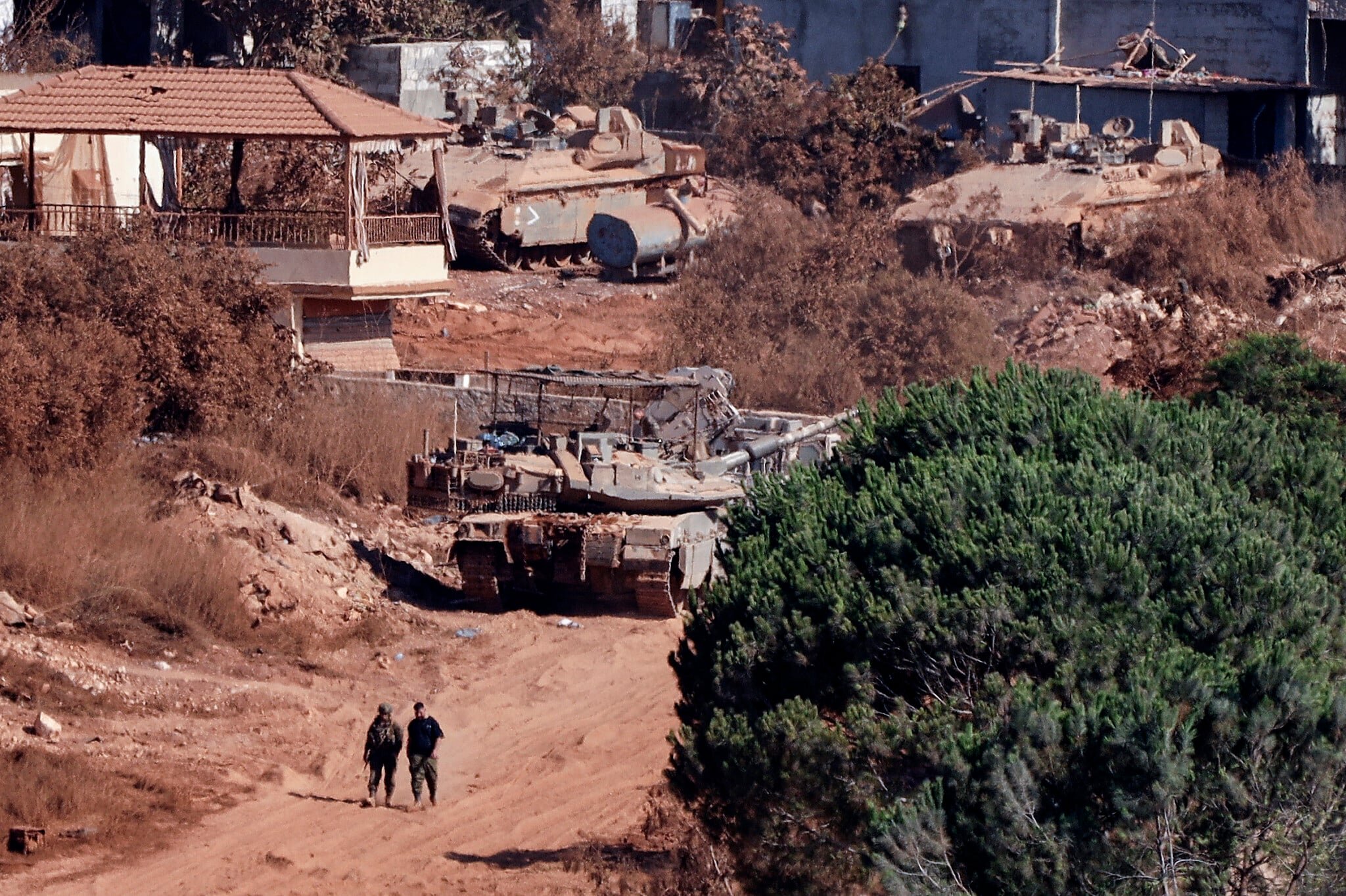
Lebanese Prime Minister Nawaf Salam on Wednesday condemned what he said was Israel's "systematic destruction" in the country's south, calling it a violation of international law, as Defense Minister Israel Katz said its military was "destroying all the houses" there.
Salam said Israeli "attacks, incursions, demolitions and the systematic destruction of homes," infrastructure, government buildings and places of worship "represent a serious violation of the principles and rules of international law and international humanitarian law."
Claiming that villages and towns "are entirely 'military facilities' does not stand up to any logic and cannot be used as an excuse for destroying them, displacing their inhabitants and preventing them from returning," he said in a statement.
Katz visited southern Lebanon on Wednesday, vowing to keep troops in the IDF's buffer zone there and saying the military was “destroying the underground infrastructure” in the area and “destroying all the houses in the area.”
"We are here above and they are below," Katz said, according to the Defense Ministry. "I have instructed the IDF to take all necessary steps to prepare for a long-term presence in the area."
Lebanon's state-run National News Agency (NNA) on Wednesday said Israeli troops carried out detonations in southern villages, including in Zawtar al-Shariqya, which abuts one of the pilot zones.
Lebanon's army said Israel had blown up "the municipal building in Zawtar al-Shariqya" as well as "a public school, a health clinic, a children's nursery and a number of homes."
Hezbollah is heavily entrenched in civilian infrastructure in southern Lebanon. The Iran-backed terror group opposes a framework deal signed in June between Israel and Lebanon that stemmed the conflict in southern Lebanon, and is meant to lead to Hezbollah's disarmament and an eventual withdrawal of the IDF from the country, as well as a potential peace accord between the nations.
The Lebanese army is meant to take over areas evacuated by Israeli troops. So far, two such zones exist. Rodolphe Haykal, chief of the Lebanese Armed Forces, met on Wednesday with visiting US General Joseph Clearfield, who heads a coordination group involved with the June agreement.
The pair discussed "developments in the south and security arrangements" relating to the deal, the Lebanese military said, as well as "the difficulties the army faces in carrying out its missions, primarily due to the continuing attacks, bulldozing and destruction by the Israeli occupation."
Lebanese President Joseph Aoun also met Clearfield, his office said, and discussed the implementation of the framework deal.
Last week’s round of US-sponsored talks ended early on their second day, amid an escalation in southern Lebanon between Israel and Hezbollah. Beirut is also frustrated with the pace of Israeli withdrawals, feeling that Jerusalem is dragging its feet ahead of October elections, while Israel argues that verification of Hezbollah disarmament must be completed first.
Israel and Lebanon are to hold an eighth round of US-sponsored negotiations next month , in Rome.
Separately, an Israeli official denied a report by Reuters that it agreed with Lebanon on naming Britain, Italy, Switzerland and Indonesia as potential contributors to a proposed mechanism that could see foreign troops deployed to Lebanon to verify Hezbollah's disarmament.
The Prime Minister's Office had no immediate comment on the report, but the official denied that any agreement had been reached regarding the countries that will make up the verification committee, and said that talks on the matter are still ongoing.
According to Reuters, the shortlist emerged from US-mediated talks in Rome last week.
The countries could help define the mechanism's scope, provide personnel to oversee its implementation or contribute troops to observe or take part in inspections verifying disarmament, three sources said.
A source with direct knowledge of the matter said discussions surrounding the shortlisted countries are in the early stages, but says they are "cautiously optimistic" the effort will proceed.
Switzerland's foreign ministry told Reuters it is exploring ways to support "various stabilization processes," but declined to provide details. A British Foreign Office spokesperson said Britain is ready to support efforts to de-escalate tensions and long-term security, particularly in southern Lebanon, without elaborating.
The Lebanese presidency and Indonesian foreign ministries did not immediately respond to requests for comment.
Firefighters in Lebanon told the Guardian news outlet on Wednesday that the IDF has purposely been starting fires in the border area, where there is dense vegetation, a terrain which poses a challenge to Israeli forces.
It is believed such fires are intended to aid the army in identifying terrorists trying to infiltrate Israel or carry out attacks on the border.
Hussein Fakih, head of the civil defense in the Nabatieh area, told the Guardian that most of his missions relate to fires.
“There are enormous areas of woodland that have burned. I don’t have the exact figures, but in the areas close to the [frontline], around 30-40% of the land has been affected by fires," he told the Guardian.
“Small drones come out and drop incendiary materials, [white] phosphorus shells are fired at the woodlands, in addition to illumination flares that they drop during the daytime so the vegetation catches fire," he explained.
The Guardian reported that firefighters in other areas reported similar activities. According to the outlet, firefighters must relay requests to fight fires through the Lebanese army, which contacts a deconfliction mechanism set up to ensure the ceasefire.
In response to the report, the IDF said its activities are "conducted while taking precautionary measures to mitigate harm to civilians and the environment."
Additionally, the IDF said overnight that its air defenses launche...