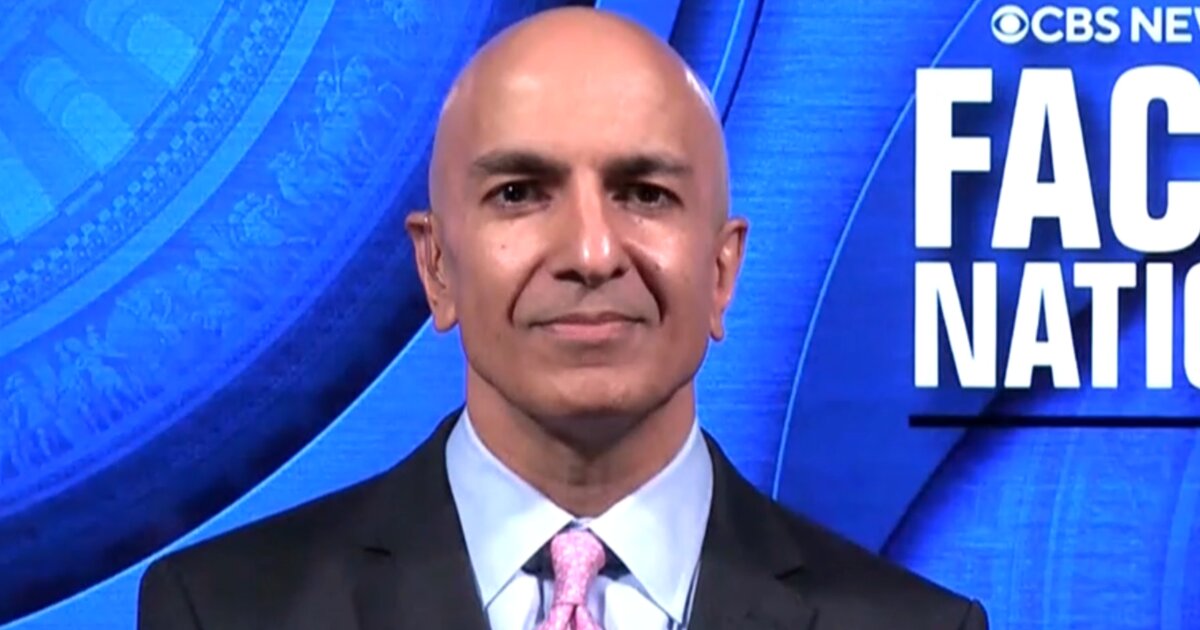
The following is the transcript of an interview with Neel Kashkari, President and CEO of the Federal Reserve Bank of Minneapolis that aired on "Face the Nation with Margaret Brennan" on Aug. 23, 2026.MARGARET BRENNAN: For more on what\u0027s next for the American economy, we\u0027re joined by Neel Kashkari, President and CEO of the Federal Reserve Bank of Minneapolis. Welcome back to Face the Nation.NEEL KASHKARI: Thanks for having me, Margaret. Great to be with you.MARGARET BRENNAN: So when we spoke back in May, I asked you about the debt level America has. You said you didn\u0027t see an immediate crisis brewing, but at some point, this is going to become a problem. We just hit $40 trillion. Are we at the point where this is a problem?: Well, Margaret, if you look at the Treasury yields, yields are high, 4.7% for example, on the 10-year Treasury. They\u0027re high relative to recent history. They\u0027re not high relative to more longer American history. In the early 2000s, the 10-year Treasury and the 30-year Treasury were around these levels. In the 90s, they were meaningfully higher than they are now, and there\u0027s no sign of Treasury market dysfunction or breaking down in financial markets. There are a lot of different factors that go into those Treasury yields. Inflation, and the outlook for inflation is one of those factors, that\u0027s the Fed\u0027s job. But there are many other factors, like, it\u0027s the AI investment, government borrowing, economic growth. All of those end up going together to set these long-run Treasury yields.MARGARET BRENNAN: But we saw this bond sell-off. We saw extraordinary action by the Treasury Secretary Scott Bessent to intervene. He said what was happening was due to traders having bad information. Is that what\u0027s happening?: Well, I\u0027m going to leave it to the Treasury Secretary to manage the Treasury debt market. That\u0027s the job of the Treasury Department. The Fed\u0027s job is really to take care of the inflation piece of it. We are all absolutely committed to getting inflation back down to 2%, but long run, it\u0027s going to be fundamentals of debt issuance, of investment, of economic growth and productivity. Long run, that\u0027s what sets the Treasury yields, and not just in the U.S. but government bond yields all around the world.MARGARET BRENNAN: No, and I appreciate as a central banker, you don\u0027t want to get involved in fiscal policy or what the markets are doing day to day, but there is this debate right now about whether something more fundamental is shifting. Investor Mohamed El-Erian wrote in the New York Times, "There\u0027s a breathtaking leap in the cost of borrowing. If it persists, it could mark the beginning of a structural economic shift more enduring and more globally consequential than most previous episodes of market volatility." Is that overstating things? Are we in the midst of a huge shift?: Well, there are a lot of different factors going on at the same time. So, the stock market, as you know, has been really bullish for the last several years, really excited about AI and the prospects that that will lead to productivity growth. You know, a more optimistic take on these market moves is that the bond market is catching up to the stock market, and the bond market is seeing a higher growth trajectory. If the- if the global economy is in for higher productivity growth and higher growth, you would also expect to see higher yields all around the world. Now, I\u0027m not endorsing that view. I\u0027m not saying that\u0027s right. But, there are many different ways that you could see bond yields go up globally. It is- Mr. El-Erian is right. These moves are happening all around the world at the same time. I think that there are negative views of what could be driving that. There are also more optimistic views. It\u0027s hard to know right now which is the- the bigger driver.MARGARET BRENNAN: Well, the vice president J.D. Vance, in a TV interview, said Secretary Bessent has a, quote, "very discreet plan to shrink the nation\u0027s debt." Mr. Bessent is holding a press conference tomorrow, or is supposed to, and- and he said he\u0027s going to do things about fiscal consolidation. What are the things that people at home should be listening for that say America\u0027s debt load is really being dealt with now, that this isn\u0027t a problem?: Well, I just think you can look to the Congressional Budget Office, which makes forecasts of debt, U.S. debt and deficits for decades out into the future, and many Fed leaders have said for a long time that the debt trajectory is on an unsustainable path. I think ultimately it\u0027s up to our fiscal actors. That\u0027s the Treasury and the executive branch working with Congress to design a fiscal package that can change that and put it on a sustainable path. But obviously, you know, you said it a moment ago. That\u0027s not the Fed\u0027s role. The Fed\u0027s role is to take whatever they decide to do, put that into our forecast of the economy, and then our job is to take that and get inflation back down to our 2% target and achieve our dual mandate goals. And my colleagues and I are all committed to doing so.MARGARET BRENNAN: Right. And you have a meeting at the end of this week, I understand, out in Jackson Hole. But, I\u0027m- I\u0027m wondering how all these dots connect because do you think that this kind of activity and level of concern in the markets is going to make your job harder when it comes to- to making some decisions or cause the Fed to intervene?: I don\u0027t think so, right. As I mentioned a few moments ago, there\u0027s every indication that the U.S. Treasury market is functioning as it should--\u00a0MARGARET BRENNAN: Okay.\u00a0: --that trades are taking place. That there\u0027s liquidity in the market, and so that enables us to focus on the federal funds rate as our primary policy tool to get inflation back down. And so I think we have the freedom to...