This is one outlet's own report from Forbes — the article as it was filed.
AIPROPX ReportForbes · 4h ago
Russia’s FPV-Stopping Arena System For Tanks Gets Combat Debut
Aerospace & Defense Russia’s FPV-Stopping Arena System For Tanks Gets Combat Debut By David Hambling ,
Forbes contributors publish independent expert analyses and insights. I'm a South London-based technology journalist, consultant and author Follow Author Aug 10, 2026, 10:24am EDT Aug 10, 2026, 10:44am EDT Summary Russia's new Arena-M Active Protection System (APS) for tanks has debuted in Ukraine, designed to counter FPV drones. Deployed on T-72s during a failed assault, the system reportedly shot down multiple FPVs, making tanks harder to destroy. Analysts are divided; some hail it as a success, potentially signaling a return for maneuver warfare, while others remain skeptical. Arena-M uses radar and interceptor rounds for 360-degree protection, but its limited ammunition capacity and high cost are notable drawbacks. Critics emphasize that FPV drones are cheap, numerous, and rapidly evolving, suggesting any APS advantage will be temporary. This ongoing arms race underscores the challenge of protecting expensive armor against adaptable, mass-produced threats, with drone operators quickly developing new tactics.
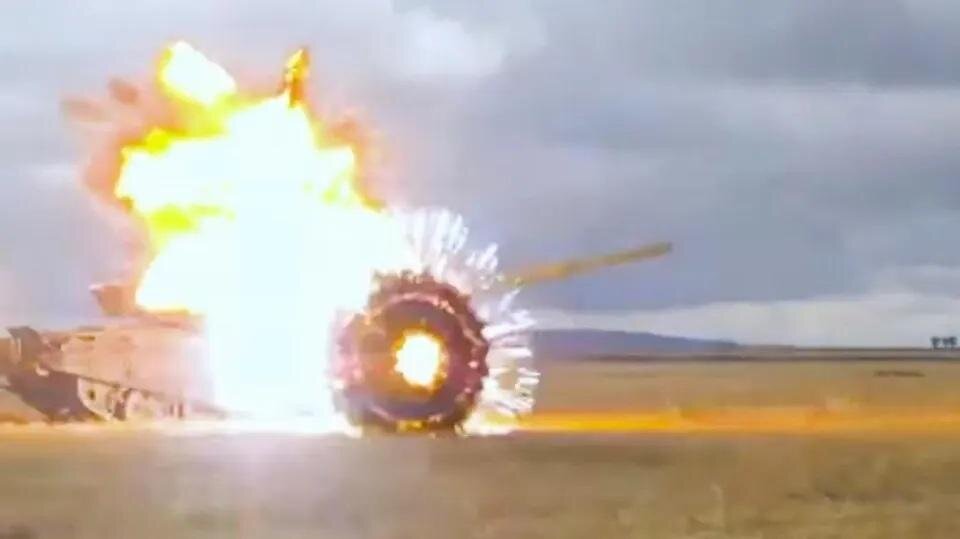
A new Russian “Active Protection System” for tanks which shoots down incoming FPVs has been used in action in Ukraine for the first time. The Arena-M Active Protection System (APS), which destroys drones with high-speed projectiles, was deployed on T-72 tanks in an assault near the village of Maiak in the Donetsk region.
The assault failed with heavy casualties, just like previous efforts. But some analysts are hailing the APS as a success and suggesting that it could signal the return of tanks and maneuver warfare to a battlefield which has become largely static and where vehicles are destroyed as soon as they are detected.
Did the Russian APS succeed or fail, and why are there such different interpretations of the same events?
The APS is an evolution of earlier reactive armor blocks, which explode in response to a hit, disrupting shaped charge warheads and preventing them from penetrating armor. After the Chechen war in the 1990s when Russian tanks were decimated by light anti-tank weapons, the Russians introduced the Arena Active Protection System to detect and intercept incoming projectiles.
The APS comprises three elements: an array of radar sensors on the outside of the tank, a computer control system, and launch tubes or silos for interceptor rounds. Arena automatically tracks incoming threats, specifically anything moving between 150-1500 mph. It filters out false targets including outgoing rounds and near misses which do not threaten the tank, as well as birds and small projectiles. When the threat approaches within 160 feet, the system launches an interceptor rocket.
A total of 26 interceptors are arranged with overlapping fields to provide 360-degree protection. The interceptor detonates close to the threat, detonating in a dense, directional spray of shrapnel. The original Arena did not provide 360-degree coverage but was followed by Arena-M giving protection from all angles including top-attack. The new version also fires two interceptors at a time to increase the chances of destroying the threat. In 2021, the makers claimed it was proof against all Western anti-tank missiles including Javelin.
Arena was not installed on Russian tanks, apparently due to cost. Israel pushed ahead with APS and the Trophy system, made by Rafael, is described as ' the World’s Only Operational Active Protection System .' Trophy is installed on a variety of IDF tanks and has been effective at stopping RPGs and guided missiles.
The makers upgraded Arena-M to detect small, slow-flying drones in 2024 and its appearance in Ukraine has been widely anticipated.
“Unfortunately, it works,” concluded Dmytro Putiata writing on X describing the action at Maiak.
One of the Arena-M systems was seen shooting down 7 attacking FPVs in succession, and the vehicles fitted with APS were harder to destroy than regular tanks.
“In general it took from 15 to 20 FPV drones to destroy a tank,” writes Putiata.
While estimates vary considerably, a 2024 study by the German Institute for Defence and Strategic Studies (GIDS ) estimated that it generally takes 3-6 FPVs to destroy a tank. “Michael” commander of the Ukrainian National Guard's Typhoon drone unit, told me that it usually takes “several” FPV hits , the first one or two to immobilize the vehicle and the rest to destroy it.
A 2025 study by the Swedish Defence Research Agency came up with an average number of 4-5 FPVs to destroy an armored vehicle, but noted that this could be much higher with unskilled operators and lower with skilled ones. On the optimistic side, in May 2026, Hryhoriy Shapoval, spokesperson for Ukraine's Operational Command East, stated that “ two or three” FPVs are usually enough to destroy an armored vehicle.
Rob Lee, Senior Fellow at thinktank Foreign Policy Research Institute and writing on X, notes that the assault failed partly because it faced one of Ukraine’s toughest units. But he believes the first use of APS was a success.
“The Arena-M APS demonstrated effectiveness and will likely be improved,” writes Lee , adding later, “it could be a partial solution to employing armor again.”
Lee previously told Foreign Policy that it can take “ten or more” FPVs to kill a tank, but sees APS as a significant improvement in protection.
If this is accurate, it is a huge development. But there are reasons to be skeptical that tanks with APS are going to be thundering across the battlefield en masse.
FPVs represent a novel type of threat to tanks. Unlike traditional anti-tank guided missiles (ATGMs) such as Javelin, they are extremely affordable – more like $500 than the $200,000 of the Javelin – and are being made in vast numbers. Ukraine aims to supply 7 million drones this year, most of them FPVs. Further, the traditional counters to ATGMs, such as smoke screens, rapid maneuvering behind cover, and suppressing ATGM firing p...
AIPROPX is an independent multi-source news index — we track, compare, and connect coverage from across the web into one place you won't find anywhere else.