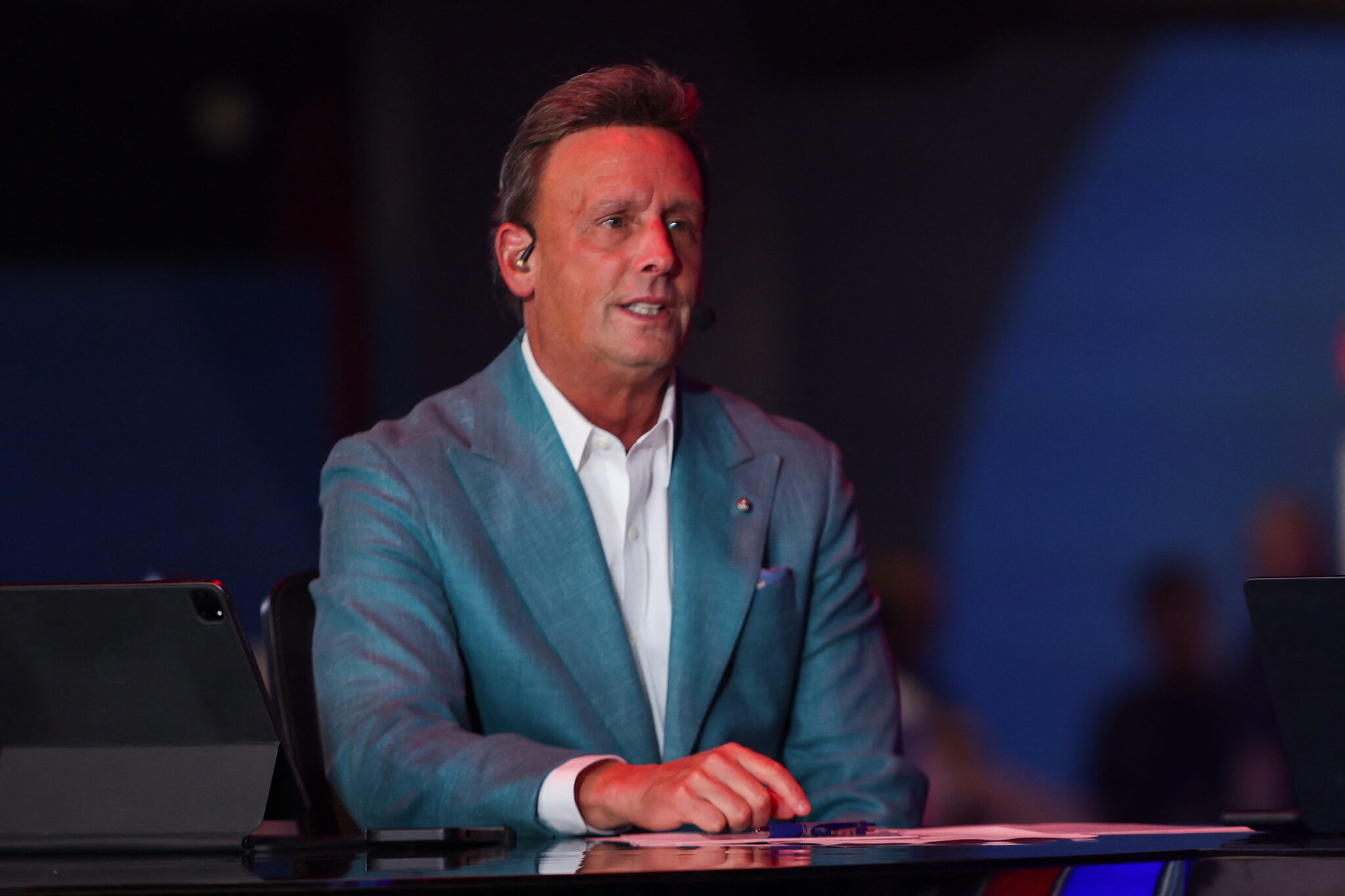
SOUTH WILLIAMSPORT, PA — It all started for Karl Ravech in Needham, Massachusetts, before and after dinner, on fields and courts with friends, playing what he calls “runaround sports.”
“I get asked, ‘How'd you get into broadcasting?’ ” Ravech says. “And a lot of people got into broadcasting because they watched the event and wanted to emulate a broadcaster. That was never me. I was outside running around.”
It will end, at least for now, in this picturesque setting where 12-year-olds are doing pretty much the same thing at an event Ravech has called for 21 years.
“ESPN treated me really well,” he tells USA TODAY Sports. “I got a chance to cover the major league World Series for two decades, College World Series I've called for a long time, and Little League World Series. So I see it at every level, and I always say Little League is my favorite event because there's just so much joy associated. It's the fun of the sport, which is what it's intended to be.
“It's playing with your pals that you grew up with, you go to school with. It's sportsmanship, it's not do or die, nobody's gonna get fired. Nobody's gonna get let go because they didn't make a play. You're still learning, you're still impressionable at that age.”
Ravech is now 61, and after 33 years of entering living room and dens and devices around the world broadcasting sports, he expects Sunday’s Little League championship game between Nevada and Curacao on ABC to be his last with the network. He was part of ESPN’s layoffs last month .
“Given the opportunities that I've had, to cover the events that I've had, to be so associated with a sport, the idea that I got to ESPN in 1993 and I'm sitting here in 2026, and apparently looking for work elsewhere, I'm not nearly as attractive as an employee if I didn't have all the experiences,” he says. “I just learned so much about so many people, worked with incredible teammates.”
Ravech spoke with us about his career and shared his thoughts on youth sports, which he has developed a passion for as a broadcaster and dad.
Authenticity is 'most important,' as a broadcaster and a parent
Ravech says he has always tried to be the same person as he is on your screen.
“Authenticity is the most important characteristic of any broadcaster,” he says. “I've never been a shtick person, and I think people appreciate that side of it. … We're condiments to the meal. A steak is what you're coming to eat. And that's the role and goal to me of a play-by-play guy. This thing has afforded me the opportunity to just interact with people, to meet people, to cover a game that I love, respect the people that are involved in it, never be too judgmental about anybody because you learn when it comes to a pitching change, whether it's Little League baseball, college or Major League Baseball, (coaches) know their players a lot better than I do, and the fans do.”
The task gets trickier to restrict yourself from influencing the story as a parent observing your kid play. We want to be part of coaches’ decision-making and we challenge them – sometimes loudly – when they make decisions that don’t benefit our child.
There are exceptions , of course, but many coaches grow to learn their teams, and there interactions with your kids can be life-altering if you give them a chance .
Ravech has two sons, Sam, 31, and Max, 26. Sam has followed him into broadcasting . In his office, he has a picture of Max and him at the Little League World Series when his younger son was 8 or 9.
“Sam came up to visit earlier this week and Max is coming up over the weekend to be here,” Ravech says. “So I'm grateful they're coming up. They said, ‘Should we come, would you like us to come?’ My first reaction is you don't need to do that. They’ve seen me do the TV thing, but I realized to share in what very well may be the last Little League World Series, it means something to them. They know it means something to me.”
He treasures how when he hosted Baseball Tonight and they were boys, his program didn’t start until 10 p.m. ET. Their Little League games often started at 6 or 7. He would leave the studio after the production meeting in the Connecticut studios and still make their baseball and soccer games.
He could make every one of them on the weekends.
“I didn't live vicariously through them because I played sports as a youngster,” he says, “but boy, I respect and love the love and the pride that parents have watching their kids perform. I would just guard them against living their life through their kids. This is their journey. Let them experience their journey, let them make choices, don't force them into a sport just because you played it. They're smart enough to let you know when they're 9, 10, 11 like, wow, I can see Max really likes lacrosse. Max really likes soccer. Max may not like baseball or basketball. That's on them.
“I love seeing parents that have their heart and their head in the right place.”
Youth sports survival guide: Order Coach Steve's new book
Finding community in a locker room, and outside the studio
As he started out as a television reporter and anchor in Binghamton, New York, and Harrisburg, Pennsylvania, and then moved to ESPN in 1993, Ravech grew to love the clubhouse culture of sports.
“That's probably one of the great aspects of being in the job that I've been in is when you get to see the way that kids, young adults, and grown men get along once you're inside a clubhouse, and their willingness to accept the differences, their willingness to deal with language barriers, their willingness to accept some guys have bad days, and that's OK and we're gonna lift them up," he says. "That spirit about men, I think, we can do a better job of as male parents.”
He started out as an overnight "SportsCenter” anchor, with co-hosts like Craig Kilbor...