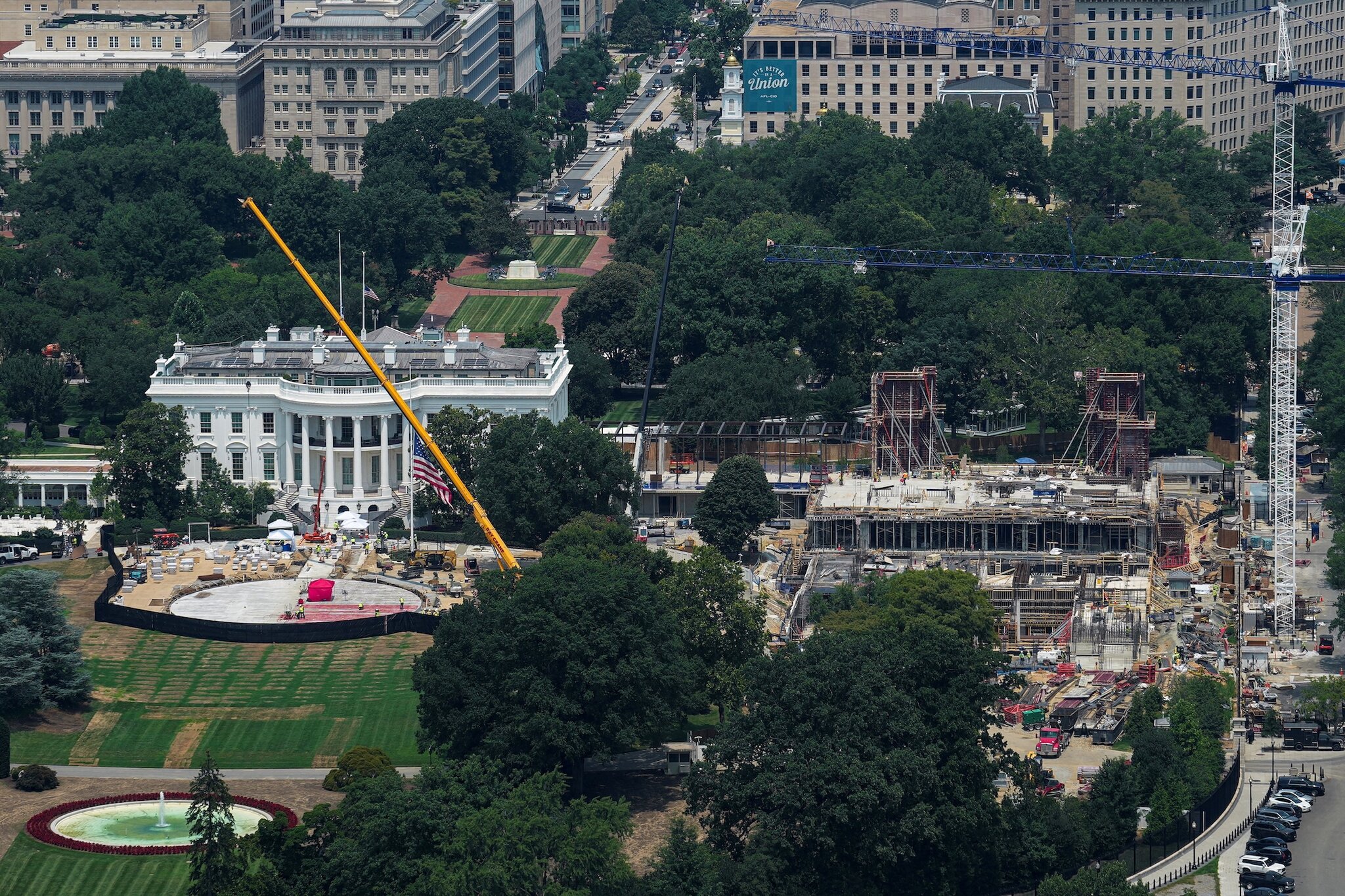
President Trump is pressing ahead with an ambitious effort to reshape Washington with new construction and renovations. The White House projects alone are now estimated to cost at least $900 million, with taxpayers funding a significant portion, despite earlier promises that private donors would cover most of the bill. White House correspondent Liz Landers takes a closer look. William Brangham: President Trump is pressing ahead with an ambitious effort to reshape Washington, D.C., with new construction and renovations around the nation's capital. White House projects alone are now estimated to cost at least $900 million. And despite earlier promises that private donors would cover most of the bills, taxpayers are funding a significant portion. Our White House correspondent Liz Landers takes a closer look. Liz Landers: The nation's capital these days seems like a giant construction site, scaffolding, work crews, heavy equipment all part of President Trump's effort to reshape Washington in ways he says will modernize the city and leave a lasting legacy. President Donald Trump: So, we're doing little things. As a real estate person, I love doing it. To me, it's an honor. It's a great honor to do it. Liz Landers: The projects include paving the White House Rose Garden and renovating the Colonnade, building a new Marine One helipad on the South Lawn, restoring the Lincoln Memorial Reflecting Pool, and gilding massive statues in gold near the Lincoln Memorial, with even more projects being planned. It's a subject constantly on the president's mind. Donald Trump: We're building something the likes of which will never be even close to being competed with. Liz Landers: In the first seven months of 2026, the president mentioned his construction projects at 84 events across 66 days, according to an analysis by the independent fact-checking site PolitiFact. That accounts for more than a quarter of his public appearances this year. Donald Trump: I put up the money to build this building along with a lot of great patriots. Liz Landers: But the biggest project by far, and the one the president has made a signature priority, bulldozing the East Wing to make room for a 90,000-square-foot White House ballroom, along with a new security facility. Donald Trump: You know, we're building a tremendous military facility at the White House. It's a ballroom, but it's also a big military facility, a drone port on top and tremendous things underneath. Liz Landers: The project has been held up with core challenges, but if it is completed, the White House says the ballroom will give future presidents a permanent space to host inaugurations and events and provide a secure state-of-the-art underground presidential bunker for national emergencies. The total cost for all of this, at least $600 million and climbing. The White House says private donations will cover the cost of the ballroom itself, but taxpayers are on the hook for the massive security enhancements. In June, the Secret Service redirected 352 million taxpayer dollars toward the ballroom project, funds drawn from Trump's One Big Beautiful Bill Act passed last year. Donald Trump: We're on time, on budget. It's going beautifully. I have all the money I need. We're making a gift to the United States. Liz Landers: The president's 2024 campaign finance chair, Meredith O'Rourke, is leading the fund-raising effort, according to Wall Street Journal reporting. Donations are funneled through the Trust for the National Mall, a small nonprofit that until now had been used to help fund more minor projects around D.C. like cherry tree maintenance. Jon Golinger, Democracy Advocate, Public Citizen: Almost no donors have revealed what they gave, and they're keeping the arrangement and the meetings that put these things together secret. Liz Landers: Jon Golinger is a former prosecutor and now works with Public Citizen, a watchdog group suing the administration for information about the ballroom and lack of transparency. The ballroom fund-raising agreement requires the trust to -- quote -- "preserve the anonymity and privacy of any donor who wishes to remain anonymous." Last fall, the White House did release a list of donors, but it was incomplete and did not include specific dollar amounts. Contributors include some of the biggest corporations in the world, including Lockheed Martin, Microsoft, Amazon, Caterpillar, and Google. Donald Trump: You have been so generous in your contributions, very substantial money, fully financed. It's fully taken care of now. And, in fact, we will have money left over. Liz Landers: A report from Public Citizen found that more than a dozen of the companies that donated to the ballroom have received new or increased government contracts over the last six months worth over $50 billion. It also found that 16 corporate donors are either facing federal enforcement actions or had actions suspended by the Trump administration, including antitrust actions, merger reviews, and SEC investigations. Jon Golinger: All -- the whole arrangement is troubling. It's not transparent. It's not accountable. And it's concerning whether there are side deals being made that nobody knows about it as of yet. Liz Landers: President Trump says that this is all a gift to the country. Is it? Jon Golinger: This is not a gift. It's a grift. I mean, President Trump figured out that he could shake down donors who want something from the government or butter up donors who want access or glory and bring in huge amounts of money that would, he thought, allow him to evade scrutiny and accountability. Liz Landers: A White House official said no donors are receiving preferential treatment. A White House spokesperson added -- quote -- "President Trump is generously donating his time and resources to build a beautiful White House ballroom, a project which past presidents only dreamed about. Since announcing this historic plan, the White House has been inundated with calls from genero...