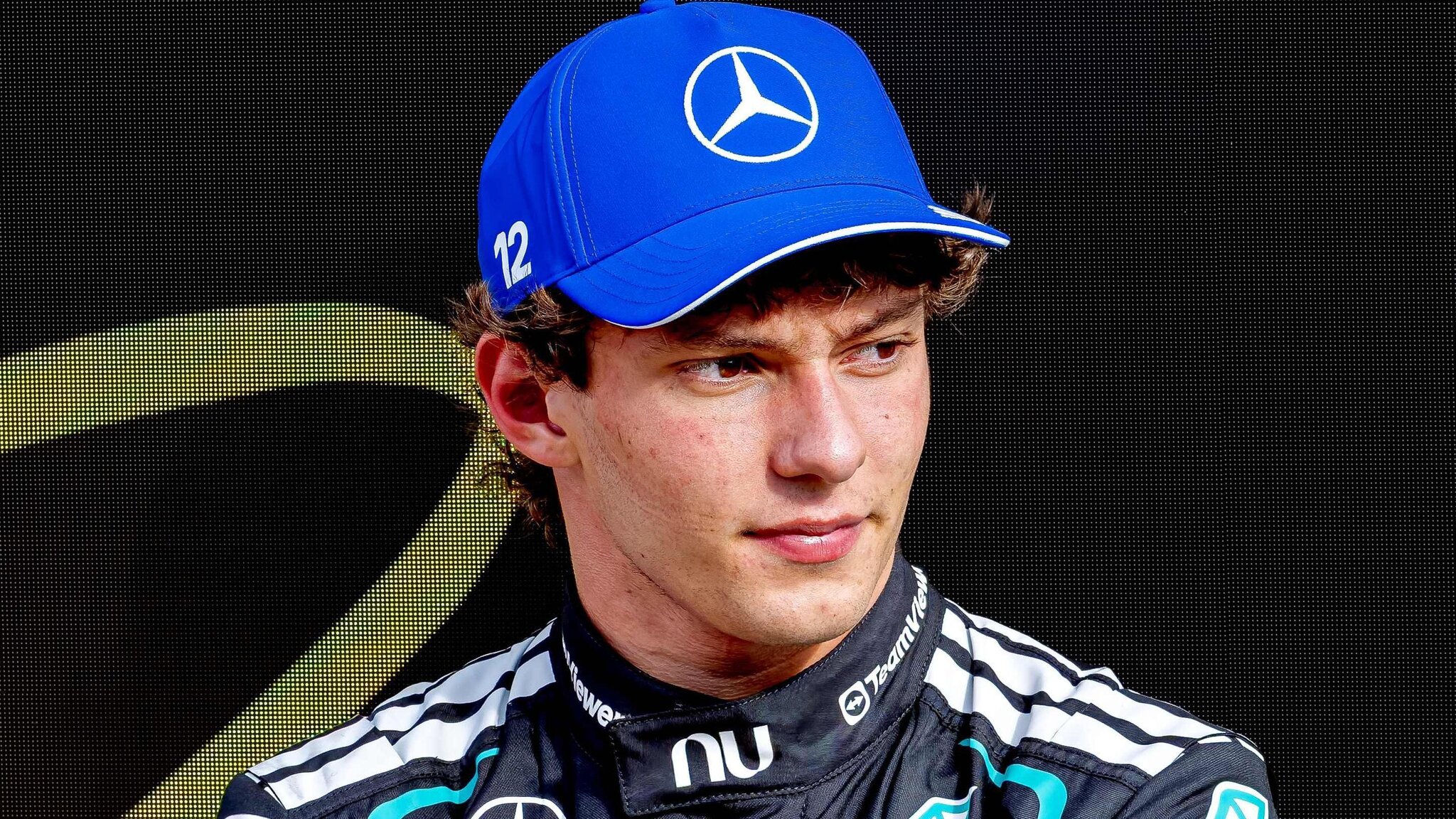
Kimi Antonelli extended his championship lead at the Dutch Grand Prix, despite failing to win the main grand prix or the sprint race [Getty Images]
Lando Norris beat championship leader Kimi Antonelli to claim his second win in a row with victoy at the Dutch Grand Prix.
Reigning world champion Norris moved up to fourth in the drivers' standings, 83 points adrift of Mercedes' Antonelli.
Four-time world champion Max Verstappen suffered heartbreak at his final home race when he crashed out heavily in the opening stages.
F1 correspondent Andrew Benson answers your questions after round 12 of the campaign in Zandvoort.
Is it fair to say the dominance of Mercedes is over? They haven't won a race since Spa-Francorchamps, and even then that victory wasn't consecutive. Are they focusing more now on scoring points than they are winning races?
There has been a very obvious shift in competitiveness at the front as the Formula 1 season has progressed.
Mercedes won the first six races of the season, but have won only two of the subsequent six.
Mercedes took 10 consecutive poles in the first 10 races, but have been beaten by McLaren's Lando Norris at the past two grands prix. And the fastest Mercedes was lower than second for the first time in Hungary, where Red Bull's Max Verstappen also lined up ahead of Kimi Antonelli.
Over the season as a whole so far, the Mercedes is the fastest car in qualifying by an average of 0.316 seconds over Ferrari, with McLaren a further 0.041secs adrift.
But what happens when you split that into the first six races and the next six?
Until the Canadian Grand Prix in late May, Mercedes were 0.453secs a lap faster than the next fastest team, which was McLaren at the time, and 0.489secs quicker than Ferrari.
Since Monaco, that gap has come down to 0.163secs over Ferrari and 0.270secs over McLaren. Red Bull's gap over the past six races is 0.353secs, whereas it was 0.813secs up to Canada.
There is a very obvious reason for this - Mercedes have upgraded their car less than their rivals. To a quite stark degree.
Each race, governing body the FIA issues a sheet showing the declared upgrades each team has brought to that race.
It's not a definitive list - teams don't have to put all the changes on that sheet, only the ones that are visible. But it gives an idea.
Since the start of the season, Mercedes have fitted a total of 24 new parts to their cars, compared with 37 for Red Bull, 38 for McLaren and 40 by Ferrari.
This is not a direct representation of relative spend, as some parts are more expensive than others.
But it's striking, for example, that Mercedes have also deployed fewer upgrades than Aston Martin, Alpine, Racing Bulls, Audi and Cadillac.
Even Haas, the team with the smallest budget on the grid, have had more upgrades than Mercedes, who have the equal lowest number with Williams.
This is all in the context of the budget cap, which is set at $215m (£170m) for all teams.
The question, obviously, is what is going on here?
Mercedes team principal Toto Wolff says: "We haven't got the money to put developments on the car.
"We are trying to evenly split that through the season, based on our calculations of when we can bring the biggest updates and optimising the championship points. But we just can do what we can do."
Asked why McLaren and Ferrari appeared to have the money and Mercedes did not, Wolff said: "Well, you will see how towards the end of the season (whether) they are going to be able to deploy as much stuff on to the car as they do now.
"Someone might have a different strategy in spending more at the beginning and in the middle of the year than towards the end."
The obvious conclusion is that Mercedes either spent more money in the design and build process of this year's car than their rivals - which would make sense, given how competitive it was at the start of the season - or they have saved money to spend on their next upgrade, and/or next year's car.
That is due at the so-called Bahrain Grand Prix in Malaysia at the start of October, when there are either eight or nine grands prix remaining, depending on the situation in the Middle East.
On top of that, Antonelli will take a grid penalty at the next race in Italy for exceeding the permitted number of engine parts, and George Russell will also have one at a subsequent race, most likely Azerbaijan.
Mercedes lack money to develop car like rivals - Wolff
Antonelli - the boy 'born in a garage' who started driving on dad's lap
How did the alleged improvements go on the Aston Martin? Is there any sign of improved performance? - Chris
Honda gave a debut to its long-awaited 'spec two' engine at the Dutch Grand Prix, while Aston Martin added a new front wing and diffuser to the pretty much all-new car that was introduced at the previous race in Hungary.
Within the team, they were hoping that the Honda engine would reduce lap times by somewhere in the region of 0.3-0.5secs.
The weekend painted a confusing picture.
On the one hand, Fernando Alonso looked more competitive than ever before at various points.
But he qualified further away from pole in both positional and percentage terms than he had in Hungary.
There were, however, extenuating circumstances, in that he was 12th fastest before failing to improve on a messy final lap hindered by a sub-optimal 'prep' lap which left his tyres out of the 'window'. Without that, he probably would have progressed beyond the first session.
Nevertheless, that suggests the new Honda was little better than the old one. On the other hand, the new engine's drivability was definitely worse, which may have skewed the picture.
But then Alonso drove an outstanding race on a one-stop strategy to take ninth place, looking after tyres and measuring his pace with all the expertise and skill he has shown throughout his career to hold...