This is one outlet's own report from Engadget — the article as it was filed. Other outlets are covering the same event; open the full story to compare every source side by side.
The OG goes "pro" with two lenses, class-leading dynamic range and optical zoom.
James Trew for Engadget RATING : 9 / 10 To say it's been a long road to the Osmo Pocket 4P is an understatement. It first l eaked in March , was officially teased in May, then fully launched in China in June while Europe and the US remained under embargo. DJI offered a few more glimpses before going quiet again, but the official global launch is finally happening today.
There's just one catch. Thanks to government restrictions on DJI products , no retailer in the US can officially sell it. It's not impossible to get hold of one , if you really want it, but the question is: Do you? Let me help you with that.
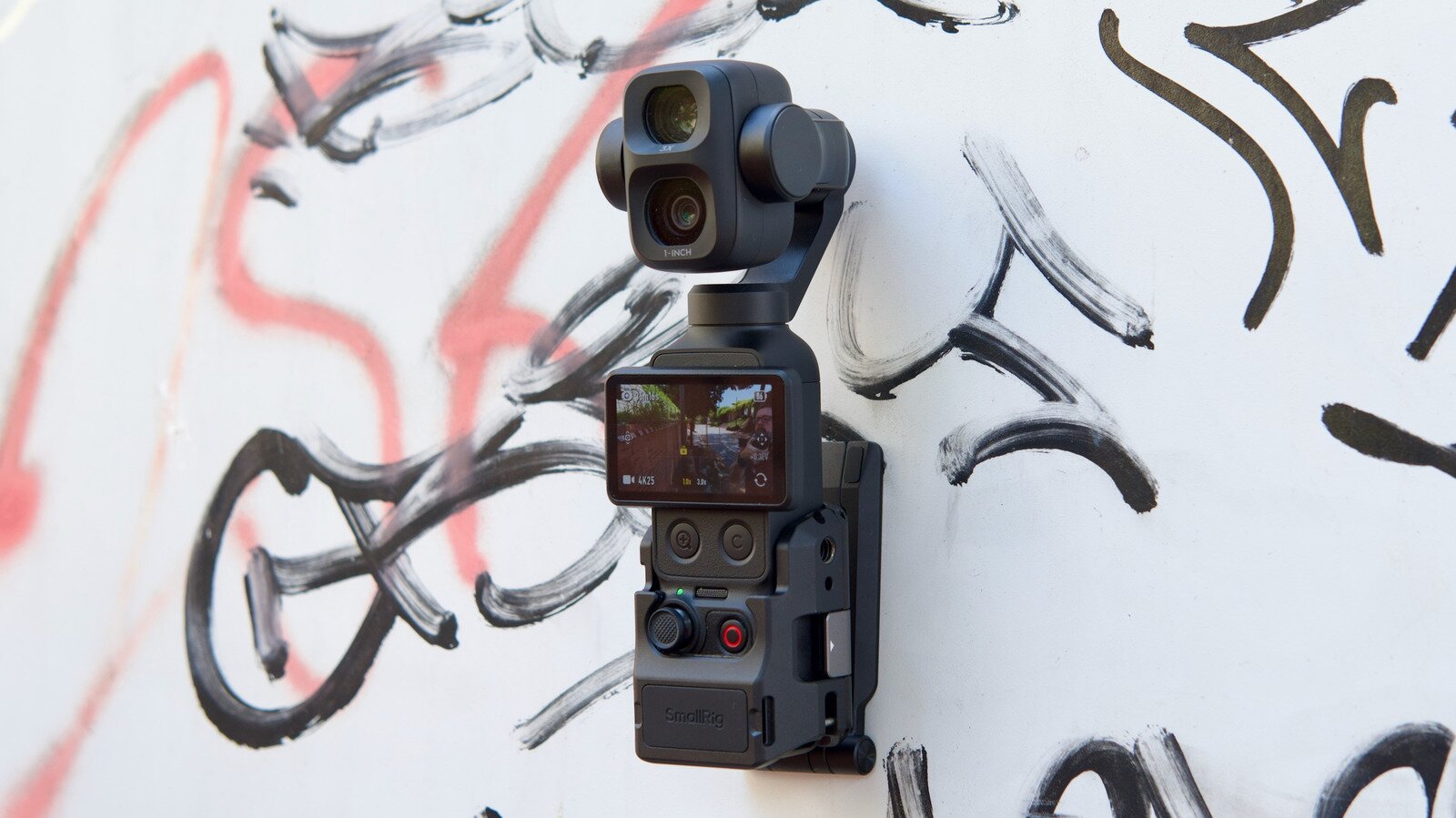
The headline feature of the Pocket 4P is its new dual-lens gimbal. The primary camera is a familiar 20mm-equivalent f/2.0 wide-angle with a 1-inch sensor, while the new addition is a 60mm-equivalent f/1.8 medium telephoto paired with a 1/1.28-inch sensor. Together they deliver true 3x optical zoom, up to 6x in-sensor zoom and a maximum 12x digital zoom.
Despite early rumours, the Pocket 4P doesn't record in 6K. Instead, it tops out at 4K video, with frame rates up to 240 fps for slow motion, alongside 37-megapixel stills.
One of the first features DJI highlighted during its unusually drawn-out launch was the claimed 17 stops of dynamic range. That's an eye-catching figure for a camera aimed at creators and vloggers — especially when Sony rates its $6,000 Alpha A1 at 15 stops. If those claims hold up, the Pocket 4P has the potential to offer class-leading performance in challenging lighting. There are caveats, though. The full 17 stops are only available from the primary camera, and only when shooting in the new 10-bit D-Log 2 color profile, which I'll come back to later.
Elsewhere, the body is unchanged from the standard Pocket 4 . You get the same 2-inch OLED touchscreen, two physical buttons — one dedicated to zoom and another that can be customized — plus a clickable joystick for zoom and gimbal control. It also comes with 103GB of internal storage, a microSD card slot and the expansion port for accessories such as DJI's magnetic fill light. Because the camera's body is the same as the regular Pocket 4, it means it's also immediately compatible with a wide range of third-party accessories.
James Trew for Engadget The Pocket 4P's optical zoom deserves its own section because it's that good. DJI isn't the first to put a dual-lens system on a gimbal camera — Insta360 won that race — but it's a huge leap over the Pocket 4's 2x in-sensor zoom. The familiar 20mm wide-angle remains a capable all-rounder, while the new 60mm medium telephoto dramatically expands what the camera can do.
DJI is quick to point out that 60mm is the "sweet spot" for portraits, giving more natural face proportions, but it offers much more than that in practice. The smaller aperture also creates a shallower depth of field. This naturally puts more focus on your subject, be it a person, object or landmark. I particularly enjoyed the freedom to reframe shots in-camera without worrying about loss of quality. I shoot a lot of top-down product shots, and being able to reframe the subject before I press record is a huge time saver. Better still, ActiveTrack continues to work while zoomed in, making it far easier to keep yourself framed when filming solo.
True optical zoom tops-out at 3x, but the in-sensor zoom still preserves a high amount of quality. It was hard to find much noticeable degradation in quality or noise in anything I shot at 6x. Honestly, even at 12x, well into the realm of digital zoom, I was hugely impressed with the fidelity. At this extreme, you will notice a drop in quality, but it is less than I expected. When compared to 12x zooms from the Insta360 Luna Ultra , it's hard to pick a winner as both have their strengths.
The transition between the two lenses isn't completely seamless, however. DJI has already reduced the issue with a firmware update, but you'll still occasionally notice a slight shift in exposure, color or framing as the camera switches to the telephoto lens at exactly 3x. There's also a small perspective change caused by the physical distance between the lenses. The Luna Ultra behaves much the same way, and it's largely a limitation of the hardware rather than something software can eliminate entirely.
One area where Insta360 still has the edge is zoom control. On the Pocket 4P, you can zoom using either the joystick or the dedicated zoom button. The button works well: single presses jump between 1x and 3x, a double press goes to 6x, while a long press performs a smooth continuous zoom. The joystick is less convincing. It's easy to leave it assigned to pan mode, only to realise after recording has started that it isn't controlling zoom at all.
The Luna Ultra's thumb slider feels more intuitive than the one on the 4P. Short presses step through the zoom levels, while a long press delivers a smooth zoom, and those controls remain available regardless of screen orientation. On the Pocket 4P, the zoom button disappears from the interface when shooting in portrait mode, making it slightly less convenient for vertical video.
James Trew for Engadget DJI's 10-bit Log modes have come a long way. The Pocket 3 was limited to D-Log M, a simplified version of the company's professional D-Log profile. The Pocket 4 introduced full D-Log, but the 4P goes a step further with D-Log 2 — the mode that enables the 17 stops of dynamic range.
There's a trade-off, though. Enable D-Log 2 and the camera becomes much more restrictive. Zoom is disabled, limiting you to the primary 20mm lens, and slow-motion recording is unavailable. ActiveTrack still works, however, so you're not giving up every advanced feature.
D-Log 2 also caps the ISO at 3,200, which can become a limitation in darker environments. On the plus side, its minimum ISO drops to 100, compared with ISO 400 on the original D-Log. That makes it much eas...
AIPROPX is an independent multi-source news index — we track, compare, and connect coverage from across the web into one place you won't find anywhere else.