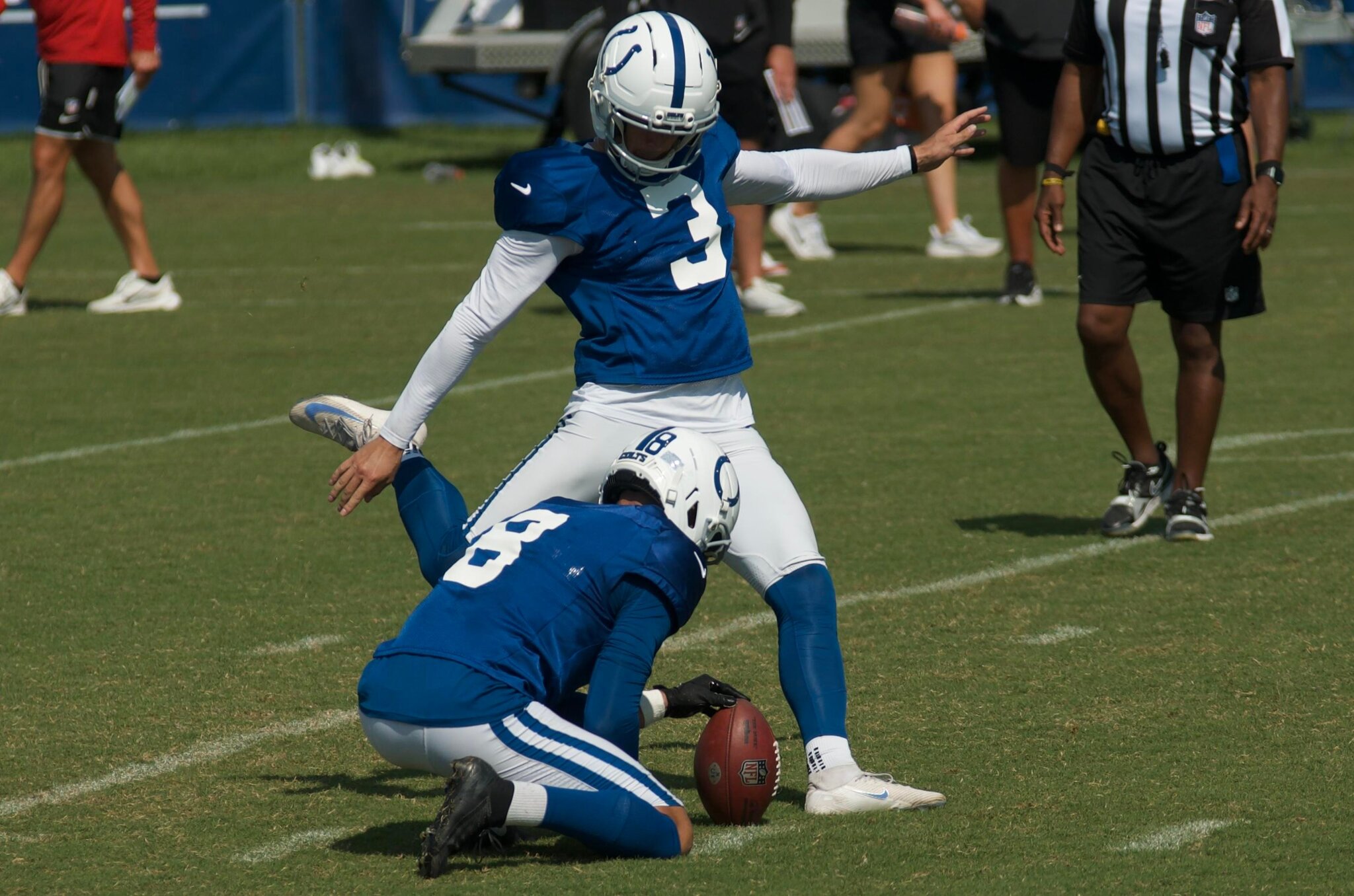
Indianapolis Colts kicker Spencer Shrader makes a 48-yard field goal in the final practice session of Thursday’s joint-practice with the Atlanta Falcons at Droplight Grand Park Sports Campus in Westfield, Ind. — Aug. 20, 2026. | Thomas Butler-Guerrero
INDIANAPOLIS — There was nowhere to hide, especially not behind the home faithful. Not even behind the preseason label, because the game exposed a bit more.
The depth of the Indianapolis Colts was tested in Saturday’s preseason home opener as the Falcons dominated with an overwhelming score of 34-6 inside Lucas Oil Stadium. It wasn’t just that the Falcons piled up in the first half, or needed just four plays to march into the end zone to start the second half. For Indianapolis, the numbers were ugly from virtually every angle. The Colts committed eight penalties, were forced to punt seven times, and started 0-for-9 on third down to collect only 91 total yards of offense with their second unit.
Second-year quarterback Riley Leonard got the start Saturday to command the second-team offense, but completed just 7-of-14 passes for 62 yards in the first half. Three of those completions came essentially in garbage time, when the Colts had no realistic chance of moving the ball into scoring range. Indianapolis’ first five possessions lasted just 24 plays and gained just 70 yards.
The offense finally crossed midfield late in the first quarter after a defensive pass interference penalty against Atlanta was followed by an unsportsmanlike conduct penalty, which gifted the Colts 31 extra yards. Kicker Spencer Shrader salvaged consecutive first quarter possessions with a 48-yarder and a 53-yarder, but that was as close as the Colts came.
The lone true offensive highlight of the game was when Leonard found slot receiver Coleman Owen wide open for a 39-yard gain. Indianapolis used a trips formation with Owen motioning into the mix before running a scissors concept that left him uncovered on a corner route to march into Falcons territory.
Atlanta, meanwhile, repeatedly found ways to attack Indianapolis’ secondary, particularly cornerback Mekhi Blackmon. Blackmon was flagged for pass interference on consecutive targets during a 13-play second-quarter drive, including one that moved the Falcons 18 yards. Atlanta eventually faced fourth-and-3 from the Colts’ 6-yard line, but another pass interference call against Blackmon kept the drive alive. Two plays later, Nick Carter powered across the goal line for a 1-yard touchdown, taking a big hit from Austin Ajiake before spinning his way onto the goal line.
With less than a minute left before halftime, Falcons quarterback Jack Strand rolled into play-action and found running back Cash Jones wide open in the flat for a 13-yard touchdown. No Colts defender had a realistic chance to make the play before the ball crossed the goal line. Suddenly, the Colts were staring at an 18-point deficit heading into halftime and it only got worse from there.
Atlanta needed just four plays to reach the end zone on their opening possession of the second half. After Strand launched a 36-yard completion down the right sideline to breach the red zone, he tucked it himself and scampered 16 yards for a rushing touchdown. The Falcons extended the lead to 30-6 less than two minutes into the half.
The only audible cheers was when Anthony Richardson entered to take over with the third stringers, but even his athleticism couldn’t spark Indianapolis’ offense. His first possession began with a 17-yard completion to Raylen Sharpe that was nullified by an offensive pass interference penalty on Pharaoh Brown, which of course forced another punt three plays later. Richardson’s second drive began backed up at Indy’s own 3-yard line, asked to lead an offense of third-stringers nearly the entire length of the field.
It predictably went nowhere as Richardson nearly threw an interception while attempting to escape pressure in his own end zone, then was stuffed at the line of scrimmage on a keeper himself. By the start of the fourth quarter, the Colts had punted six times, while picking up just four first downs. Richardson completed just 3-of-9 passes for a mere 24 passing yards, while he added 15 rushing yards on three carries.
Even when they finally earned their fifth first down, an inside run by running back Austin Castle that gained 10 yards, the drive ultimately went backward. The disorganization continued as a dropped pass by Samir Hagans was followed by a false start, then a sack on third down terminated the possession and forced Indianapolis to punt again. Despite moving the sticks, the Colts’ ninth drive finished with a net loss of two yards.
The scoreboard ultimately means nothing in the grand scheme, but the performance in the preseason home opener exposed something Indianapolis cannot ignore. Depth matters over the course of a season.
When the Colts caught the injury bug last season, it flipped the season upside down. After an NFL-best 8-2 start, the Colts lost their final seven games of the 2025 regular season to free fall out of the AFC playoff race. The Colts entered the second preseason game hoping to evaluate the players fighting for roster spots and establish which reserves could be trusted when injuries inevitably spring during the regular season.
Instead, the backups were sloppy and inefficient. The offense struggled to sustain drives, while the defense could not get stops and spent nearly 39 minutes. Sure, Indianapolis could have been shut out, but that misses the point. For 60 minutes, the Colts produced one explosive passing play and one explosive run when the game was out of reach. Two of their first four first downs through the first three frames came because of Atlanta penalties. At home, the Colts reserves were simply exposed.
With many roster decisions looming over the next week, Saturday’s performance should be a stark reminder that the difference between a competitive contender ...