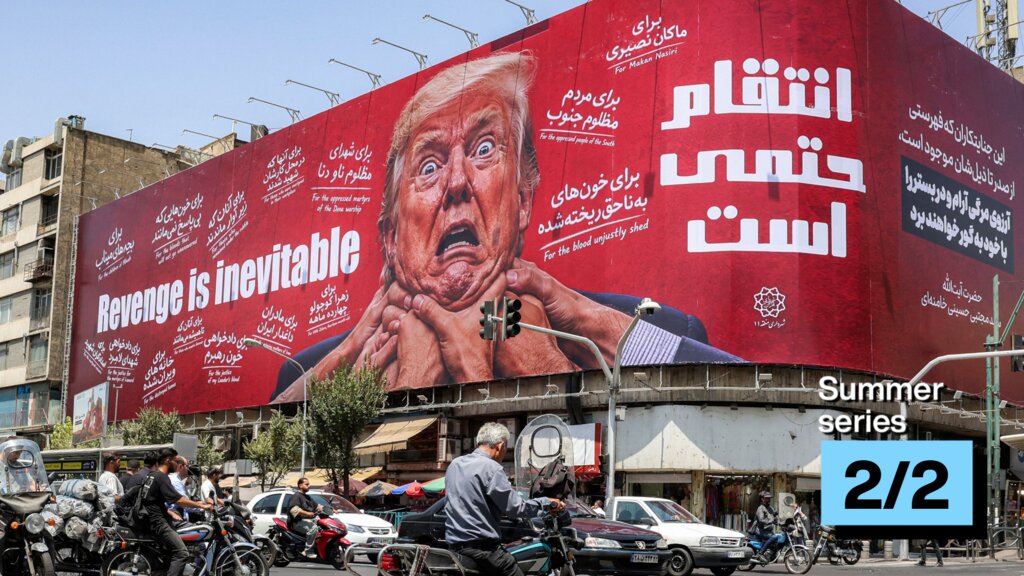
Tehran at War (Part 2/2). In Iran, the war with the United States is also fought through enormous, state-sponsored posters. Murals transform walls into billboards advertising the official narrative, designed to carry the government's voice far beyond its borders. FRANCE 24 examines this visual strategy, shaped during the Islamic Revolution and supercharged by artificial intelligence.
Issued on: 08/08/2026 - 09:36 Modified: 08/08/2026 - 10:07
By: Bahar MAKOOI A towering image of Donald Trump with his mouth sewn shut looms over Valiasr Avenue, one of Tehran’s busiest thoroughfares. The US president’s mouth is covered by a blue veil in the shape of the Strait of Hormuz .
Beside his image, a slogan in Persian – which graphic designers have made sure to also translate into English reads: "At the breaking point."
The billboard-sized poster was installed on May 2, when the war was in full swing and negotiations over the reopening of the Strait of Hormuz had stalled. This maritime passage, which Iran seeks to control – and through which nearly 25% of the world's oil is transported, is displayed here as a weapon capable of silencing Washington.
How Israel reduced Iran’s historic Rafi-Nia synagogue to rubble (1/2)
From Tehran’s walls to the world: Iran’s visual propaganda as an art of war (2/2)
Since the start of the war against the United States and Israel , these colourful murals have been displayed across the capital.
Very few images make it out of the country. Journalists in Iran are subject to intense scrutiny, and the internet is still largely cut off for the public, especially during the first few months of the war.
However, Iran’s leaders permit and even encourage news agencies to photograph and officially circulate posters like the one where Trump’s mouth is sewn shut. The image was widely shared by international media on social media.
Other posters include a mural of Iranian drones shattering the Star of David and protesters chanting "Death to America".
Another banner depicts the lineage of religious leaders standing together on a field of flowers: the founder of the Islamic Republic, Ruhollah Khomeini, stands beside Ali Khamenei – killed in the war's initial strikes on February 28 – who hands the Iranian flag to his successor and son, Mojtaba Khamenei .
The walls and buildings of Tehran have become canvases for state propaganda. The messaging is not just targeted at Iranian citizens – it’s also intended to speak to Iran’s foes.
While many of these monumental wartime billboards are now designed to be shared by non-Iranians outside of its borders, they are part of a long tradition of visual propaganda within the country.
For Iranians, they are a fixture of the urban landscape. Since the 1979 Islamic Revolution, walls have served as a "space for political expression", explains Sepideh Parsapajouh, an anthropologist and researcher at the French National Centre for Scientific Research (CNRS).
Large-scale murals constantly reinforce the narrative of the values upheld by the Islamic Republic – be it to eulogise martyrs of the Iran-Iraq War (1980–1988) and display revolutionary slogans, or express anti-American sentiment and hostility towards Israel. “The city thus becomes a vast narrative space," the researcher explained.
However, this culture of visual messaging predates the current regime by a long time. According to Parsapajouh, this method of storytelling through images is rooted in an older tradition called “pardeh-khâni” – a practice in which a storyteller would share religious or epic tales in front of a massive painted canvas depicting various scenes from the story.
"At the start of the Iran-Iraq War, many of the paintings were created by committed artists, art students, and sometimes talented amateurs," said Parsapajouh, adding that there were also community-driven local initiatives.
“Sometimes, the families of martyrs made requests. Artists painted portraits of young men who had died on the walls of their homes, as gifts for their mothers. There was a deep personal and emotional dimension to it."
But this artistic and emotional dimension gradually faded away. "It became institutionalised very quickly. The murals turned into actual state-commissioned projects," she noted.
Today, the process is entirely centralised. The massive billboards that have replaced hand-painted murals are commissioned directly by government bodies. Some designs are produced by the "House of Islamic Revolution Designers", a semi-governmental arts and media organisation. The installation of the designs is managed by several institutions, including the Islamic Development Organisation and the Tehran Municipality’s Beautification Bureau.
There’s been a change in medium as well. Delicately painted murals have given way to giant printed banners that can be installed or replaced in a matter of hours – allowing the Iranian regime to adapt its visual messaging in real time.
AI has also played a major role in accelerating the speed with which these often-theatrical images are rendered, and it has also affected the actual content of the posters.
"Compositions today are far more sophisticated. They borrow the visual language of advertising, cinema, and blockbuster movie posters," observed Parsapajouh.
Some even draw on Western pop culture. One notable example, displayed on the facade of a building in Fatemi Square in east-central Tehran, caught the attention of several Western media outlets because it referenced fantasy saga “The Lord of the Rings”.
A programme on popular Franco-German channel Arte called “Le Dessous des Images” ("Behind the Image") highlights this mural , which depicts two colossal statues standing on either side of a narrow waterway symbolising the Strait of Hormuz. Their arms are outstretched in a signal to block aircraft carriers and warships from passing through.
The statue on the left is Alireza Tangsiri, the former commander-in-chief of the Revolutionary Guard Navy wh...