This is one outlet's own report from Deutsche Welle — the article as it was filed. Other outlets are covering the same event; open the full story to compare every source side by side.
Nepal floods: More than 160 killed, nearly 1,400 missing
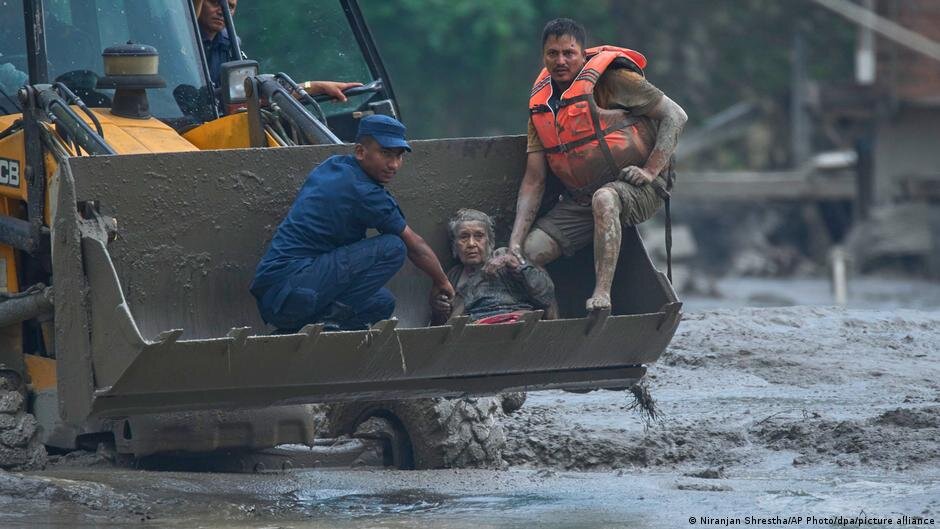
Rescue teams are searching for survivors after a glacial collapse triggered catastrophic floods in Nepal and Tibet. Hundreds of foreign tourists are missing.
https://p.dw.com/p/5JSU3 Advertisement The death toll from catastrophic flash floods along the border between Nepal and Tibet has risen to at least 165, while nearly 1,400 people were missing.
Rescue teams were searching for survivors on Thursday, a day after a glacial collapse sent a huge wall of mud and rock barreling through the Himalayan communities, sweeping way entire villages.
Devastating flash floods hit northern Nepal To view this video please enable JavaScript, and consider upgrading to a web browser that supports HTML5 video
Nepal's National Disaster Risk Reduction and Management Authority said 826 people were missing in the country, almost 600 of them foreign nationals.
In Tibet, Chinese broadcaster CCTV reported 558 people missing in Gyirong county, including 260 foreigners. Three deaths had been confirmed there as of Thursday morning, with two villagers rescued.
The disaster struck Wednesday when a glacial collapse triggered a flood in the Lhende Khola river, a tributary of the Bhotekoshi, in a corridor popular with trekkers and pilgrims connecting Kathmandu with Lhasa.
Nepal police spokesperson Abi Narayan Kafle told Reuters the death toll was expected to keep climbing: "This will go up, as we have resumed the search and more bodies are expected to be recovered."
Among those missing in Nepal were large numbers of foreign tourists.
Sunil Sharma, a tourism board spokesperson, told the AP news agency that 133 of the missing were Indian pilgrims traveling to Mount Kailash in Tibet, a site sacred to Hindus, alongside 47 Americans, 34 Australians, 33 Britons and 24 Canadians.
China's foreign ministry said nearly 100 Chinese nationals were missing.
During a press conference in Beijing, foreign ministry spokesperson Lin Jian said they were still verifying the breakdown of nationalities of the missing foreigners in Tibet, who were mostly tourists and pilgrims.
China authorities said they were in close communication with Nepal on search and rescue efforts.
As the scale of the disaster became apparent on Thursday, locals recounted a torrent of mud rushing toward them. "As it got closer, it kept rising higher and higher. When I saw it enter our home, I tried to grab my wife's hand and take her to the terrace. But she was swept away by the mud," Keshav Prasad Baral, a 68-year-old survivor, told Reuters.
He was rescued by helicopter four hours later. "My wife is still somewhere beneath the mud."
"She's gone," he said. Sagar Pandey, who heads a Himalayan tourism operator, surveyed the area by helicopter and saw that entire settlements had vanished.
"There are no human-made things, no human settlement left. Everything is just flat. So anyone in the hotel, the restaurant, or the car, I believe that everybody is gone," he told Reuters. More than 5,000 army and police personnel have been mobilized in Nepal, according to army spokesperson Raja Ram Basnet. They were using helicopters to drop supplies, including tents, food and more, donated by India to communities cut off by the disaster.
The US Geological Survey initially recorded the event as a magnitude-4.4 earthquake near the border. But USGS later said it was seismic energy generated by the collapse of glacial rock and ice, rather than an earthquake. Climate scientists at the Kathmandu-based International Centre for Integrated Mountain Development told the AP that an ice-rock avalanche likely dammed the river before releasing a sudden surge. "The Lhende Khola has flooded twice in 14 months, this time triggered by an ice-rock avalanche from a glacier on the Nepal side that blocked the river and released a sudden surge downstream," said Saswata Sanyal, a disaster risk specialist at the group, stressing the need for early-warning systems in "a warming Himalaya."
Experts note that the disaster fits a broader pattern of accelerating glacial instability caused by global warming.
A Kathmandu-based study earlier this year found that glaciers across the Hindu Kush Himalaya are melting at a faster rate, with ice loss roughly doubling since 2000, AP reported.
A similar flood in the same river system killed nine people in August last year, when high temperatures led to a glacial lake in Tibet overflowing.
As local authorities race to rescue survivors, the international community has stepped forward to offer support.
The International Federation of Red Cross and Red Crescent Societies (IFRC) released $1.4 million and said it was dispatching water and emergency supplies, including blankets, sleeping mats, first aid kits, stretchers and body bags.
"The priority now is to reach affected communities and get assistance to people who have lost their homes, suffered injuries or have been cut off," its head of delegation in Nepal, David Fisher, said.
Australian Foreign Minister Penny Wong said at least 34 Australians on pilgrimage and hiking tours were missing and that Canberra was coordinating with Nepal, the United Nations and the Red Cross.
Australian Prime Minister Anthony Albanese noted that detailed information remained scarce given Nepal's limited resources. "Nepal... is a developing country. It doesn't have the resources that an event like that would have in Australia, so information is difficult," Albanese said.
The US State Department said it is sending a disaster response adviser along with $500,000 (€429,000) in assistance.
If you rely on our team for trusted reporting, please take a moment to select us as your Preferred Source on Google , so you'll always see our verified news first.
AIPROPX is an independent multi-source news index — we track, compare, and connect coverage from across the web into one place you won't find anywhere else.