This year's Perseid meteor shower is active up until August 24
It peaked on August 12-13, but will be clearly visible in the Northern Hemisphere again tonight
Head to a dark sky area and look up any time between 11pm and 5am
As if a total eclipse before sunset across parts of Europe wasn't enough, the Perseid meteor shower peaked on the same day, August 12 (with a rare six-planet alignment chucked in for good measure).
You'd think that as a professional photographer I would've had all the gear for the 2026 eclipse (which maxed at around 91% where I was in the UK), but I opted to simply enjoy it with my family and a colander. The Perseids on the other hand, were the celestial show that I got my gear out for.
Like the six planets, the conditions aligned for optimum photography of the Perseid meteor shower; a dark new moon and clear dark skies graced where I live during peak activity. It was warm enough to be out in shorts, too.
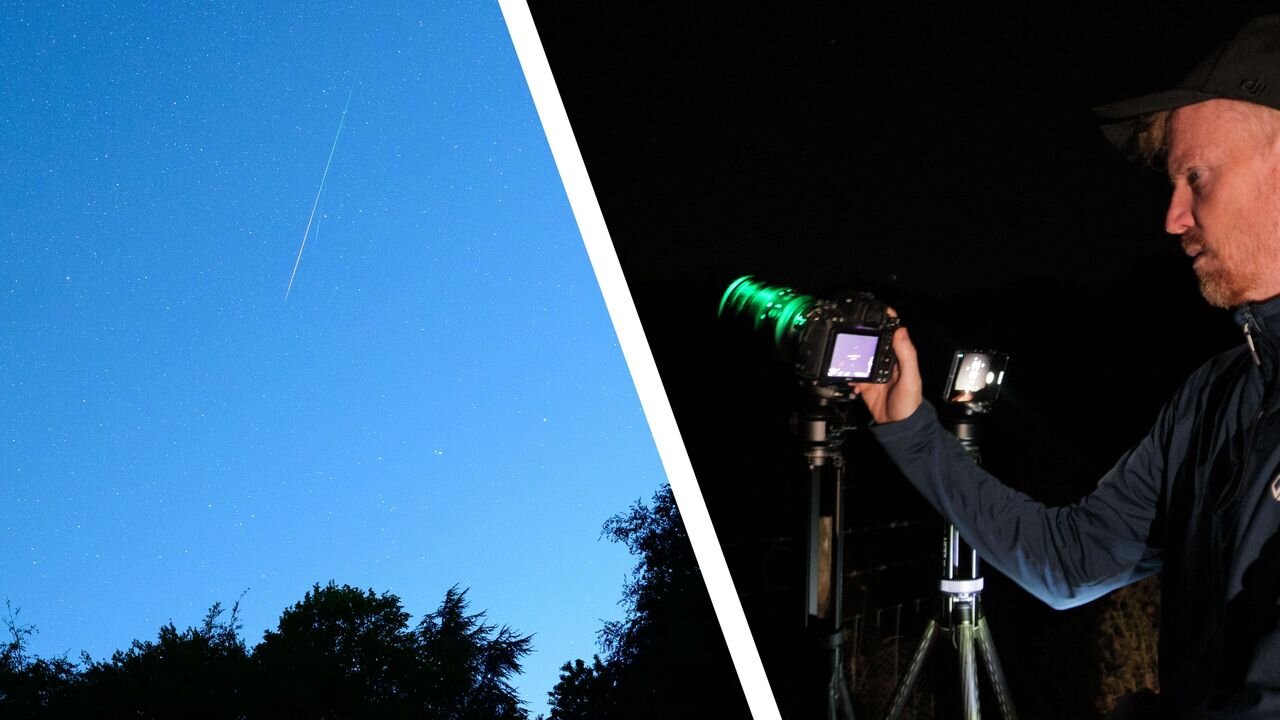
I set up my Google Pixel 8 Pro phone on one tripod and a Nikon Z6 II mirrorless camera with pro 24-70mm Ff/2.8 S on another side by side in my garden, and sat back with my son. And once our eyes had adjusted to the dark, the fun began within minutes.
Tim Coleman
Tim Coleman
Tim Coleman
Tim Coleman
How I photographed the Perseid meteor shower
For meteor photography, you absolutely need a method of keeping your camera completely still. I recommend a tripod support, though at a pinch you could prop your gear on a solid surface.
For my Pixel phone, I selected the Night Sight mode in the camera app. Once it had detected that the tripod-mounted device was completely still, the crescent moon on the photo icon changed to stars, indicating that the astrophotography mode had become available.
Hitting the photo icon on screen then starts a +4 minute timer on screen, at the end of which an optimized night sky image appears in the phone's gallery, together with one second-long timelapse video covering that entire sequence.
The alternative is standard the Night Sight mode, though to have any chance of a bright enough exposure, you'll need to manually increase the exposure time to the maximum possible six seconds. The astrophotography option yields much better quality results. For other devices besides the Pixel, check for equivalent photo modes.
Meanwhile, I set my Nikon lens to its widest 24mm focal length and an f/3.5 aperture, and set the Z6 II camera exposure settings manually to 20 seconds and ISO 3200. Any slower and the stars would start to streak (trail) rather than be distinct dots (the astrophotography rule of thumb for crisp stars is calculated as follows: focal length multiplied by shutter speed = 500 or less).
I usually shoot night sky photos in RAW format, and set the white balance to the tungsten setting for a rich blue color. I manually focus the lens to infinity and then dial it back a fraction.
Once the mirrorless gear was ready, I took the meteor photos with a self timer to avoid camera shake that occurs when pressing the shutter button by hand. The Z6 II can take up to nine consecutive images with the timer option, which in this scenario covered three minutes each time (given each photo is 20 seconds long). Alternatively, I could have locked the shutter button down with a remote release and the camera would run all night, which is what I do for star trail photography.
The Nikon camera was more enjoyable to shoot with for the experience (Image credit: Tim Coleman)
Smartphone vs mirrorless: which rig did I prefer?
Given the need for a tripod support, I didn't really feel that the phone was any more convenient than the bulkier mirrorless system, despite its simpler design.
Furthermore, the astrophotography mode remains illuminated on screen during the 4+ minute process of capturing a single image, which was somewhat of a distraction — you don't want a bright screen in sight when watching a meteor shower. Conversely, the Nikon camera's screen goes dark during each long exposure, which complimented the whole experience much better.
More importantly, I found that I couldn't rely on the Pixel's astrophotography mode auto editing. In almost all of the final photos, there were no visible meteors despite them clearly occurring during the four minute capture and being in frame, confirmed when I watched back the one-second timelapse video sequences (see below).
It seems as though for the most part, the Pixel device edits out meteors (and passing planes) in favor of a clean night sky image. It reminded me of my experience photographing the northern lights with a Pixel a couple of years back — I found the astrophotography mode over-edited.
A plane trail (bottom left) is followed by a meteor closer to the central tree Tim Coleman
But the auto edited image removes both Tim Coleman
More plane trails in this sequence Tim Coleman
Some of which remained in the final image Tim Coleman
And in this sequence, a meteor flashes across the sky at the very end Tim Coleman
And on this occasion, it makes the final image Tim Coleman
The Nikon camera, meanwhile, faithfully recorded each meteor in frame during the 20-second-long exposures. And, with a little creative editing, I could composite multiple meteors from multiple photos into one (assuming from images with identical composition) to get a final image with multiple meteors. You can see some of my photos below.
Put simply, I preferred the handling of the mirrorless camera, and the faithfulness of the images it produces, over my experience using a Pixel phone.
A collection of photos taken with the Nikon mirrorless camera system Tim Coleman
Tim Coleman
Tim Coleman
Tim Coleman
Tim Coleman
The Perseids lowdown for tonight
The Perseids are active up until August 24, but your best best is getting out asap this week. Last night, August 12 into the early hours of August 13, was the peak, but you can expect to see plenty more meteors tonight and in the coming evenings.
During peak activity, you can exp...