This is one outlet's own report from Gizmodo — the article as it was filed. Other outlets are covering the same event; open the full story to compare every source side by side.
Spacecraft Sent to Rescue NASA Telescope Is Having Its Own Issues
Earlier this month, NASA sent a servicing mission to stop one of its satellites from falling out of the sky. The satellite in distress is awaiting a slight nudge to move it into a safer orbit, but its long-awaited rescue is currently in jeopardy.
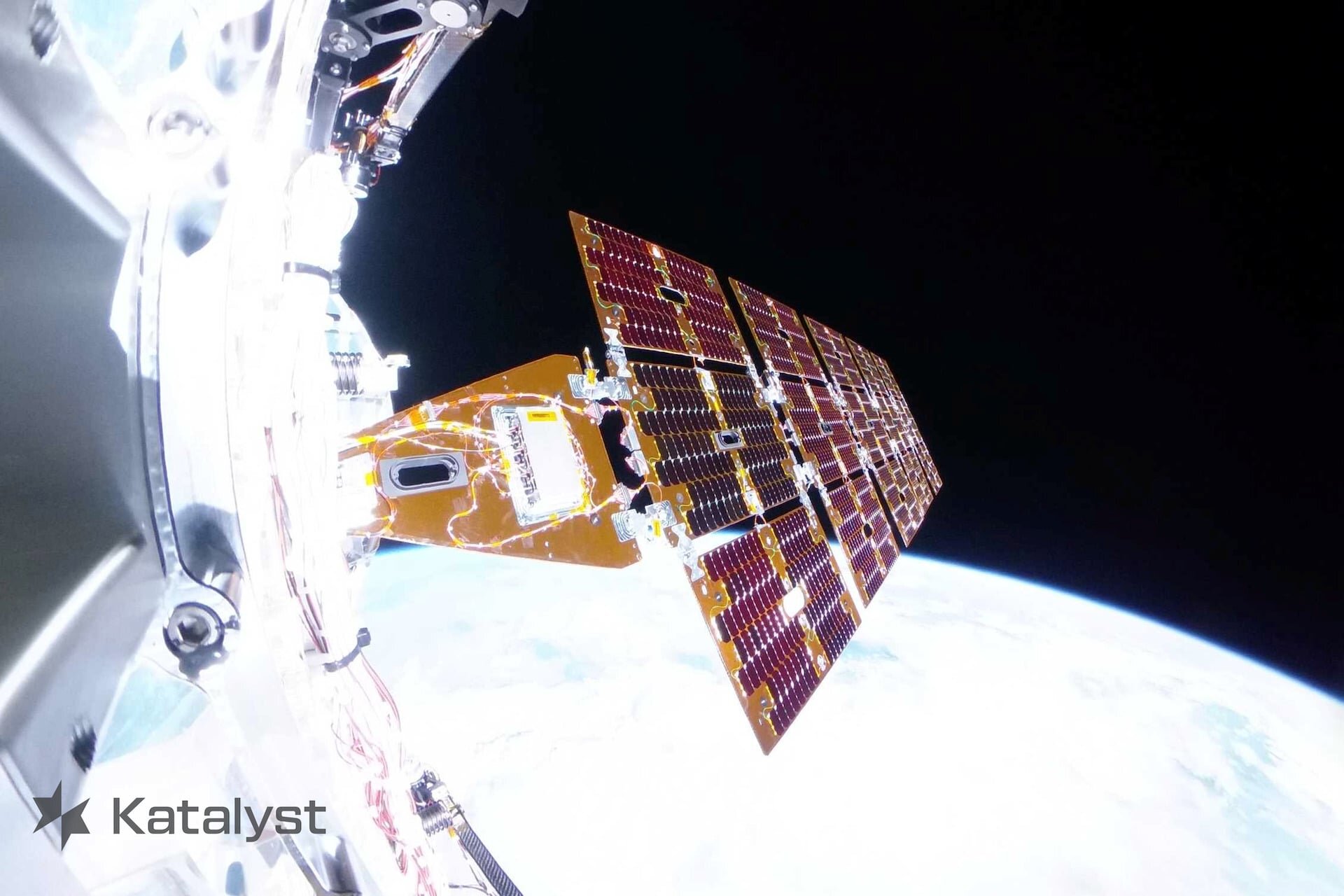
The servicing spacecraft, developed by contractor Katalyst Space Technologies, experienced issues with attitude control over the weekend, NASA shared in an update . This has caused the spacecraft, dubbed LINK, to spin while in orbit and resulted in sporadic communications.
The team behind the mission is currently working to stop LINK's unfortunate orbital tumble and reestablish a stable attitude.
The three-armed LINK spacecraft took off on July 3 onboard a converted Lockheed L-1011 aircraft from Kwajalein Atoll in the South Pacific. LINK was then launched into space from an altitude of 7.6 miles (12.2 kilometers) using a Northrop Grumman Pegasus XL rocket.
Things were looking good at first as Katalyst deployed LINK's solar arrays and established communications with its spacecraft. There were, however, some earlier concerns regarding one of the spacecraft’s three reaction wheels.
Reaction wheels control a spacecraft's orientation and stabilize its rotation using electric motors to discharge momentum. "The Katalyst team also quickly addressed early communications and attitude control issues seen during flight operations, including an issue with one of the spacecraft’s three reaction wheels," NASA wrote in an update on July 15. "After identifying the cause, they implemented flight software patches and operational updates that restored reliable communications and stable attitude control."
As the spacecraft's commissioning process continued, however, it looks as though the rotation wheel failure persisted. "Preliminary investigation shows that two of LINK’s three reaction wheels currently are not operable, and there is some loss of functionality in its cold gas thruster system," NASA's latest update read.
NASA is attempting to use LINK to try and boost the sinking Neil Gehrels Swift Observatory . Swift launched toward low-Earth orbit on November 20, 2004, to study the most powerful explosions in the cosmos: gamma-ray bursts. Over the course of its mission, Swift gradually lost altitude due to atmospheric drag and has a 50% chance of an uncontrolled reentry by mid-2026.
Earlier this year, NASA suspended all scientific activity onboard its Neil Gehrels Swift Observatory in the hopes of buying it more time until LINK is able to rendezvous with the aging satellite.
The LINK spacecraft is designed to rendezvous with Swift and nudge the spacecraft to a more stable orbit. In doing so, NASA is hoping to avoid Swift being dragged down low enough to hit Earth’s atmosphere and burn up on reentry, thereby extending its lifespan.
The Katalyst team is still in contact with LINK and working to use the spacecraft's electric propulsion thrusters to stop it from spinning. The team is also planning to update LINK’s guidance, navigation, and control to accommodate the spacecraft’s new configuration.
From there, the Katalyst team, working closely with NASA, will evaluate revised plans to approach and capture Swift depending on LINK's health and whether it's safe to follow through with the rescue mission.
AIPROPX is an independent multi-source news index — we track, compare, and connect coverage from across the web into one place you won't find anywhere else.