This is one outlet's own report from Tehran Times — the article as it was filed. Other outlets are covering the same event; open the full story to compare every source side by side.
Iranian, Russian universities discuss ways to deepen cooperation
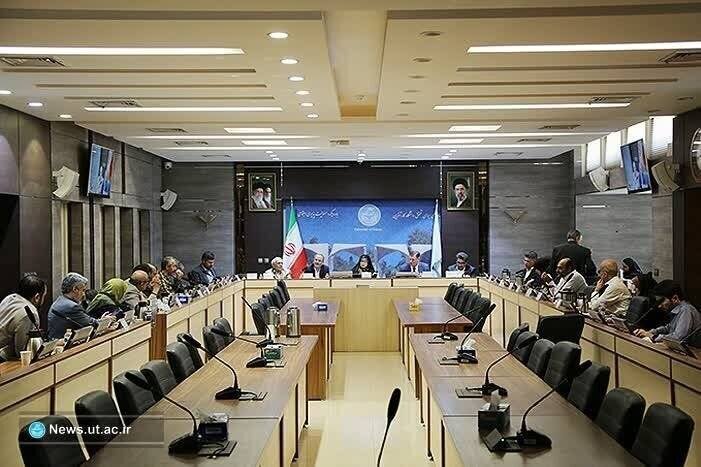
TEHRAN – At a coordination meeting held to discuss the implementation of memoranda of understanding (MOUs) signed between the universities of Iran and Russia, the two sides underlined the need to develop ties in strategic areas, mainly artificial intelligence and maritime economy.
The Monday meeting was attended by Elham Aminzadeh, the vice president of the University of Tehran for international affairs; Igor Demkin, an advisor to the Russian ambassador; and representatives from Russkiy Mir Foundation, which promotes Russian language abroad, ISNA reported.
During the meeting, Aminzadeh presented a report on the international activities of the top Iranian universities. Highlighting the success of a summit titled ‘new horizons in international activities’, she said the summit addressed current challenges, resilience during crises, the engagement of Iranian elites living abroad, and the design of new educational methods, particularly virtual, short-term, and skill-oriented programs.
Elaborating on the number of foreign students studying at the University of Tehran, the official said out of 3,300 received applications, 364 were accepted to be enrolled, 59 percent of whom are postgraduate students.
Underlining the country’s science diplomacy, she said, “Since the beginning of the war, we have communicated with some 300 best European, American, Asian, and African universities. We have agreed with the South Korea Foundation for Science to establish a Korean language major at the University of Tehran.”
The official went on to say that over the past 12 years, the cooperation between Iran and Russia was centered around exchanging students and professors, holding summer and winter schools, utilizing facilities in Russian laboratories, collaborating with BRICS, holding Persian and Russian language teaching courses, professional courses, and webinars.
Highlighting the need to establish a ‘permanent committee for cooperation between top-tier universities in Iran and Russia to analyze existing weaknesses, she said that the two sides could collaborate in various areas such as maritime economy and AI.
Moreover, Mahmoud-Reza Delavar, the director general of the office for international students at the University of Tehran, proposed establishing a joint financial fund to secure resources for collaborative projects.
Iranian and Russian universities can develop cooperation in different sectors including aerospace, maritime economy, the steel industry, transportation, and geophysics, he added.
For his part, Demkin said the two sides have so far benefited from only 30 percent of their scientific potential. Tehran and Moscow have signed some 350 MOUs. However, just 10 to 15 percent of them have been implemented. It is essential to distinguish significant and insignificant MOUs, and focus on the most important ones. The next two years present an opportunity to expand essential cooperation, he noted.
On June 10, Science Minister Hossein Simaei-Sarraf and Russian Science and Higher Education Minister, Valery Falkov, reviewed strategies for developing scientific, educational, and academic cooperation between the two countries with an emphasis on expanding professor and student exchanges, strengthening research cooperation, and facilitating academic interactions.
In a telephone conversation, Simaei-Sarraf expressed hope that in-person meetings between the two sides will be held in Tehran and Moscow in the near future, IRNA reported.
He also announced the upcoming holding of a meeting of the presidents of top Iranian and Russian universities in Tehran, and considered the development of Russian language chairs in Iranian universities and Persian language chairs in Russian universities as a sign of deepening scientific and cultural ties between the two countries.
Falkov, for his part, pointed out the beginning of a new university admission period in Russia and the welcoming of Iranian students to study at the country’s universities, emphasizing the importance of providing employment opportunities and utilizing the academic potential of graduates after their return to Iran.
Referring to the decrease in the number of Russian universities approved in Iran’s evaluation system, he called for a review of the methods of evaluating and validating educational qualifications.
Simaei-Sarraf continued by emphasizing the readiness of the Ministry of Science, Research, and Technology to review the evaluation system of Russian universities and develop joint educational and research cooperation.
The two sides also agreed to continue cooperation on developing professor and student exchanges and expanding scientific cooperation between the universities of the two countries. The discussion ended with Simai-Sarraf and Falkov mutually emphasizing the continuation of consultations, strengthening academic cooperation, and planning for face-to-face meetings in the near future.
In December 2025, the second scientific conference between Iran and Russia was held in Moscow on Monday, with Iran’s ambassador to Russia, Kazem Jalali; science attaché, Hadi Goudarzi, and representatives from universities and scientific institutions of the two countries in attendance.
Referring to Iran’s unique history and the civilizational commonalities between the two countries, Russian Presidential Aide Andrei Fursenko emphasized the need to strengthen cultural and academic relations between Iran and Russia, msrt.ir reported.
“The Russian government is completely ready to promote collaborations with Iran in the science and technology sectors. Russia and Iran need to rely on their capabilities in the pursuit of global development and play their historical role,” he noted.
Deputy Minister of Science and Higher Education of the Russian Federation, Denis Sergeevich Sekirinsky, for his part, said the two nations have their own distinguished civilizations, maintaining cultural traditions and spiritual values. These historical commonalities have res...
AIPROPX is an independent multi-source news index — we track, compare, and connect coverage from across the web into one place you won't find anywhere else.