This is one outlet's own report from Motor1 — the article as it was filed. Other outlets are covering the same event; open the full story to compare every source side by side.
It is powered by two production-based JCB hydrogen combustion engines tuned to a combined 1,600 horsepower.
The run eclipses BMW H2R\u2019s 185.5 mph hydrogen-IC record, the 303 mph fuel-cell mark, and JCB\u2019s 350.092 mph Dieselmax.
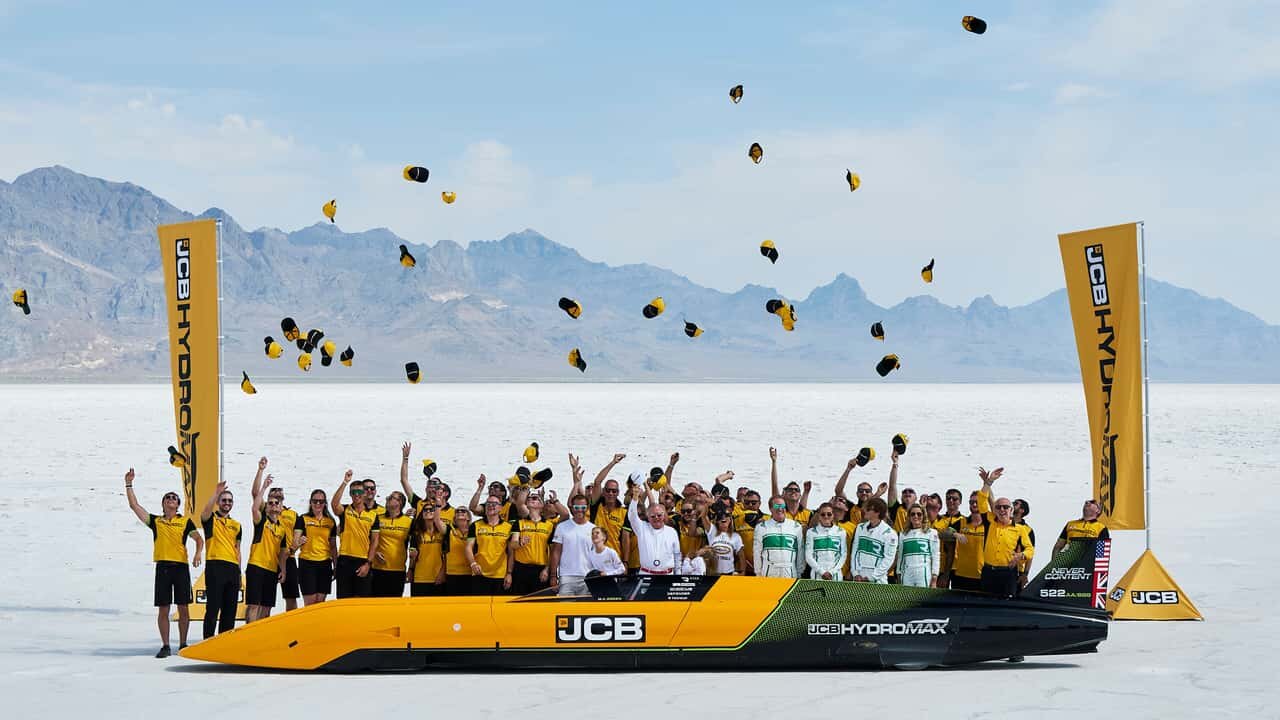
JCB Hydromax has pushed hydrogen power deep into four-figure territory, setting a provisional world land speed record of 406.320 miles per hour on the Bonneville Salt Flats in Utah. The British-built streamliner runs on hydrogen-fueled internal combustion, not fuel cells, and was driven by Wing Commander Andy Green OBE, pending final ratification by motorsport\u2019s governing body.
The 32-foot Hydromax completed two runs across Bonneville yesterday to meet F\u00e9d\u00e9ration Internationale de l\u2019Automobile (FIA) rules, which require passes in opposite directions within one hour. The car averaged 400.623 miles per hour on its first run and 412.135 miles per hour on its second, for a two-way average of 406.320 miles per hour over the flying kilometer distance.
That figure comfortably eclipses the previous FIA-officiated hydrogen internal combustion record of 185.5 miles per hour set by the BMW H2R in 2004. The new record falls under the FIA\u2019s Category A, Group XIV, Class 7 World Flying Record Start Land Speed Record, and remains subject to official confirmation by the FIA before it becomes fully certified.
Power comes from two of JCB\u2019s production-based hydrogen \u201cdigger\u201d engines, tuned to deliver a combined 1,600 horsepower and built at the company\u2019s engine plant in Foston, Derbyshire, England. According to JCB, these are fundamentally the same hydrogen combustion units already fitted to its construction machines as part of a \u00a3100 million hydrogen development program.
The new mark also vaults past JCB\u2019s own diesel land speed record. Hydromax exceeded the 350.092 miles per hour benchmark set by the diesel-powered JCB Dieselmax, which Green drove on the same stretch of salt in August 2006, this time using an engine that JCB notes produces no CO\u2082 at the tailpipe. The latest run also tops the 303 miles per hour hydrogen fuel cell record, making Hydromax, by JCB\u2019s count, the fastest hydrogen-powered vehicle of any kind so far.
JCB Chairman Anthony Bamford, who has overseen the hydrogen engine project, framed Hydromax as a follow-up to the Dieselmax effort two decades ago at Bonneville. \u201cTwenty years ago we came to Bonneville with JCB Dieselmax and showed what British engineering could do with diesel power. Today we have done it again\u2014this time with engines powered by hydrogen,\u201d Bamford said.
Green, already known as the fastest man on earth at 763.035 miles per hour and the only person to break the sound barrier on land, called the new run a privilege. \u201cBonneville is the spiritual home of the world land speed record, and JCB Hydromax has just written itself into that history,\u201d he said, describing the car as \u201cstable, strong and fast\u201d and crediting \u201ca world class team and superb technology.\u201d
The Bonneville record attempt followed a warmup appearance at the Southern California Timing Association\u2019s Bonneville Speed Week. There, Hydromax set a 368.347 miles per hour average in the Blown Gas Streamliner AA/BGS 500-plus cubic inch class, establishing a new SCTA mark and an early milestone in the car\u2019s development program.
Motor1's Take: Hydromax\u2019s run shows hydrogen combustion can be pushed to extreme performance, turning what was once a research project into a serious route for production-based engines and giving OEMs, fleet operators, and builders a real-world data point as they weigh hydrogen against batteries and fuel cells.
AIPROPX is an independent multi-source news index — we track, compare, and connect coverage from across the web into one place you won't find anywhere else.