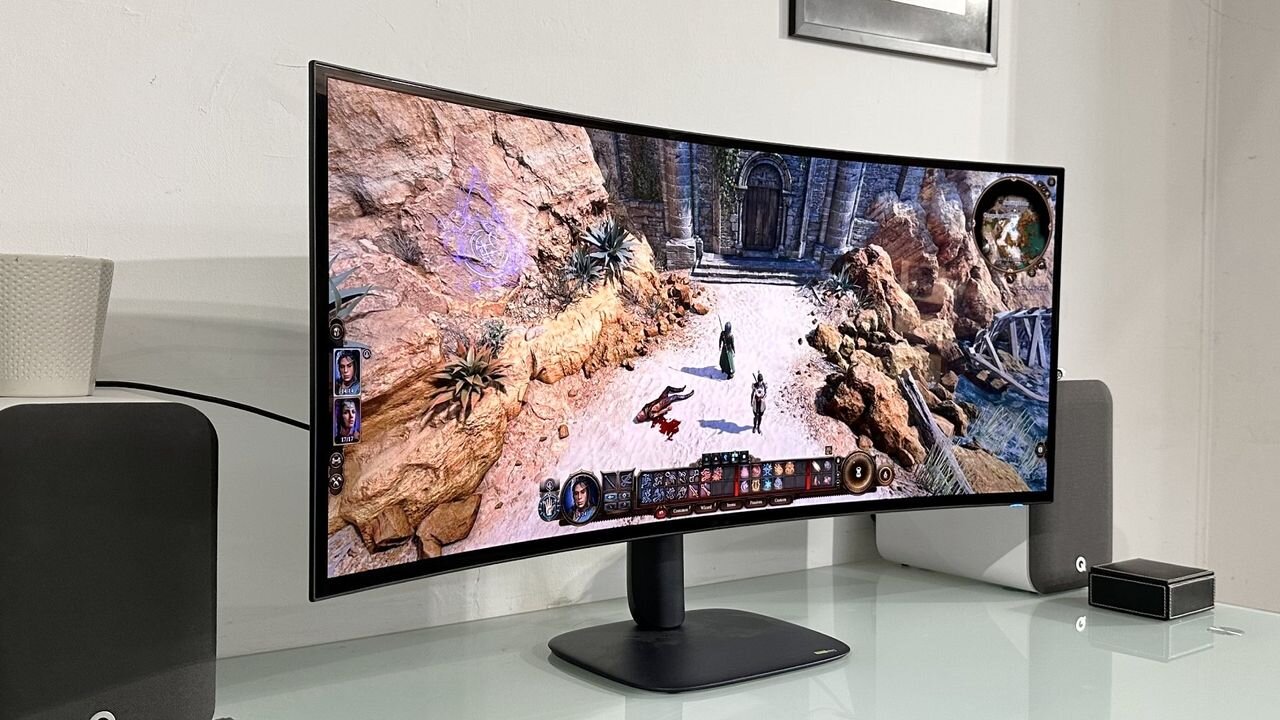
This is one outlet's own report from PC Gamer — the article as it was filed. Other outlets are covering the same event; open the full story to compare every source side by side.
For a new gaming monitor that ticks an awful lot of boxes, the Alienware AW3926QW has also arrived with an awful lot of controversy. Some early adopters of this epic 39-inch 5K2K OLED panel have reported numerous issues, including green tinting, so-called "vignette dimming" and adaptive refresh flicker.
We'll get into the specifics of what Reddit is losing its hive mind over with the Alienware AW3926QW later. But first let's consider the stellar on-paper proposition of this monitor. For starters, it's OLED. Not just any old OLED, but LG's fancy Tandem WOLED tech.
Oh, and it has pure RGB-stripe subpixels, it's a 39-inch ultrawide with sensible 1500R curvature for epic immersion, packs a 5K2K native resolution and thus excellent pixel density, has a glossy screen coating, DisplayHDR True Black 500 certification, a high-refresh 330 Hz dual-mode and, well, plenty more besides. Heck, it's even cheaper than you might expect, coming in at just $1,099 in the US and £999 in the UK, therefore undercutting LG's own $1,799 5K2K 39-inch OLED model by miles. And that LG monitor doesn't even get RGB-stripe tech. No question, this Alienware is absolutely stacked.
AW3926QW specs Screen size
39-inch
Resolution
5,120 x 2,160
Brightness
300 nits full screen, 1,300 nits peak HDR
Response time
0.03 ms
Refresh rate
165 Hz @ 5K2K, 330 Hz @ 2,560 x 1,080
HDR
DisplayHDR True Black 500
Features
LG Tandem OLED RGB-stripe panel, G-Sync, 2x HDMI 2.1, DisplayPort 2.1, USB-C with 90 W PD, USB hub
Price
$1,099 | £999
Buy if...
✅ You want an ultrawide OLED with everything: This Alienware has it all: Tandem OLED, RGB-stripe, good pixel density, the works.
Do not buy if...
❌ You can't afford a decent GPU: The 5,120 by 2,160 native resolution means you're going to want a decent graphics card to drive this monitor.
If that's the broad brush strokes of the Alienware AW3926QW's proposition, how about the finer details of its tech specs and configuration? The basic panel format is 21:9 aspect and 5K2K resolution, which means it's essentially a 32-inch 4K 16:9 panel widened out to 21:9 and with exactly the same pixel density, just on an even more immersive ultrawide panel.
As I've covered on several previous occasions, Tandem WOLED is LG's very latest panel tech. Confusingly, the "W" doesn't refer to the white subpixel that all previous generations of LG's monitor panels have included, but rather the white colour of the light produced by each subpixel, which in turn is passed through a colour filter.
Likewise, the "Tandem" bit as used here doesn't mean two full OLED panels sandwiched together as per, say, a tandem OLED panel in a Apple iPad Pro. Instead, it's a reference to the additional emissive layer LG has added, again within the sub pixels.
(Image credit: Future)
Anyway, this new Tandem WOLED generation is brighter than ever before. At least, it is in some cases. This is actually the fourth OLED we've reviewed this year with the new Tandem WOLED panel tech. The first two, the aforementioned LG UltraGear Evo GX9 39GX950B and then the Asus ROG Strix XG32UQWMS , use LG's traditional RGWB subpixel structure, cranked out 1,500 nits of peak HDR brightness and good enough for DisplayHDR True Black 500 certification.
But the Asus ROG Swift PG32UCWM adds a twist by taking that Tandem WOLED panel tech and inserting LG's new pure RGB-stripe subpixel structure that does away with the additional white subpixel in a quest for sharper, more precise rendering and broader colour coverage. In that Asus Swift, RGB-stripe comes at a pretty pointed cost when it comes to brightness.
Where the two RGWB Tandem WOLEDs I mention hit around 330 nits full screen, the RGB-Stripe Swift can only manage 250 nits. It also tops out at just 1,000 nits peak HDR and makes do with DisplayHDR True Black 400 certification. But here's where it gets really confusing. This new 5K2K 39-inch Alienware is also RGB-stripe Tandem WOLED just like the Asus Swift, but achieves 300 nits full-screen brightness, 1,300 nits peak HDR and DisplayHDR True Black 500 certification.
Yep, it's another Tandem WOLED with true RGB-stripe subpixels. Future
Long story short, then, what this Alienware seems to offer is the benefits of RGB-stripe subpixels, including more precise rendering at subpixel level and so crisper text and fonts, plus wider colour coverage more akin to Samsung's competing QD-OLED tech, while minimising the downsides in terms of compromised brightness.
Of course, all this also promises a monitor that might match QD-OLED's vibrancy without that technology's own downsides, which include purple tint and compromised contrast in bright ambient light, plus overly warm colour balance. Then there's the usual upsides that come with all OLED monitors, like perfect per-pixel lighting and ridiculously quick 0.03 ms response times. It's a lot to keep up with but a tantalising overall proposition.
For the record and just to cover off the broader feature set, the Alienware AW3926QW is very well specified beyond the core panel tech. You get DisplayPort 2.1, two HDMI ports and USB-C with 90 W of power delivery, plus a multi-port USB hub and a KVM switch. As for refresh rate, at the native 5K2K or 5,120 by 2,160 pixel resolution, the AW3926QW hits 165 Hz, while an alternative 2,560 by 1,080 resolution dual-mode ups that to 330 Hz.
There's the usual upsides that come with all OLED monitors, like perfect per-pixel lighting and ridiculously quick 0.03 ms response times.
There are also additional alternative resolutions of 4K at 165 Hz, and a couple of further 25-inch and 27-inch 330 Hz modes which run at sub-1080p. As you would expect, further gaming-friendly features include AMD FreeSync and Nvidia G-Sync support. It's all buttoned up by a full three-year warranty that includes the all-important cover for OLED burn-in.
Finally, the physical design is a dead ringer for other Alienware monitors. Gone is the Storm Trooper-style white plastic and retro ...
AIPROPX is an independent multi-source news index — we track, compare, and connect coverage from across the web into one place you won't find anywhere else.