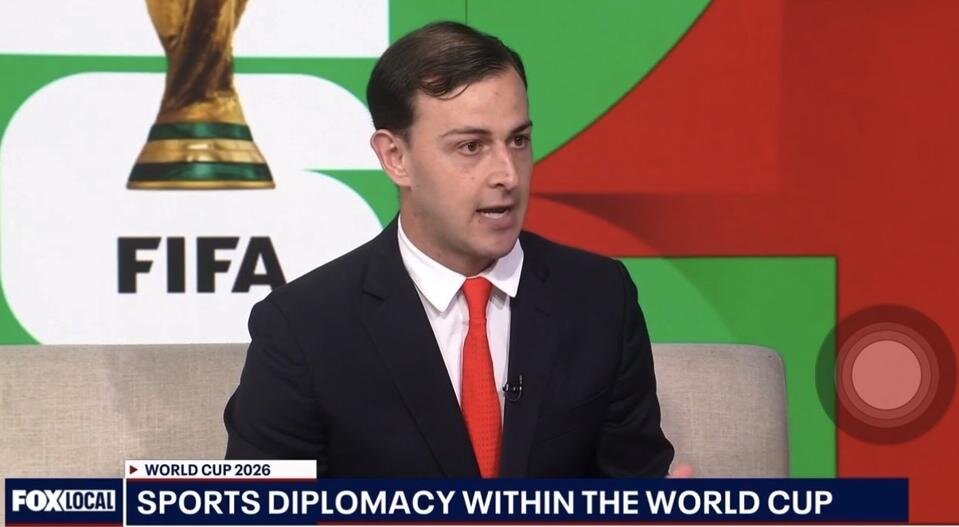
Samuel Hymes understands the importance of sports diplomacy at big international events such as the World Cup.
Photo courtesy of Samuel Hymes
The 2026 FIFA World Cup turned out to be one memorable event, but it was hardly a stand-alone global extravaganza.
As it turns out, the quadrennial tournament is positioned to kick off a pivotal decade of international sporting championships in the United States, says strategic advisor and Harvard Fellow Samuel Hymes.
He noted that the U.S. faces an unprecedented opportunity, and if the powers that be do the right things, mostly off the playing field, it could go a long way in helping what he calls sports diplomacy.
"The recently introduced American Decade of Sports Act reflects a growing recognition that these events should not be treated as isolated spectacles, but as part of a longer national strategy," Hymes said recently, which he also wrote in a paper looking at the future.
Over the next eight years, the U.S. will host several major sporting world championships. Here is the impressive list of events:
* 2027 Military World Games (for military sportspeople) in Charlotte, N.C.
* 2028 Summer Olympics and Paralympics in Los Angeles
* 2031 Men's Rugby World Cup
* 2033 Women's Rugby World Cup
* 2034 Winter Olympics and Paralympics in Salt Lake City
A sixth world championship is expected to be added to the list by FIFA at its Extraordinary Congress in Zurich, Switzerland on Nov. 23. The U.S., along with co-hosts Mexico, Costa Rica, and Jamaica, are the lone candidates.
METLIFE STADIUM, EAST RUTHERFORD, NEW JERSEY, UNITED STATES - 2026/06/16: A giant screen displays the word 'Attendance 80,545' during the FIFA World Cup 2026 Group I football match between France and Senegal. France won 3-1 over Senegal. (Photo by Nicolò Campo/LightRocket via Getty Images)
LightRocket via Getty Images
The importance of sports diplomacy
Sports diplomacy, which is essentially soft power, can go a long way in helping a country solidify better relationships with the rest of the world.
"That strategy matters because the benefits could be far greater than ticket sales and television ratings," Hymes stated. "If handled well, this decade of sports could help the country strengthen global relationships, improve public diplomacy, attract investment and tourism, support American business, expand cultural influence, and build people-to-people ties that outlast any single event. In a moment when America’s image abroad is often filtered through political polarization and geopolitical competition, major sporting events offer a different kind of stage—one where competence, openness, and cultural confidence can speak louder than official messaging."
Before this year's tournament, which was co-hosted by Mexico, Canada and the USA, Hymes stated that "the World Cup is one of the few events powerful enough to shape how a nation is seen in real time."
Hymes felt that the 2026 World Cup was a prime example. Due to the exorbitant ticket price controversy that dominated headlines before the tournament, there was much trepidation about how the World Cup would be received by the U.S. and the rest of North America.
A record 6,810,966 spectators attended games in 104 matches in 16 venues across the USA, Mexico and Canada.
"I think people can take a sigh of relief that the World Cup was a resounding success," Hymes said. "Prior to the World Cup, for my research, many media were afraid to even talk about this World Cup, even from specific sports publications. They actually spoke more about the World Cup leading into Qatar 2022. But the one about our backyard made a lot of us very nervous, specifically. So, I think after looking back, this is so exciting. And I love how we're already talking about the excitement of 2038, which I think just shows how great and how excited we are."
Hymes meant there has been talk of the U.S. hosting the 2038 World Cup, three cycles down the road. But we'll deal with that in a while.
Players embrace cities, fans embrace teams
NEW JERSEY, UNITED STATES - JULY 05: Erling Braut Haaland of Norway celebrates with team mates at full time by banging a drum and doing the viking row after the FIFA World Cup 2026 Round of 16 match between Brazil and Norway at New Jersey Stadium (MetLife Stadium) in East Rutherford, New Jersey, USA, on July 05, 2026. (Photo by Abdulhamid Hosbas/Anadolu via Getty Images)
Anadolu via Getty Images
Beyond Spain winning its second World Cup behind an impressive, new-look defense that was almost impossible to crack, Hymes felt that the biggest victories came off the playing field.
Many cities embraced teams, and foreign spectators embraced many cities. For example, Algerian, Argentine, and English fans were welcomed by the citizens of Kansas City, and the states of Kansas, and Missouri.
Visiting fans sometimes stole the show and headlines with their conduct and enthusiasm. Whether it was a march to the game, invading or taking over Times Square in New York City by the dozens or hundreds, or the Scottish supporters drinking Boston dry, some of the most entertaining and unforgettable moments came well off the pitch.
During and after games, Norway's fans performed the Row With Me routine, which the team recreated after the final whistle. And who was beating the drum? Team leader Erling Haaland.
"It's just everything, even from players really embracing the American culture," Hymes said. "I think Haaland really embraced Texas. He was one of the people that really embraced the American culture the best."
EAST RUTHERFORD, NEW JERSEY - JULY 19: Shakira performs during the Topps Final Halftime Show the FIFA World Cup 2026 Final match between Spain and Argentina at New York New Jersey Stadium on July 19, 2026 in East Rutherford, New Jersey. (Photo by Lars Baron/Getty Images)
Getty Images
The first World Cup final ...