This is one outlet's own report from Axios — the article as it was filed. Other outlets are covering the same event; open the full story to compare every source side by side.
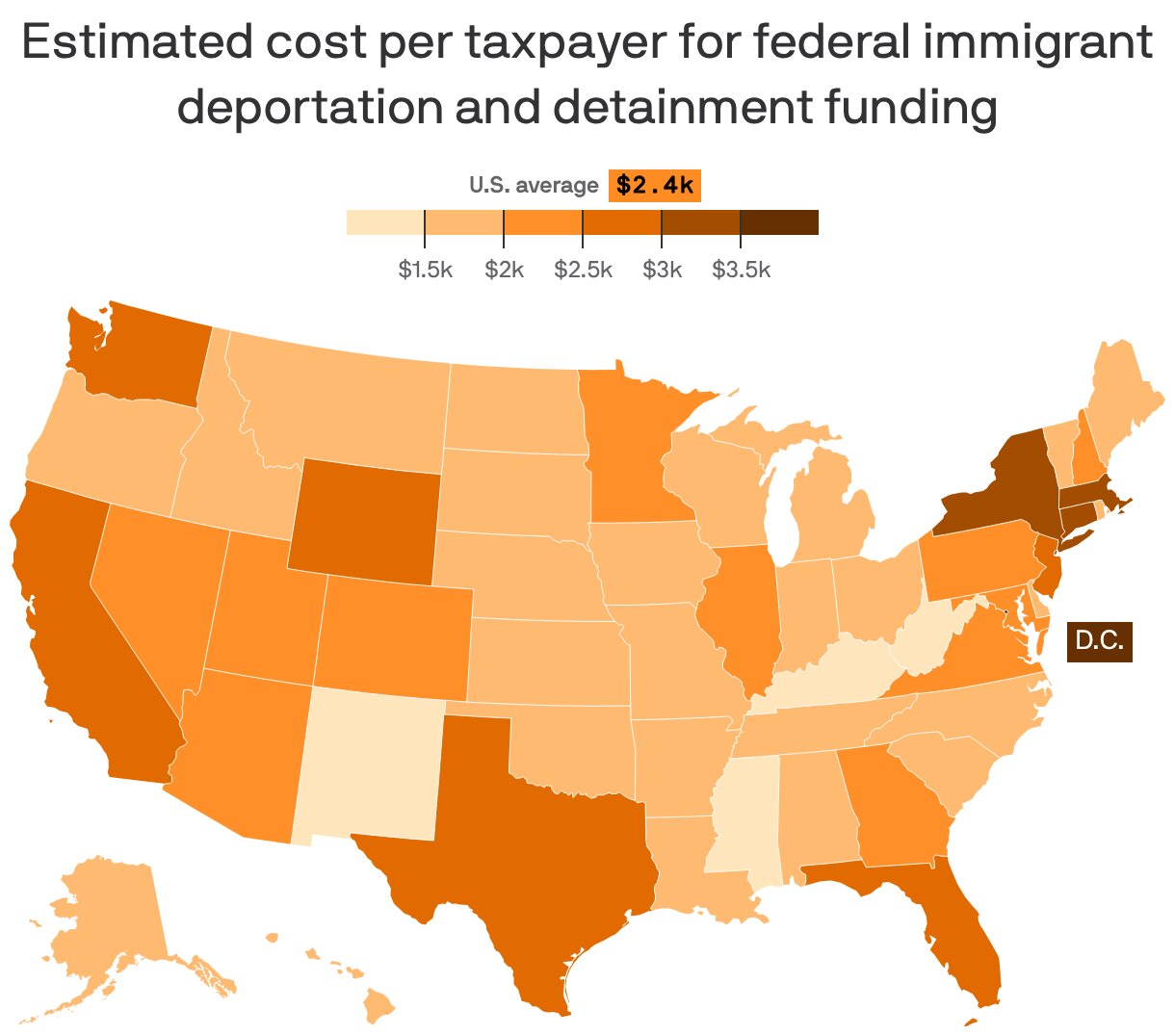
Data: Economic Policy Institute ; Map: Danielle Alberti/Axios
American taxpayers would pay about $2,358 each for President Trump's mass deportation push, according to a new calculator tool from the Economic Policy Institute.
Why it matters: The estimate fuels debate over whether billions of federal dollars devoted to deportations could instead fund other public priorities such as food assistance, health care or housing.
By the numbers: EPI estimates the $268.9 billion projected for deportations could alternatively fund more than 118 million additional SNAP recipients over the remaining 2.5 years of the Trump administration, based on National Priorities Project data.
Alternatively, nearly 12 million additional people could receive Medicaid .
Or, more than 9.7 million households could gain access to low-cost public housing .
What they're saying: "I don't think people realize how much money is being spent on these mass deportations," Gordon Lafer, a professor at the University of Oregon's Labor Education and Research Center and research associate at EPI, tells Axios.
"In almost every place in the country, there a lot of people who are struggling to not be hungry, to have affordable housing, kids are in overcrowded classrooms, people don't have health insurance, and those are the things that matter most."
"Instead, we're spending an unbelievable amount of money, chasing down, detaining, deporting people," he said, noting that most undocumented people lack criminal records . "It costs money that is desperately needed for other things in almost every community in the country."
The Department of Homeland Security did not immediately respond to Axios' request for comment.
Zoom in: EPI estimated each area's share of federal income taxes to calculate how much taxpayers in each state, county and city would contribute toward deportation spending.
Areas that contribute a larger share of federal income taxes would shoulder a larger share of the projected cost.
Washington, D.C., taxpayers could pay $3,930 each. That amount could instead fund SNAP benefits for 455,000 additional people, public housing assistance for 21,000 households or Medicaid coverage for 30,000 people.
In a small state like Connecticut, taxpayers could pay $3,395 per person. According to the analysis, that amount could alternatively fund SNAP benefits for 1.9 million Connecticuters, public housing assistance for roughly 181,000 households or Medicaid coverage for 186,000 people.sh
Yes, but: Taxpayers in states that contribute less in federal income taxes would pay less.
In West Virginia, for example, taxpayers could pay about $1,297 each.
That amount could instead fund SNAP benefits for 328,000 people, public housing assistance for 46,000 households or Medicaid coverage for 31,000 people.
Context: The $268.9 billion the administration is slated to spend over the course of Trump's second term on deportations is from a combination of money from the One Big Beautiful Bill Act , budget reconciliation bills, regular appropriations and other repurposed funds.
DHS previously told Axios in July that the government spends roughly $18,000 per non-voluntary deportation.
What's next: If Congress approves additional funding through the appropriations process or other avenues, total deportation spending would increase.
Go deeper: How Trump's "self-deportation" push has ramped up
AIPROPX is an independent multi-source news index — we track, compare, and connect coverage from across the web into one place you won't find anywhere else.