This is one outlet's own report from Forbes — the article as it was filed. Other outlets are covering the same event; open the full story to compare every source side by side.
Forbes contributors publish independent expert analyses and insights. David Kirichenko is a journalist focusing on war and technology. Follow Author Aug 09, 2026, 06:06am EDT --:-- / --:-- This voice experience is generated by AI. Learn more . This voice experience is generated by AI. Learn more . Summary Ukraine is racing to make its drones more autonomous as Russian electronic warfare makes traditional radio-controlled systems less effective. AI-enabled drones can navigate through contested environments and continue toward a target after losing their connection with an operator. Some systems are also becoming cheaper and easier for frontline soldiers to use. Ukrainian developers are now trying to scale the technology across the military while determining which systems actually perform reliably in combat. The result could push Ukraine's strike capabilities farther behind Russian lines and reshape how drones are used on the battlefield.
When Vladimir Putin launched his invasion of Ukraine in February 2022, he expected a quick victory rather than a prolonged war. Now, well into its fifth year, Russian soldiers struggle to advance through waves of Ukrainian drones across the fields of the Donbas. The character of the war has changed, as cheap unmanned systems increasingly dominate the battlefield, and the next contest is over autonomy.
Early in the war, Ukraine turned to first-person-view drones for reconnaissance before adapting them to drop explosives. Over time, the drones grew in range and capability. Ukraine also built a defense ecosystem capable of producing and procuring millions of drones.
For its part, Russia adapted to Ukraine's growing use of drones along the front by deploying electronic warfare systems at scale. Drones that rely on radio communications are vulnerable to jamming, disrupting the signals between the operator and the aircraft.
Starlink satellite communications have been a key advantage for Kyiv, providing reliable connectivity on the battlefield. However, their use is restricted to Ukrainian territory and not available for operations inside mainland Russia.
Bryan Pickens, a former U.S. Army Green Beret who fought in Ukraine, told me Russia pushes waves of infantry forward while holding key assets deep behind the front, protected by heavy electronic warfare. In the past, valuable targets were often located roughly 100 kilometers behind the front, a zone Ukraine lacked the ability to strike at scale until 2026.
"Anything radio-controlled is largely obsolete in those environments," Pickens said. "Autonomous systems or satellite communications enabled systems are the future."
Pickens added that AI navigation and autonomous targeting have made strikes against Russian forces more effective. "Technology needed to adapt," he said.
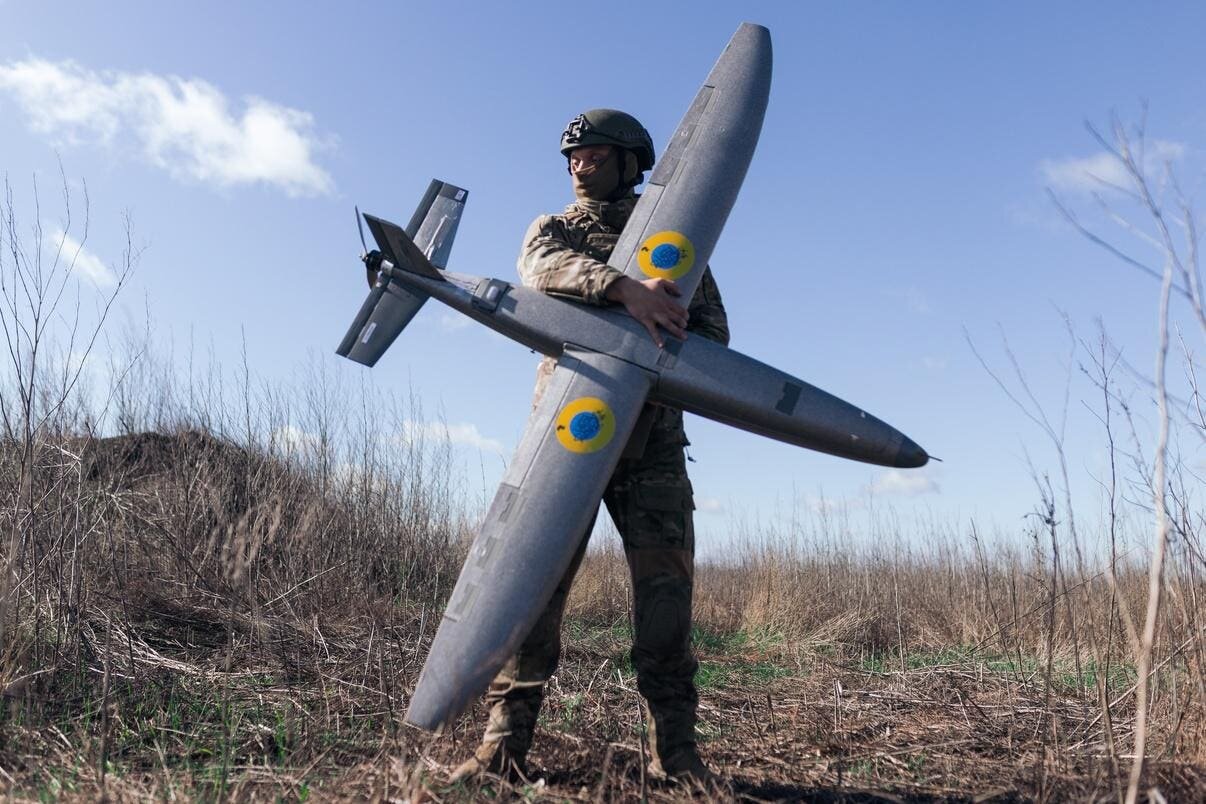
Among the drones Ukraine is using against Russian forces is the Hornet , an AI-enabled fixed-wing strike drone produced by Perennial Autonomy, a U.S. defense technology company founded by former Google CEO Eric Schmidt. The system reportedly costs less than $10,000 per unit and has become a key component of Ukraine's campaign against Russian logistics.
Other Ukrainian mid-range drones, including Darts, also use AI-enabled systems for guidance and targeting .
"The only effective drones are those that can fly autonomously on pre-planned routes and require only minimal human input in the final stage," said Pickens. He compared manually controlled first-person-view drones to muskets, while autonomous drones are the equivalent of rifled rifles. "We're moving toward a world where one operator programs 100 drones," he added.
These AI-enabled drones have already prompted Russian countermeasures.
Danylo Tsvok, head of the Defense AI Center A1, established under Ukraine's Ministry of Defense in March to help build an AI-driven military, told me, "The enemy has begun camouflaging its equipment to deceive our drones' computer vision systems." Ukraine responded by retraining its models on new data, specifically images of equipment using the new camouflage patterns.
“The future of warfare is a competition of operating systems,” said Tsvok. “The side whose system understands the battlefield better, draws conclusions faster and recommends action wins.”
Autonomous technologies help speed up the kill chain, improving target identification, while increasing strike effectiveness.
"Obi," a special forces operator from New Zealand serving in Ukraine's 3rd Separate Special Purpose Regiment, told me that Russian units try to conceal vehicles in trees, bushes, and under camouflage, but AI can identify targets that human operators might miss. "Once the target is locked, the operator can click exactly where they want the drone to hit."
Obi added, "Flying a Hornet is nothing like flying a traditional FPV drone, where precise stick control is required throughout the flight. With these newer systems, someone who is comfortable using a computer can learn very quickly."
Still, for Ukraine, the challenge is not just developing AI systems but making them widely available and standardized. "Units don't all have the same systems," said Pickens. "There's no universal operating environment."
Earlier in the war, many companies rushed to develop autonomous systems and sold upgrades to frontline units that often failed in combat, eroding trust in the technology.
Yaroslav Azhnyuk, founder of The Fourth Law, one of Ukraine's leading developers of autonomous defense technologies, is trying to solve both problems.
“Units that have tried other last-mile autonomy solutions often tell us they don't need autonomous targeting because previous systems didn't work well,” said Azhnyuk. “We then ask them to try our system. After a short demonstration, many immediately ask for large quantities because they can see the difference.”
AIPROPX is an independent multi-source news index — we track, compare, and connect coverage from across the web into one place you won't find anywhere else.