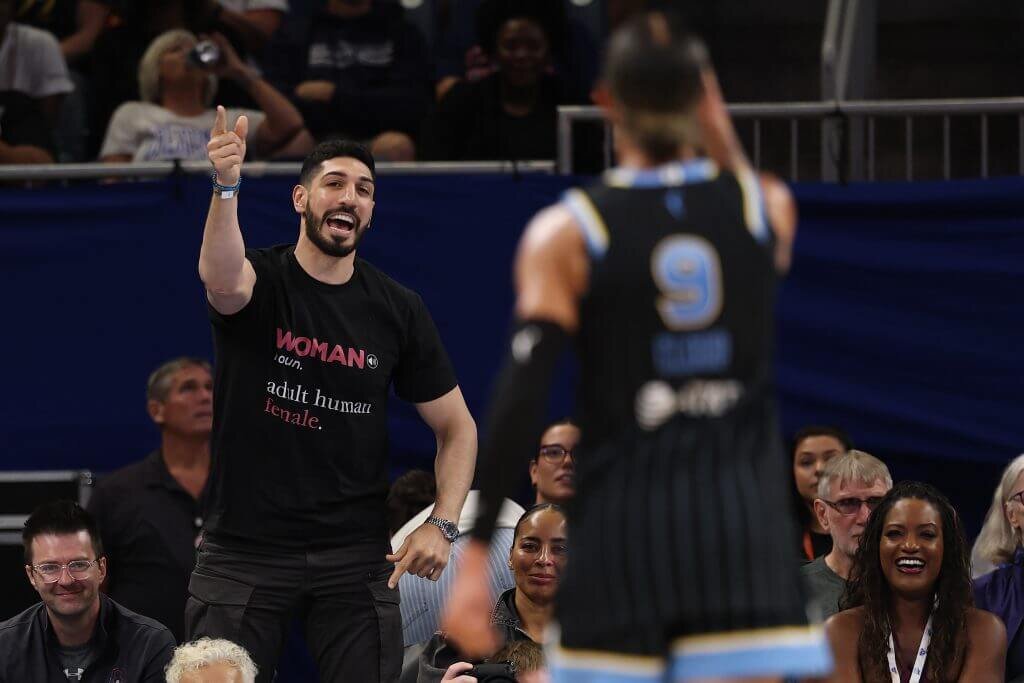
No surprise, Enes Kanter Freedom didn’t come to protect women. Freedom and women have been in conflict for a long time, in society and now in the actions of a man who made it his legal last name.
The former NBA player walked into Wintrust Arena on Sunday night with a T-shirt and a grievance to sell, dressing it up as concern for women’s sports. The shirt cloaking his 6-foot-10 frame read “WOMAN noun. adult human female.” That’s a slogan built for agitation and not conversation. He wore it into a building where actual women were about to play in a professional basketball league that women have spent 30 years building, acting as if their game needed his definition to fortify legitimacy. He wasn’t at the Indiana Fever-Chicago Sky game to defend women’s sports against transgender participation. He wasn’t there to support or persuade. He was there to be seen.
Freedom came to taunt. Freedom came to be ejected.
Freedom came to ring hollow.
He succeeded. He made a mockery of his supposed cause, but he got the attention he craved. Chicago guard Natasha Cloud, a genuine athlete activist, had enough in the third quarter. During a timeout, she hustled in the direction of Freedom and yelled what she thought of him, out loud and vulgar. Freedom stood up, spread his arms, barked back and took a step toward her. Then he let security do the rest, pulling his arms back behind him like a man under arrest as he was escorted out of the arena. He narrated his stunt in real time and posted online as quickly as he could, claiming he was kicked out for “supporting women.” Now, he’s appearing on any media platform willing to perform with him.
Former NBA player Enes Kanter Freedom was escorted out of Wintrust Arena on Sunday evening after Chicago Sky guard Natasha Cloud confronted him at his courtside baseline seat.
Late in the third quarter of a game between the Sky and the Indiana Fever, Cloud scored on a driving… pic.twitter.com/2CA4Awv6wO
— The Athletic (@TheAthletic) August 24, 2026
Cloud did not speak to reporters afterward, and she has posted just once about the incident, offering words of encouragement to the trans community. “You belong,” she wrote in her post. “You’re loved. You’re seen. You’re perfect as you are.”
The point isn’t to adjudicate the trans athlete debate based on whether you agree with Freedom or Cloud. It’s too nuanced and consequential to come down to a congeniality contest. But the faceoff and ensuing reactions underscore something that should not be dismissed. Cloud has a position, and she can shift from being heated to articulating her take with appropriate seriousness. The man self-named Freedom does not have an authentic take. He just has a tactic.
He’s here to play with all of our emotions, and it’s too bad we cannot regulate any of these feelings. A few weeks ago, he tried to declare himself eligible for the 2027 WNBA Draft, saying that he identifies as a woman. It’s not just a false claim; it’s a cruel one. Another former NBA player, Royce White, tagged along. Together, they’ve done real damage, misrepresenting trans people as cross-dressers, invalidating their humanity to make a joke. In their minds, they’re countering absurdity with absurdity. In reality, there’s no argument in their antics at all. They’re just two men who have realized that cruelty gets more views than conviction.
When the attention waned, Freedom showed up to one of Sophie Cunningham’s games, hoping to mooch off the fame of America’s new athlete face of trans resistance, wearing a shirt insisting that a woman is defined by biology alone. So he’s tried to define a woman twice this summer. Once, he included himself. Once, he excluded others. Both times, it was about him.
At 6-10 and 250 pounds, Freedom looks like an unfamiliar agitator. But he’s more like an avatar for an old sentiment. The notion of “protecting women’s sports” has been a man’s alibi many times before. While the circumstances are different throughout history, the objective is consistent: That phrase is used for permission to exclude.
Consider two examples. In 1967, a Boston Marathon official named Jock Semple spotted a 20-year-old runner, Kathrine Switzer, mid-race and decided she didn’t belong. He grabbed her and tried to tear off her bib. The sport’s governing body didn’t respond by investigating what Semple did to Switzer. Instead, it wrote a new rule banning women from racing against men. You know, to protect them. Four decades earlier, at the 1928 Olympics, officials decided after an 800-meter final that the distance was too dangerous for women. Why? Because of reports of runners collapsing post-race that footage later proved to be exaggerated. The event didn’t return to the Olympics for 32 years.
Don’t compare the issues. Just look at the eerily, lazily similar mindset. It’s a new century, but the playbook remains: With ulterior motives, men decide what women need protecting from, and what follows is never protection. It’s disruption disguised as concern, and that leaves women worse off than before the so-called protector arrived. If the trans athlete debate were an organic, fully woman-led controversy, it could have prompted meaningful conversation, empathy in the pursuit of solutions and thoughtful measures taken after an extended process. But this is a runaway train that men with extreme right-wing views pointed in the direction of the sports world to manufacture panic and gain political capital.
Their methods have resulted in 27 states enacting laws and two more implementing state policies that restrict or ban transgender youth from participating in school sports consistent with their gender identity. Several American sports organizations have changed their eligibility standards because of pressure from the Trump administration. This has all happened in the past six years, and the majority of movement occurred in the first three years of that window. Yet the trans culture war persists.
Freedom isn’t some new champio...