This is one outlet's own report from Gizmodo — the article as it was filed. Other outlets are covering the same event; open the full story to compare every source side by side.
On Monday, the chip giant announced that it was forming a coalition called the Open Secure AI Alliance, defining it's purpose as "to develop and share open technologies, techniques and tools to safeguard software and agents in the age of AI." The coalition will aim to support the proliferation of open-weight AI models, which is something that Nvidia has championed for some time now . Besides Nvidia, other inaugural members of the coalition include Palantir, Microsoft, OpenClaw, Salesforce, and SpaceX.
Some of those companies were also the co-signatories of a letter supporting open-weight models and cautioning against "premature" government restrictions that could "stifle competition or drive innovation overseas."
The discussion over open versus closed AI models and who gets to control the technology has been renewed in the last couple weeks. First, Chinese AI lab Moonshot stirred the pot by releasing Kimi K3 , a new open-weight model that ranked higher than most of its American peers in several benchmarks. Anthropic has accused several Chinese open-source model providers , including Moonshot of violating its rules by "illicitly" extracting the capabilities of its closed-source models to then build their own open-source models, prompting the Trump administration to threaten sanctions .
Then, Hugging Face got hacked by an OpenAI agent gone rogue, an incident that has gotten some members of Congress asking that AI models now come with an emergency kill switch .
After the attack, Hugging Face said that they couldn't use any closed-source models to defend themselves, because of their cybersecurity work restrictions. The closed models were unable to distinguish attackers from defenders, the company claimed. Instead, Hugging Face had to resort to a Chinese open-source model.
"The recent Hugging Face security incident delivered a clear reminder: cyber defenders need open, frontier agentic systems for self-defense," Nvidia said in a release. "Companies and governments should invest in shared open infrastructure for AI defense — datasets, evaluation frameworks, attack simulators and red-teaming tools — much as past generations invested in open source software."
For its part, Nvidia said it would be contributing " open models, model weights, data and new agent harness research" to the new coalition.
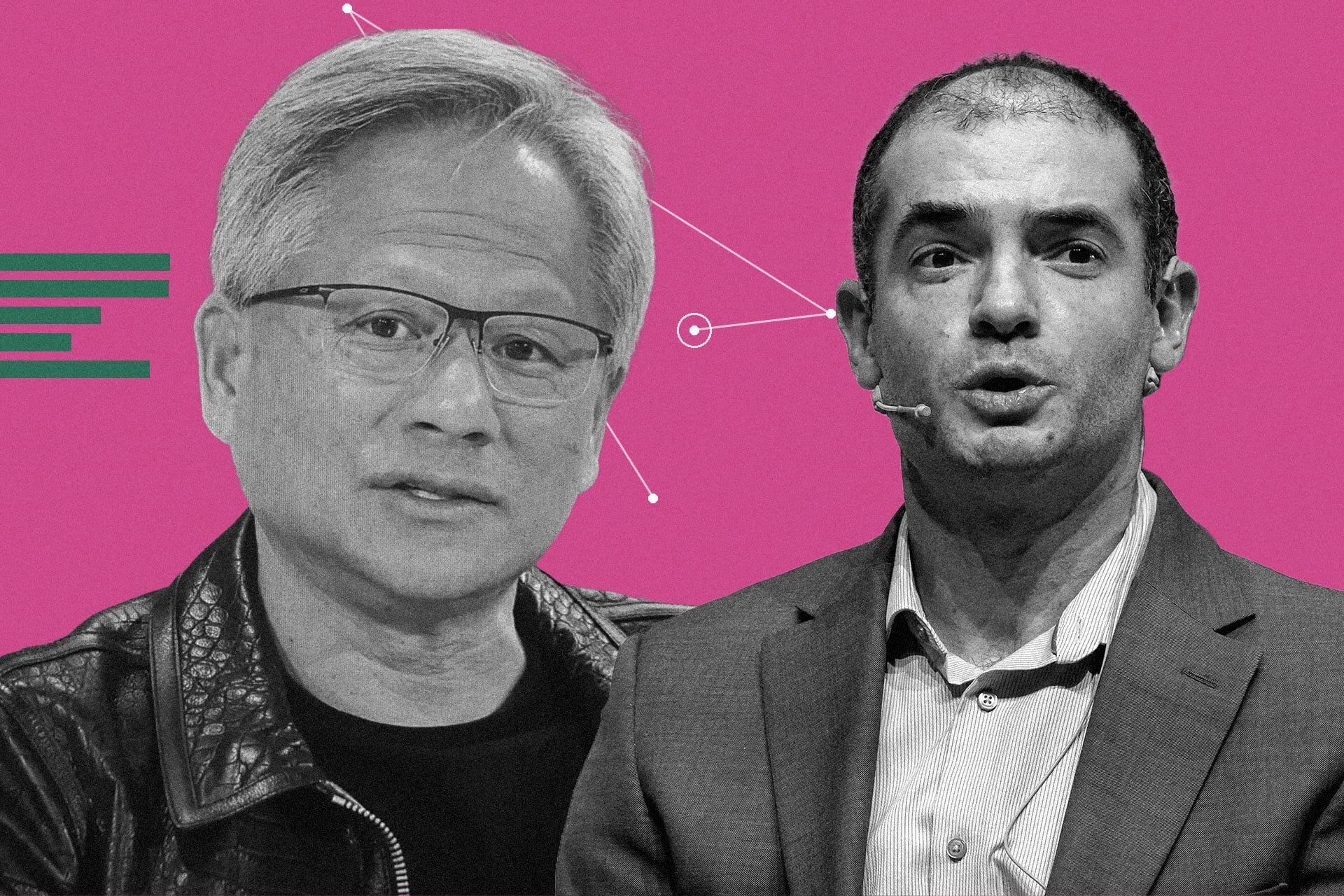
But for all its steadfast belief in open source models, Nvidia can't seem to let go of the allure of AI models developed under top secret conditions. Also on Monday, the chipmaker announced that it was entering a long-term partnership with Safe Superintelligence Inc. (SSI), the startup launched by former OpenAI chief scientist Ilya Sutskever.
Sutskever co-founded SSI in 2024, after he left OpenAI following the failed ousting of CEO Sam Altman . The startup is dedicated entirely to building "safe superintelligence," aka a theoretical type of AI that would outperform human intelligence on all fronts, albeit in this case with "safety guardrails," though it's not clear what those guardrails would be. Sutskever's company operates under total secrecy, with a straight-to-the-point mission, an even straighter-to-the-point website to accompany it, no plans to release a product , and only two offices, one in Silicon Valley and the other in Tel Aviv.
Under the partnership, Nvidia announced that it would not only give SSI access to its Vera Rubin platform, but it would also make a "substantial investment" in Sutskever's company.
“We have research that is worthy of scaling up, and having access to a big Nvidia computer will let us do so,” Sutskever said in a press release. “We’re incredibly proud to be partnering with Jensen and the NVIDIA team, and we are confident that our big bet on the Vera Rubin platform will take us to the next level.”
The investment in Sutskever's company also comes alongside more investment news from the chip giant. Over the weekend, Nvidia announced a $500 billion deal with South Korean chipmaker SK Hynix. Then, on Sunday, the Wall Street Journal reported that Nvidia was in talks to help finance OpenAI's massive data center project on federal land in southern Ohio in a roughly $250 billion deal. If Nvidia goes through with the reported investment, it would make the data center project the largest one announced to date, and when completed, would require enough energy to power millions of homes, WSJ said.
Nvidia's investments come at a rather precarious time for the AI industry. With mounting financial commitments , but limited immediate returns, many analysts and investors are second-guessing the necessity of this spending, and fears over a potential AI bubble continue to fester.
Those fears were first brought to the spotlight late last year after experts started warning that the AI industry had woven a potentially dangerous tangled web of circular dealmaking , where a handful of companies with overlapping interests were inking multibillion dollar investments amongst each other, with OpenAI and Nvidia at the center of these deals. Perhaps the most high profile of those deals was a $100 billion deal between OpenAI and Nvidia, a number that was eye-watering at the time but is dwarfed by the $250 billion reported by the WSJ. The $100 billion investment was announced in September but has failed to materialize still and reportedly never will .
AIPROPX is an independent multi-source news index — we track, compare, and connect coverage from across the web into one place you won't find anywhere else.