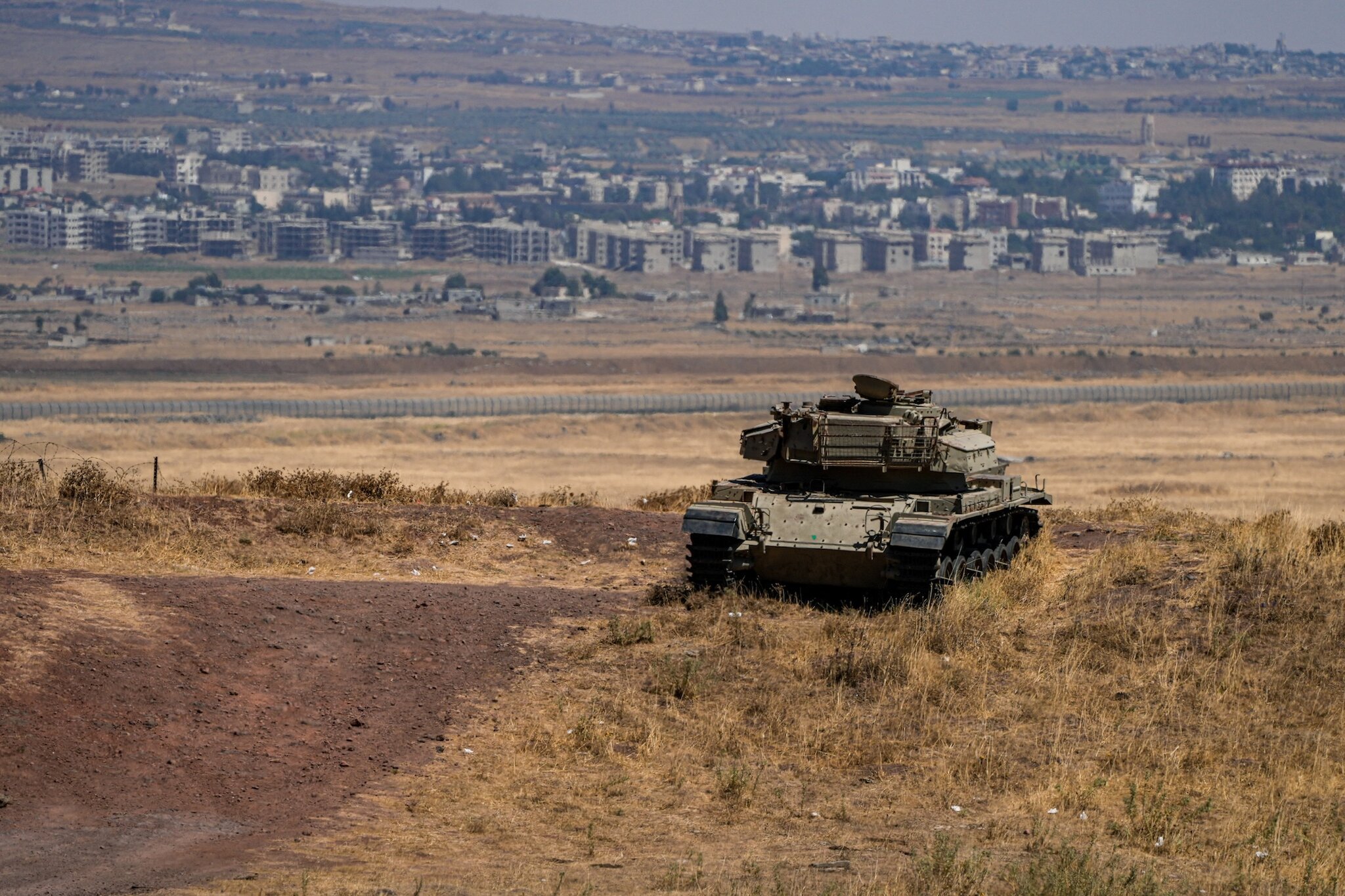
The Israeli military bombed an airbase in Syria, far from the Israeli border, sparking condemnation not only from Syria, but also Turkey and the Trump administration. U.S. Ambassador to Turkey Tom Barrack accused Israel of an "unnecessary escalation that does not advance regional stability." Nick Schifrin spoke with Barrack to discuss the tensions. Amna Nawaz: Much of the world's attention has been focused on the stalemate in the U.S.-Iran war. Meanwhile, elsewhere in the Middle East, tensions are mounting between U.S. allies, Israel and Turkey in the once hotbed of civil war, Syria. Nick Schifrin has more. Nick Schifrin: Turkey and Israel are two of the U.S.' most important allies in the region. The strike exposes their increasing tension, with Syria caught in the middle. It was overnight Monday when Israeli warplanes bombed the Abu al-Duhur Air Base. Those circles are craters made by Israeli bombs on the runways. The air base is about 45 miles from the Turkish border, 180 miles north of Israel. At first, Israel did not claim responsibility. But then U.S. Ambassador to Turkey Tom Barrack, who is also U.S. special envoy to Syria, wrote on X: "The confirmed Israeli airstrikes on Abu al-Duhur Air Base constitute an unnecessary escalation that does not advance regional stability." After that, Israel acknowledged the strike. And Israeli Prime Minister Benjamin Netanyahu said he was trying to prevent a Turkish troop deployment. Benjamin Netanyahu, Israeli Prime Minister (through interpreter): We saw that Turkey intends to establish a presence in the airport south of its current lines. So we conveyed a message. The message went through, but it seems that they did not listen. And so we made sure that they understand it better. Nick Schifrin: And, today, the rhetoric only increased. Netanyahu called Turkish President Recep Tayyip Erdogan a -- quote -- "antisemitic dictator," a statement that Erdogan's office called a -- quote -- "cheap political ploy aimed at gaining an advantage for Bibi himself in the upcoming elections." So to talk about this, I welcome Ambassador Tom Barrack. Thank you so much, Ambassador. Appreciate it. Welcome to the "News Hour." Why is this moment so important to the Trump administration? Why'd you publicly call out Israel's strike? Why are you talking about it to me today? Tom Barrack, U.S. Ambassador to Turkey and U.S. Special Envoy to Syria: It's important to the Trump administration because President Trump has engaged in a new kind of Middle East regional program. We want all of the different regional partners to start usurping their own responsibility. The answer to all this is, lower the temperature, increase the dialogue, increase the discourse, and avoid these -- abrupt kinetic action. The long and short of this is that the mistake that was made was not miscommunication. Israel had thought that they had had a tacit agreement with Syria and a discussion with Turkiye of saying, guys, after October 7, everything has changed. We, Israel, want a clear line of sight between us and Iran, and we are really encouraging you not to put defensive or offensive military equipment or people between us. Nick Schifrin: I spoke to multiple Israeli officials today, and they make a few arguments. One, they attack Erdogan personally, as you know. Two, post-October 7, they argue that they will not trust Turkish or Syrian troops anywhere near their border. And, as you said, there's an agreement between Israel, Syria, and Turkey to maintain the status quo, and the Turkish move into this base broke that status quo, they warned against it, they're enforcing their red line. What do you say to that argument? Tom Barrack: I would say I understand their point of view. They have communicated that point of view. I don't think any of the other parties agree. I know that they don't agree that there is a definitive agreement to that effect. There's a tacit understanding that that is what Israel communicated, and we understand why they communicated it. So what happened here was not a miscommunication. They had communicated to us and to the Syrians. The problem here is -- which has already been reported, the director of Mossad, who's also a very good professional, had engaged in a back-channel discussion with the prime minister, the foreign minister of Syria on Friday. They had had a discussion about this. Israel had told us for a preceding five days they were concerned about what was going on. We went to our intelligence agencies. Syria talked to Mossad, gave them the information that there were no Turkish military, there was no Turkish convoy, there were no Turkish armaments, and that there was nothing adversarial or offensive going on. That was on Friday. They were supposed to meet again the next week. The Syrians, the Americans all thought that was going to be a continued dialogue. We had set up a fusion cell if they needed to keep discussing it. And something went awry, and Israel decided that they needed to bomb the craters on two runways. The problem with this is, Turkey did not know it was coming. So the real issue here is, without notice to a country like Turkey that has a powerful military, a forcible air force, a difficult political rhetoric between Israel and Turkiye -- by the way, in my opinion, it's mostly politics. But it came 80 kilometers to their border without notification Israeli jets. Nick Schifrin: But it sounds like your message here, you're coming on here to send the message that you understand Israeli concerns, but you are concerned about how Israeli communicated leading up to this strike. Tom Barrack: Yes, I mean, I think every -- I think everybody's concern is that there was some miscommunication, because they had been communicating their concern, which as they should, and it was being received and dealt with, as it should. But the attack was unannounced. It's all a matter of, let's bring this back to a table where you can all sit down and talk. That you're going to have...