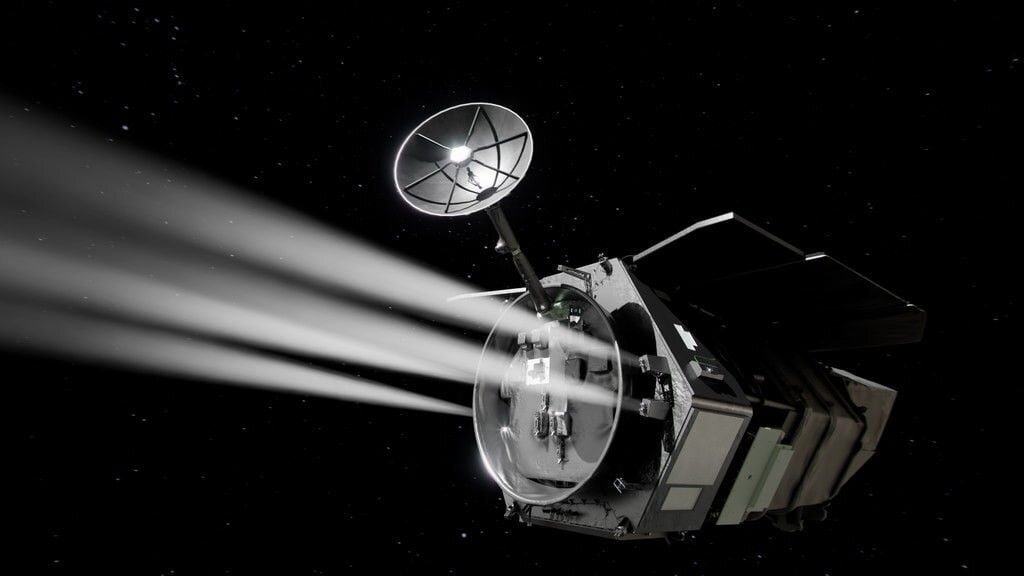
NASA 's new Nancy Grace Roman Space Telescope is headed to its frigid space outpost, where it is expected to gather unprecedented data on some of the universe's biggest mysteries.
Over the next few months, mission controllers will guide it out into deep space, deploy its hardware, test every system, and tune its vision before it begins major infrared observations of the cosmos.
Following a successful launch on Sunday, Aug. 30, Roman is now flying to a point about 1 million miles from Earth, similar to where the James Webb Space Telescope operates. It will spend roughly three months checking out its systems and instruments before NASA releases its first images in early 2027.
SEE ALSO:
NASA's Roman telescope is built to find what Hubble and Webb miss
First hours after launch
Right after Roman separated from its SpaceX Falcon Heavy rocket, several maneuvers happened quickly:
The spacecraft turned so its solar panels faced the sun to give it power.
Mission teams on the ground switched on and checked basic systems, like power and communications.
Near the end of the first day, Roman fired its engines to fine-tune its trajectory toward its final destination in space.
That location is called the second sun‑Earth Lagrange point , or L2. It's a spot in space where the gravity of the sun and Earth, plus Roman's motion, allows the telescope to maintain a steady position as it orbits the sun .
100‑day trip to deep space
Roman's cruise to get to L2 takes about 100 days. During that time, controllers do more than just wait for the spacecraft's arrival:
They unfold side panels and a sunshield, which help protect the telescope from heat and light.
They deploy a large antenna that Roman will use to transmit scientific data back to Earth.
They test the spacecraft's systems one by one — power, steering, data handling, and engines — to make sure everything works in space as it did in the lab.
"We look at it all with a fine-tooth comb," said Jeremy Perkins, Roman's integration and test scientist. "The people that built and tested and delivered Roman are the same folks that are going to make sure it's working as we expect it to on orbit."
As Roman travels farther from Earth, it passes beyond the moon's orbit and settles into a looping path around the L2 point.
Under the hood, Roman is about the size of a tour bus and as heavy as a male killer whale.
Credit: NASA’s Goddard Space Flight Center infographic
Opening the telescope and turning on the cameras
On the way out and near L2, the team starts to wake up the science gear:
They open a protective cover so the telescope can see the sky.
They power on the Wide Field Instrument, Roman's main camera, which takes sharp, panoramic pictures in infrared light.
They turn on the Coronagraph Instrument, a special device that tries to block starlight inside the telescope so it can spot nearby faint planets.
At this stage, Roman takes test images. Engineers use these early pictures to check focus, sharpness, and pointing. If the team chooses, they may release some of these images publicly on NASA's mission blog .
Three‑month checkout and tweaking
Fortunately, the team doesn't have to wait for Roman to arrive at L2 before it begins commissioning, that three‑month checkout period. That work can overlap with the journey, said Julie McEnery, Roman's senior project scientist.
"We can start our science operations before we've actually inserted into our orbit," she said. "You can expect ' first light ' sometime before the beginning of next year."
The three-month commissioning phase will overlap with the spacecraft's flight to the second sun-Earth Lagrange point, or L2.
Credit: NASA’s Goddard Space Flight Center infographic
During this time, teams will:
Measure how sharp stars look, then adjust the telescope to bring them into the best focus possible.
Repeat test observations to see if the telescope behaves the same way each time.
Check how dark and stable the telescope is, which is crucial for spotting the heat of very faint galaxies and tiny changes in starlight.
Practice sending and receiving large amounts of data, building up to about 1.4 terabytes of science data per day — far more than Hubble ever sent.
Scientists also run small "practice surveys" on limited areas of sky. These rehearsals make sure Roman and its software can handle the full‑size surveys planned for the main five-year mission.
"We're using this early time, this commissioning time, to shake out all the techniques, to find the gotchas, find the bugs, and basically do the early calibrations we need to do so that we're ready when the torrent of data starts," Perkins said.
First images and the start of the mission
Once Roman passes its early tests and calibrations, NASA plans to release the first glamor shots in January 2027. These pictures will highlight what Roman does best, such as:
The Roman Space Telescope will orbit the sun 1 million miles away from Earth so that the planet's atmosphere doesn't obscure the view.
Credit: NASA’s Goddard Space Flight Center infographic
Wide views packed with distant galaxies will help map how matter is distributed across the universe.
Dense fields of stars near the center of the Milky Way, where Roman will later search for brief brightening events that reveal hidden planets.
After the checkout phase, Roman moves into its five‑year primary mission, rotating through three main tasks:
Mapping more than a billion galaxies to study dark matter and dark energy.
Watching the same patches of sky over and over to catch changing events like exploding stars.
Staring toward the crowded center of our galaxy to find planets, including free‑floating "rogue" worlds that don't orbit a star.
Roman carries enough fuel for at least those first five years. Engineers also built it so a future mission could refuel it in space, which could keep t...