The 2026 Dutch Grand Prix was shaping up to be a Silver Arrows masterclass, but the race quickly unraveled into a frantic exercise in damage limitation. After initially looking like the favorites to secure the victory at Zandvoort, Mercedes suffered a sudden and mysterious drop in pace, ultimately handing the win to McLaren’s Lando Norris while forcing the Brackley pit wall into a highly stressful late-race position swap.
Speaking to Sky Sports F1 after the checkered flag, Mercedes Team Principal Toto Wolff broke down the dual crises that derailed their Sunday strategy.
Zandvoort’s abrasive asphalt and sweeping banked corners are notoriously brutal on Pirelli rubber, heavily punishing any car that falls out of its optimal thermal operating window. However, the suddenness of Mercedes’ drop-off caught the entire garage off guard.
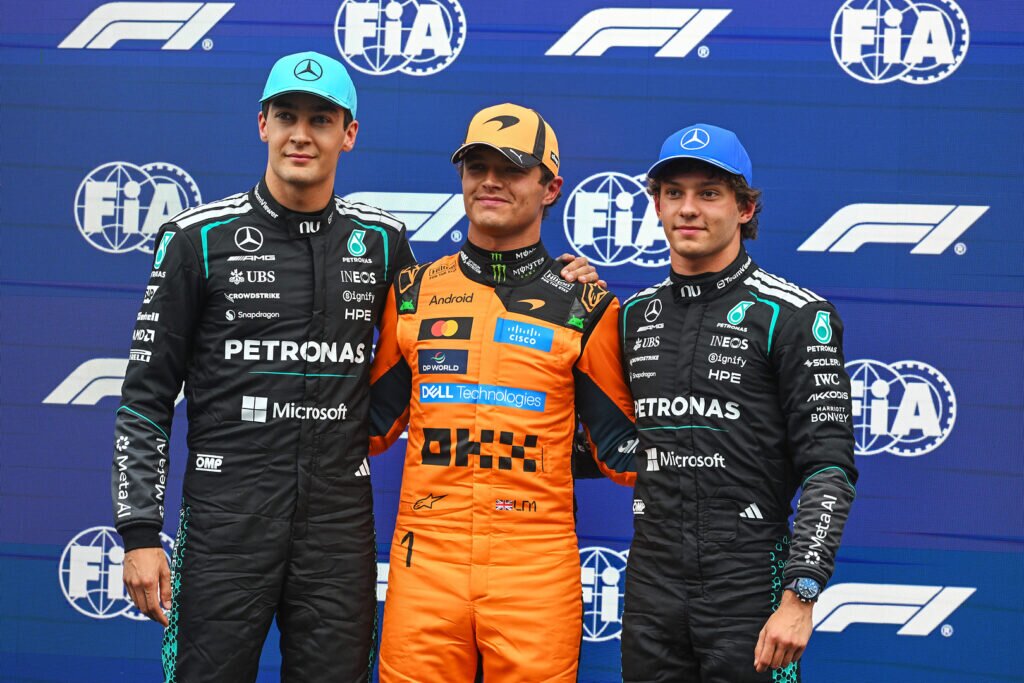
Dutch Grand Prix, Saturday ZANDVOORT, NETHERLANDS – AUGUST 22: Pole position qualifier Lando Norris of Great Britain and McLaren Second placed qualifier George Russell of Great Britain and Mercedes AMG Petronas F1 Team and Third placed qualifier Andrea Kimi Antonelli of Italy and Mercedes AMG Petronas F1 Team look on during qualifying ahead of the F1 Grand Prix of Netherlands at Circuit Zandvoort on August 22, 2026 in Zandvoort, Netherlands. (Photo by Rudy Carezzevoli/Getty Images) Wolff admitted that the team is still searching for answers in the telemetry as to why their commanding speed vanished in the final stint.
“It seemed like we had the pace to win the race, but then, for reasons that aren’t clear, we lost a lot of performance in both cars, probably even more in Kimi’s , and then we couldn’t hold the position ahead of Norris,” Wolff explained.
Once Norris broke the DRS threat and checked out at the front, Mercedes was suddenly thrust onto the back foot, transforming a race for the win into a desperate fight for survival.
Mercedes’ Championship Safety Play
With Antonelli suffering a more severe drop in pace than his teammate, and two Ferraris hunting them down on much fresher rubber, the Mercedes pit wall had to intervene. They executed a late-race position swap, shuffling George Russell ahead of the struggling championship leader.
When asked if the swap was a desperate bid to catch Norris, Wolff immediately shut down the notion, confirming it was purely a defensive maneuver to protect against the looming Ferrari threat.
Nov 21, 2024; Las Vegas, Nevada, USA; Mercedes AMG Petronas team principal Toto Wolff arrives for practice for the Las Vegas Grand Prix at Las Vegas Circuit. Mandatory Credit: Gary A. Vasquez-Imagn Images “No, I don’t think Norris was anywhere near being caught,” Wolff stated flatly. “It was simply the safest way in terms of points.”
While some fans questioned why Mercedes didn’t simply let Antonelli use his engine’s overtake mode to defend himself, Wolff emphasized that the margin for error was non-existent. Over-stressing the power unit or cooking the rear tires during an intra-team battle could have easily resulted in a catastrophic double-overtake from the Scuderia.
“Maybe you could have left Kimi in overtake mode, but, again, that would have been too risky. You had two Ferraris right behind you,” Wolff noted.
The Cost of a Title Fight
Ultimately, securing second and third on a day when the car lost its ultimate pace is exactly how championships are won. Wolff made no apologies for the conservative call, viewing it as a necessary evil in the high-stakes 2026 title fight.
“So, yes, they were some tough decisions, but they need to be made when you want to fight for the constructors’ championship and the drivers’ championship,” he concluded, calling the double-podium finish an act of vital “damage limitation.”