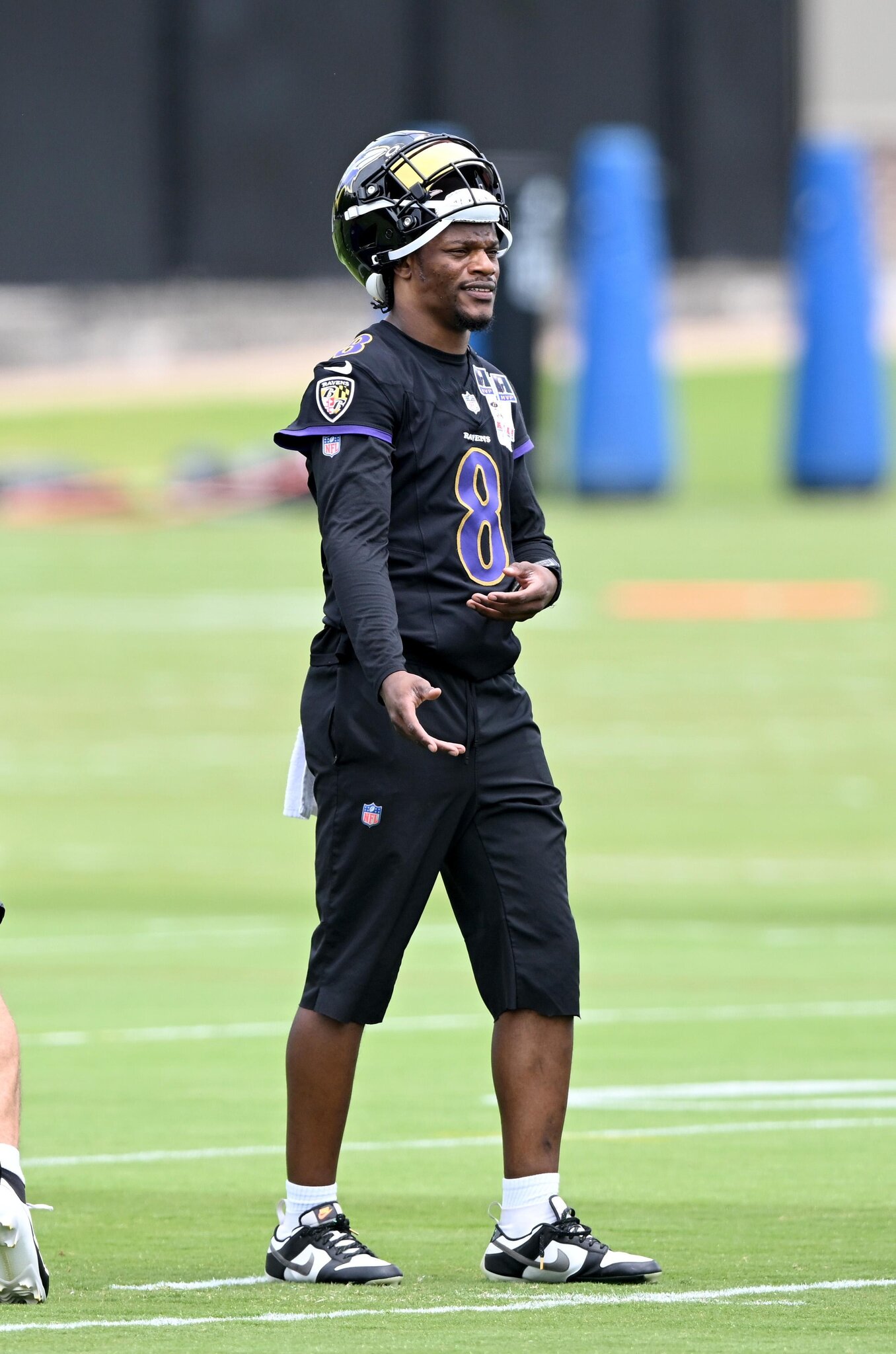
OWINGS MILLS, MARYLAND - JUNE 09: Lamar Jackson #8 of the Baltimore Ravens looks on during Baltimore Ravens Mandatory Minicamp at Under Armour Performance Center on June 09, 2026 in Owings Mills, Maryland. (Photo by Greg Fiume/Getty Images) | Getty Images
Welcome back to Baltimore Beatdown’s special series on Lamar Jackson, written by former Ravens Super Bowl champion Femi Ayanbadejo. Part One examined the narrative amnesia surrounding Jackson’s career. Part Two tested criticism of his play against the film and data. Part Three examined unsupported narratives surrounding his contracts, character, and off-field decisions. Part Four asks the final question: Where does Jackson’s legacy go from here?
Critics underestimated Lamar Jackson’s ability to play the quarterback position. Some underestimated the processing behind his athleticism. Others manufactured narratives from his silence or attacked his character without verifiable evidence.
Even now, it does not cease.
Win one Super Bowl and the conversation will shift to whether Jackson needs two to stand beside Patrick Mahomes. There will always be another comparison, another threshold.
Narrative Amnesia, in Real Time
On the eve of Baltimore’s first preseason game, the pattern surfaced again.
ESPN analyst Dan Orlovsky ranked the NFL’s starting quarterbacks across seven individual traits: arm strength, ball placement, mechanics, decision-making, pocket presence, second-reaction ability and rushing ability. Jackson was the only quarterback to appear in the top 10 in all seven categories.
That should establish him as the position’s most complete player. Instead, the individual rankings reveal the same lingering resistance to fully crediting what he has become.
Jackson ranked no higher than sixth in any category except for rushing, where he (of course) led the pack. Once again, his full complement of quarterbacking skills are discounted. His legs continue to carry the burden.
This is not an accusation of bias or bad faith. Orlovsky based his rankings on current performance and expectations for 2026, and Jackson’s injury-disrupted 2025 season belongs in the evaluation. But the rankings still illustrate the central argument of this series: Jackson’s evolution is recognized in the aggregate and understated in the details. His completeness is acknowledged while his mastery is discounted.
That is narrative amnesia in real time.
But one ring would settle one question permanently. It would invalidate the categorical claim that Jackson’s style cannot win a Super Bowl. Not every criticism would disappear, but one of the loudest would be rendered obsolete.
I believe that championship is coming. That is my projection, and I am putting it on the record.
What He Has Already Changed
Few quarterbacks have expanded the accepted prototype of the position as dramatically as Jackson. He did not invent dual-threat football, but he stretched its possibilities. He became a unanimous MVP while leading the most productive rushing offense in NFL history, then won another MVP after assuming greater responsibility in a more expansive passing system.
His influence is visible below the NFL. At flag football games, children wear number 8, make off-platform throws, run, cut and play with a freedom that mirrors him. Boys and girls can imitate his creativity even if they cannot reproduce the speed. His game makes exceptional football feel accessible.
Greg Cote argued that without a ring, Jackson’s career could be remembered alongside Dan Marino’s: historic individual production without the ultimate team accomplishment. The comparison was intended as a warning, but it also establishes an extraordinary floor. Marino is a Hall of Famer and one of the greatest quarterbacks ever. Jackson is still just 29 years old.
His legacy is already significant. It remains unfinished.
Faith, in His Own Words
After winning his first MVP, Jackson credited God: “I give Him all His praise, the glory, the honor.” Years later, his message remains the same.
When asked about his legacy in June, Jackson said: “I really don’t think about my legacy. I just try to be the best player I can be, keeping God first. Probably when I start thinking about retiring, I’ll probably be thinking about that, but not now.”
Those statements establish what Jackson has chosen to make public: Faith is central to how he discusses success, and present work matters more to him than public legacy debates. Anything beyond that is interpretation.
His observable pattern is restraint. He rarely litigates every criticism, and when he responds, he usually does so briefly.
In July, Jackson reposted a prayer about releasing what cannot be controlled and trusting God with what lies ahead. Considered alongside his repeated public statements about keeping God first, it supports a careful conclusion—not certainty about his private thoughts—that his faith appears to help him separate effort from outcome.
He can pour himself into preparation while entrusting what he cannot control to God’s will. That is not passivity. It is a framework for competing fully without pretending that any player controls every result.
The Physical Peak and the Ascending Mind
That restraint is sometimes labeled mercurial or immature. The public evidence supports a simpler reading: Jackson communicates on his own terms. Silence is not proof of instability, and unconventional communication is not evidence of deficient leadership.
Jackson may be at or near his physical peak. That does not mean he has reached his peak as a quarterback.
The position rewards accumulated recognition: anticipation, protection control, coverage identification, situational judgment and the ability to create answers before the snap.
Tom Brady at 35 was more complete than Brady at 27. Peyton M...