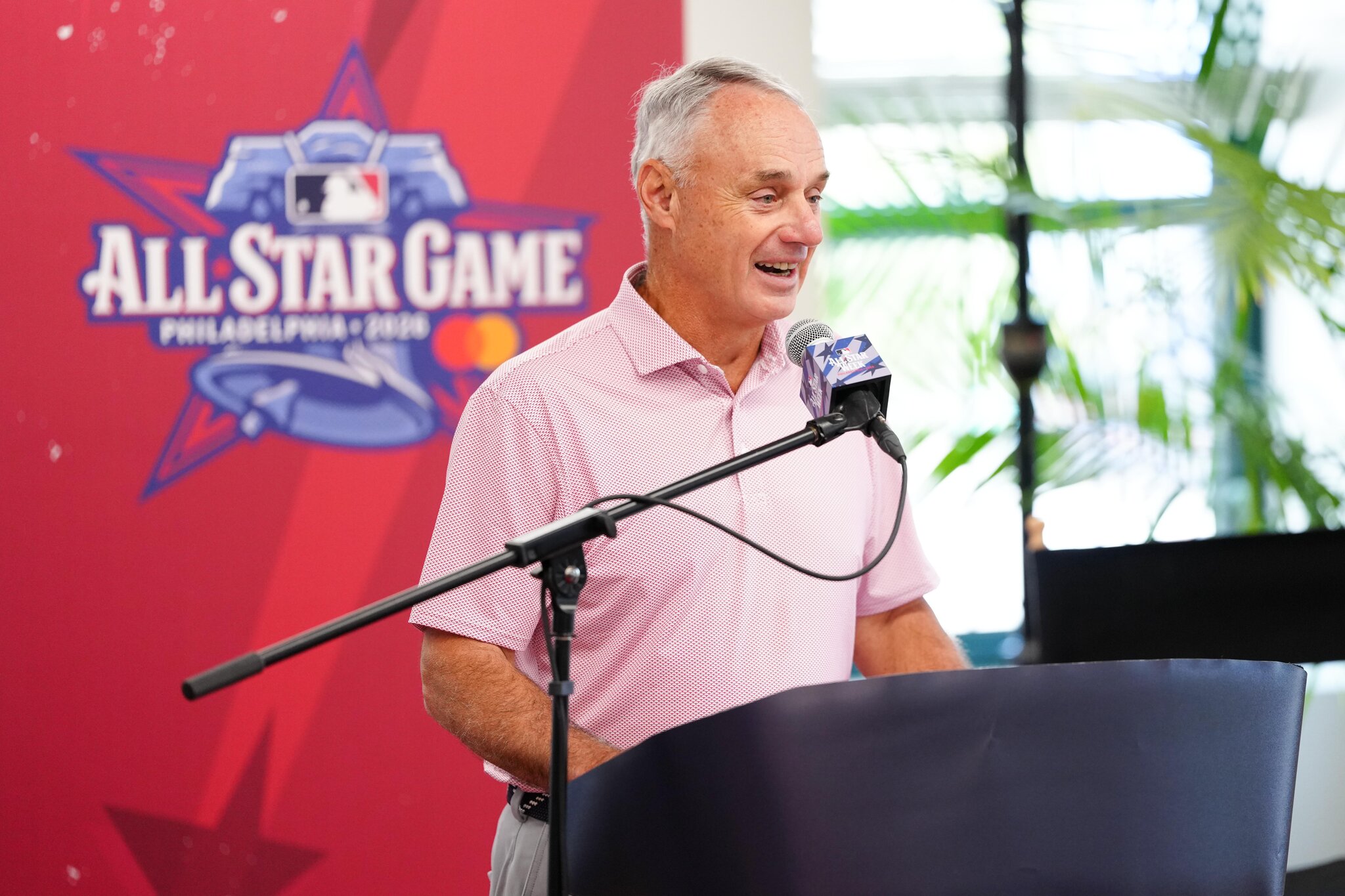
PHILADELPHIA, PA - JULY 13: Commissioner of Major League Baseball Robert D. Manfred speaks during the 2026 All-Star Legacy Veterans Multi-Service Center renovation at Veterans Multi-Service Center on Monday, July 13, 2026 in Philadelphia, Pennsylvania. (Photo by Daniel Shirey/MLB Photos via Getty Images) | MLB Photos via Getty Images
Major League Baseball’s collective bargaining agreement expires on 11:59 p.m. ET on Tuesday, December 1, and the owners will almost certainly lock out the players the moment the CBA expires, just as they did in December 2021 before eventually coming to an agreement in March 2022.
This time around, a salary cap and competitive balance have been the driving forces behind the owners’ talking points, in both the foreground and background of their known offers to the players. That was the case on Thursday, when MLB owners proposed the idea of a quiet period for signings, limiting free agent movement to only a few weeks in December. From Ronald Blum of Associated Press :
MLB proposed extending the quiet period until noon Eastern on the Monday of the winter meetings, usually held in early December. Management said the additional time would be needed for revenue and salary cap figures to be finalized ahead of the business season.
MLB would allow negotiations during the quiet period but would not permit any contracts to be finalized.
Free agents could sign through 5 p.m. Eastern on Dec. 21 and then wouldn’t be allowed to until noon Eastern on the first Monday in February, just ahead of spring training.
Another aspect of the league’s proposal included a tweaking of the injured list, instead of the current 10-day stint for position players and 15 days for pitchers. From Evan Drellich at The Athletic :
The current 10-day minimum stay for position players would be replaced with a one-week designation, and the 15-day pitcher injury list would become a two-week designation.
But that doesn’t mean “seven days” and “14 days,” respectively. Instead, teams would have to count Mondays.
Position players would have to stay on the IL for at least one full Monday-to-Monday span, with pitchers spanning two of those stretches.
For example: If a position player goes on the IL on Wednesday, he still has to stay on the IL for the entirety of the following week, Monday-to-Monday.
The 60-day injury list would change to 12 weeks and would still free up a 40-man roster spot.
While active rosters would still be capped at 26 players, teams could carry 14 pitchers, up one from the current allowance.
Also from last week, Drellich at The Athletic answered many labor questions in a mailbag .
That every MLB proposal thus far has been contingent on the players accepting a salary cap and floor shows that the negotiations won’t get serious until after the owners lock out the player in December, writes Marc Normandin of Baseball Prospectus :
Would it be wonderful if there was less sitting around and more player transactions during the offseason, with the bulk of them happening sooner than later? Absolutely—making players wait until the spring to sign isn’t great for whatever excitement the league is trying to generate, or the players who still don’t know where they are going to spend their next season when February, and sometimes even March, hits. This doesn’t actually solve that, though, especially since it just removes the awkward middle part where teams and players are in a staredown and fast-forwards to the end. It’s kind of like how MLB doesn’t bargain quite as seriously as it should before the CBA expires, but then once the lockout hits it rushes everything to a forced conclusion. Hey, I’m paraphrasing Rob Manfred’s own justifications for a lockout here, don’t shoot the messenger.
Michael Baumann at FanGraphs wrote this in his lengthy analysis of the proposal :
My position on the general shape of this CBA negotiation remains unchanged: Only one Big Four sports league has imposed a salary cap on its union in the 21st Century. The NHL got its salary cap, and severe salary rollbacks, but not until it broke the union. And that took canceling an entire season, which damaged the sport in ways from which it still has not recovered 20 years later.
It’s going to take at least one lost season to break the MLBPA, maybe more, and I have no idea whether the owners have the stomach for that intense a fight. I’m not sure the owners themselves know at this point; that’s the kind of thing we won’t be able to get a read on until next February or March at the earliest. Until then, we can treat any proposal that’s contingent on a cap-and-floor system as DOA.