This is one outlet's own report from Deutsche Welle — the article as it was filed. Other outlets are covering the same event; open the full story to compare every source side by side.
Nepal-Tibet flood death toll passes 500 as rescue resumes
The Red Cross says more than 93,000 people are affected by the deadly floods and landslides on the China-Nepal border. Rescue efforts were temporarily paused after an overflowing lake threatened to trigger more floods.
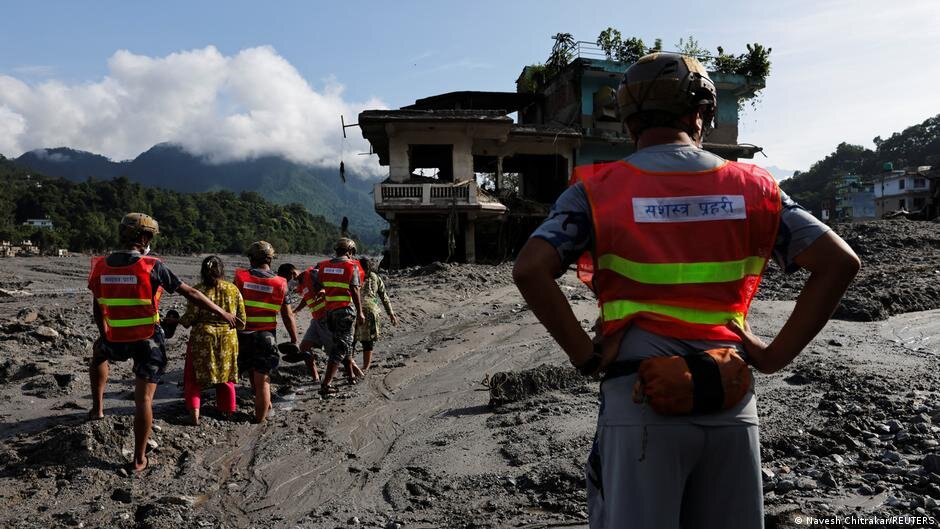
https://p.dw.com/p/5JXj5 Advertisement Rescue workers have resumed a search for hundreds of people still missing two days after catastrophic flash flooding hit the border between Nepal and China .
Their efforts were briefly put on hold on Friday after a lake formed by debris began overflowing, threatening areas already devastated by the disaster.
"We have received a notice saying that the lake has broken its banks," Narendra Pariyar, the most senior bureaucrat of the hard-hit Rasuwa district, told DW. "We can see that the level of water in the river is rising."
Residents in Nepal's border district of Rasuwa were seen fleeing up hillsides as they braced for a surge in river levels, Reuters reported.
Authorities later said the threat had eased but that they were closely monitoring the situation.
Meanwhile, Nepal said the death toll had risen to 538, up from 390 a day earlier . China has updated its earlier count of three to five deaths in Tibet.
More than 1,400 are still believed to be missing, including as many as 517 foreigners from more than 30 countries.
The International Red Cross estimated that over 93,000 people have been directly affected by the catastrophe and are in urgent need of humanitarian assistance.
"We're of course very concerned about a secondary flood," said spokesman David Fischer at a press briefing in Geneva, adding that Red Cross relief trucks had been blocked by the lake which formed following the landslide.
Kamal Kishore, Head of the United Nations Office for Disaster Risk Reduction, warned of further "cascading hazards that might unfold" and said: "The disaster is not yet completely over. It is still unfolding in some ways."
The World Health Organization (WHO) warned of the risk of disease in the wake of the disaster.
"Following a disaster of this scale, displacement, overcrowding and disruption to water, sanitation and health services can increase the risk of infectious diseases, including diarrhoea and respiratory illnesses," said spokesman Tarik Jasarevic.
Wednesday's disaster, triggered by a glacial collapse that sent rock and meltwater surging into rivers below, left a new danger in its wake: a barrier lake formed upstream by debris dams.
China's Ministry of Water Resources said the lake held roughly 2 million cubic meters of water as of Thursday and was expected to receive another 3 million cubic meters — equivalent to about 1,200 Olympic swimming pools — over the following three days, with peak flow expected around September 1.
Chinese national broadcaster CCTV said the lake's barrier sat more than 10 kilometers (6.2 miles) from Gyirong Port, the border crossing that was engulfed by the initial flood, and is at an elevation roughly 1,000 meters (3,280 feet) above it.
More than 1,000 believed missing after Nepal flash floods To view this video please enable JavaScript, and consider upgrading to a web browser that supports HTML5 video
The country had mobilized an eight-member engineering team to survey the lake by air and build 3D models of the site. Engineer Chen Hanxiao described the difficulty of the terrain: "After the glacier collapse created the lake, many isolated cliffs and steep cliffs appeared along it," he told CCTV.
He said the team's general strategy was to dig a drainage channel at a lower point of the dam, though the channel's exact width and depth would depend on calculations of water flow and how quickly the lake continued to fill.
Their survey found the lake to be about 150 meters long and 40-50 meters deep. Continuing rain in the area, which is forecast to last through the coming week, has further destabilized the surrounding soil and rock.
On Friday afternoon, Chinese state media reported that the first professional rescue teams had reached the "core rescue site" or the area wiped out by a mudslide.
Nepal's Foreign Ministry said Friday it does not need foreign assistance for search-and-rescue operations, despite offers of help from several countries with nationals still missing. Foreign Ministry spokesperson Lok Bahadur Chhetri said Nepal's security agencies were managing the response. "The offer for help is natural. Our security agencies are doing the search and rescue operation. For now we don't require such help," he said. Hundreds of foreign nationals remain unaccounted for, including from South Korea, which has already sent a response team and plans to dispatch a disaster relief unit. South Korea's Foreign Ministry confirmed that Nepal had indicated it was not yet ready to accept foreign rescue teams, adding, "South Korea will keep negotiating with Nepal over the matter." Seoul has pledged $1 million (€860,000) in humanitarian aid through international organizations, after reporting nine of its nationals missing and 10 stranded after a hydropower plant they were working at was hit by the flood. According to local media, India, China, the United States, Britain, Japan, South Korea, Sri Lanka and Bangladesh have all asked Nepal's government for permission to send their own search-and-rescue teams to assist.
If you rely on our team for trusted reporting, please take a moment to select us as your Preferred Source on Google by clicking here and hitting the "star" or "preferred" button so you'll always see our verified news first.
AIPROPX is an independent multi-source news index — we track, compare, and connect coverage from across the web into one place you won't find anywhere else.