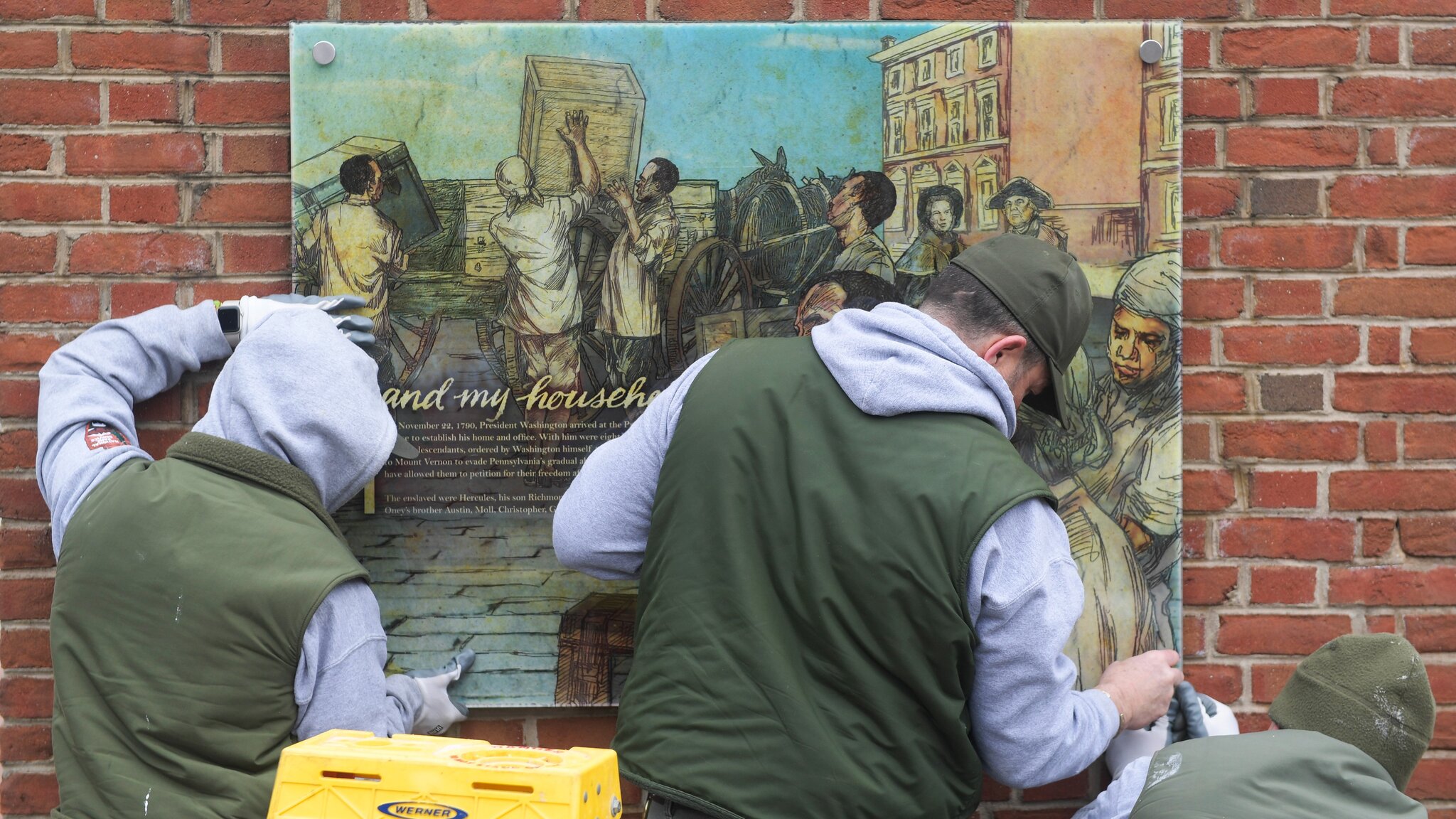
In 2010, the National Park Service installed an outdoor exhibit at the President’s House Site near Independence Hall in Philadelphia, which told the stories not just of George Washington but also of those he’d enslaved. One was Ona Judge, who escaped and evaded Washington’s yearslong effort to recapture her. Their names—Judge, Hercules Posey, Christopher Sheels, Austin, Richmond, Giles, Moll, Paris, and Joe—are still carved into a stone wall in huge letters.
In January, the Trump administration took that exhibit down , and last week, after months of legal wrangling , the NPS installed a new exhibit at the site, one that fundamentally changes the story visitors will find there. Where once the exhibit focused squarely on the individuals Washington enslaved, the new exhibit views Washington’s ties to slavery through the lens of his personal conscience, extensively highlighting his statements opposing slavery. In the sole panel now summarizing Washington’s participation, nearly every paragraph makes some mention of his ostensible antislavery views.
The new exhibit at the President’s House Site offers a profoundly misleading interpretation of Washington’s history with slavery, denying visitors an opportunity to contemplate the irreconcilable tensions between American slavery and American freedom. Rather than focus on the decades he spent actively enslaving other human beings—including while president in Philadelphia—the exhibit now uses Washington’s private statements questioning slavery and his posthumous emancipation of the people he enslaved to diminish the importance of the institution to his life. These revisions distort our history and deprive Americans from encountering history’s full complexity at the site where it happened.
The changes are part of a wider effort by the Trump administration to rewrite and sanitize American history following a March 2025 executive order targeting the Smithsonian and other federal history installations and a corresponding order from the U.S. Department of the Interior two months later. As a result, NPS staff have been ordered to change exhibits, publications, and other materials, particularly historical information that the administration views as insufficiently patriotic or disparaging toward prominent historical figures.
The revisions at the President’s House Site have drawn intense scrutiny , exemplifying both the aims and the limits of the broader effort. Even where the text acknowledges that Washington owed his status and livelihood to slavery and maneuvered to keep people in bondage, the interpretation focuses mostly on his “private doubts” about slavery and his private approval of efforts to gradually abolish it. Most notable, the new exhibit emphasizes the emancipation provisions of Washington’s last will and testament. “In death,” a panel explains, “George Washington committed his most public and personal anti-slavery act.” This is true and important, but it's presented in a way that overshadows Washington's lifetime of enslaving.
The Trump administration is hardly the first to find this selective editing of Washington’s legacy useful. For more than two centuries, highlighting Washington’s antislavery bona fides has functioned as a politically convenient rhetorical tool. Where Americans once invoked this interpretation of Washington to bring an end to slavery, conservatives are now reviving it in a way that denies the institution really mattered at all.
For the entirety of his adult life , George Washington enslaved other human beings. He bought and sold people, exploited their labor to build his substantial wealth, directed their punishment, and pursued those who attempted to escape. Over the last two decades of his life, however, Washington privately voiced his uneasiness, expressing an opposition to separating enslaved families and a wish to see Congress or state legislatures gradually end the institution. In his will , Washington directed that all of the 123 enslaved people he owned outright be emancipated following his and his wife’s deaths. (Martha Washington freed them early, about a year later, at the beginning of 1801; she died in 1802.) That group included a little fewer than half of the more than 300 enslaved at Mount Vernon at the time; the rest were owned by the estate of Martha Washington’s first husband, leaving Washington legally unable to free them.
When Washington died, in December 1799, some Americans immediately began shaping Washington’s legacy in a way that would support the cause of Black freedom. Two weeks after Washington’s death—and just one day after Henry Lee forever memorialized Washington as “first in the hearts of his countrymen”—Richard Allen, a free Black minister and a co-founder of the African Methodist Episcopal Church, delivered a eulogy. “We, my friends, have peculiar cause to bemoan our loss,” Allen told his congregation of Black Philadelphians. This was not only because of Washington’s singular contributions to the nation. Allen also claimed Washington supported Black freedom. “He whose wisdom the nations revered,” Allen said, “thought we had a right to liberty.”
Allen stood on firm ground. Remarkably, he was among the very first to mention publicly that Washington had freed the people he enslaved. Through this final act, Allen believed, Washington had redeemed himself: “He dared to do his duty, and wipe off the only stain with which man could ever reproach him,” Allen said. ”He ‘let the oppressed go free.’”
[ Read: How America gave up on its own story ]
As the antislavery movement gained momentum in the decades that followed, abolitionists used this same framing. In 1838, John Quincy Adams relayed Washington’s antislavery legacy to the Rhode Island Anti-Slavery Society and concluded that “George Washington was thus, in the broadest and most comprehensive sense of the word, an ABOLITIONIST .” Even William Lloyd Garrison—whose abolitionist newspaper The Liberator published blistering denunciat...