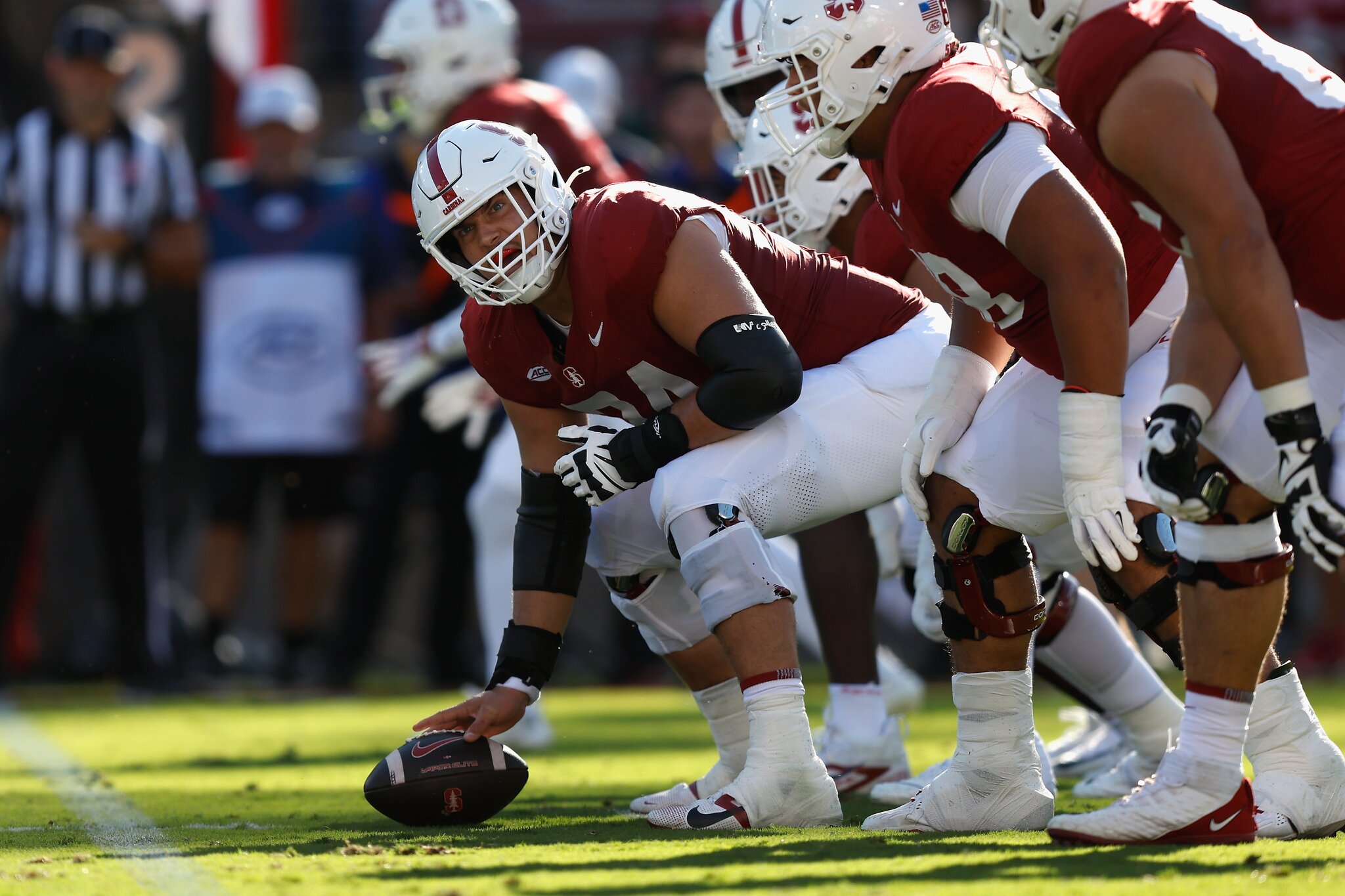
The momentum for collective bargaining within college athletics took another leap this week.
A group of Stanford University football players are establishing the first-ever chapter of the College Football Players Association in a move intended to create a foundation for eventual unionization and collective bargaining, the association and players announced Monday.
In the fifth year of the CFBPA's existence, Stanford became the first school to reach the membership threshold of players necessary to elect representatives. Those include fifth-year senior linebacker Ernest Cooper and offensive lineman Fisher Anderson, who calls the move a "milestone" and "step forward" for all of the sport.
Anderson expects players at other schools to follow the group's lead by establishing chapters so "we can ride the wave together."
"The time is now to do something," said Anderson, who earned 10 starts at center last year for the Cardinal. "This is college football and it's increasingly becoming more like the NFL. At some point, we're likely going to need a CFBPA."
Jason Stahl, the College Football Players Association executive director, described the player-led chapter as a "precursor" to a collective bargaining agreement from the conference level by making it "easier" for leagues to now "voluntarily recognize that bargaining unit" and begin the bargaining process with players. However, what lies ahead is a long, arduous process of rallying players at more ACC schools and beyond to create chapters, eventually sign union cards and then, as a group, present to conference leadership.
Stahl and CFBPA executives presented in front of more than 50 players at a meeting on the Stanford campus in June and then held followup meetings with several smaller groups of players. He did not disclose the number of Stanford players who signed chapter membership with the association.
"Down the line, it would be cool to turn into a players association," said Stanford defensive lineman Benedict Umeh, who signed on as a member after meetings with CFBPA officials.
"Just like the NFLPA, we could have collective bargaining with these conferences and could have a collective bargaining agreement that would standardize the issues of controversy we're seeing around college football," Umeh said.
CFBPA leaders are in active conversations with players from at least three other schools and executives are confident in the announcement of more chapters in the coming weeks.
While not completely groundbreaking, the creation of the Stanford chapter is noteworthy in a time of upheaval in the college sports ecosystem as multiple players association leaders, college executives and even congressional lawmakers attempt to bring stability and regulation to an industry crippled by legal losses.
There is stark disagreement among stakeholders on the two primary routes — Congress or collective bargaining — to achieve stability in a sport rapidly transitioning into a more professional entity. Many believe that federal legislation should provide that regulation and have for years lobbied Congress for a bill — one that sits on the precipice of a vote in the U.S. Senate .
While complex and some believe impossible, collective bargaining continues to gain momentum even among high-level college sports stakeholders who are adamant that it can be done despite many hurdles, including the employment of public school college athletes, Southern state laws that prevent bargaining and, maybe most notably, the athletes themselves organizing.
Perhaps the latter is beginning to take shape during an era in which universities are now directly paying their athletes to play sports, many of them in excess of $40 million in annual roster spend at the power conference level.
Stahl's first chapter comes four years after he attempted a similar move at Penn State. However, that player gathering was not sanctioned or even known by university coaches and administrators. The effort backfired when a staff member walked into a team meeting of players discussing unionization.
Just 18 months later, athlete employment and unionization are viewed in a different light, even by some of the most high-profile coaches and officials across the country. Some Stanford administrators and staff members knew of Stahl's meetings as most of them were held within campus athletic buildings. University executives did not respond to a request for comment as of Sunday night.
"That was the wrong time, wrong team, wrong leaders," Stahl said of the Penn State situation. "College football wasn't ready for it in many ways. Guys weren't being paid directly from their schools as they are now. And so [it's a] leap to say, 'How do you have collective bargaining if guys aren't being paid by their employer?' We've now crossed that bridge."
The CFBPA is one of many entities organizing athletes in an effort to unionize.
Athletes.org, led by Brandon Copeland and Jim Cavale, have spent the last several years pitching players and administrators on collective bargaining models and have current membership totals exceeding 5,000. The National College Players Association, founded by Ramogi Huma, has worked to lobby state and congressional lawmakers for more friendly college athlete policy and has spearheaded the creation of dozens of state NIL laws to protect athlete rights.
The United College Athlete Association, started in 2024 by Andrew Cooper, has found a lane in organizing women's basketball players, some of whom have publicly espoused their desire for employment.
"I think it's time to come to the truth: We are employees," said Oluchi Okananwa, a Maryland women's hoops player from Boston, the Big Ten's Defensive Player of the Year last season and a UCAA member.
Stanford center Fisher Anderson is one of...