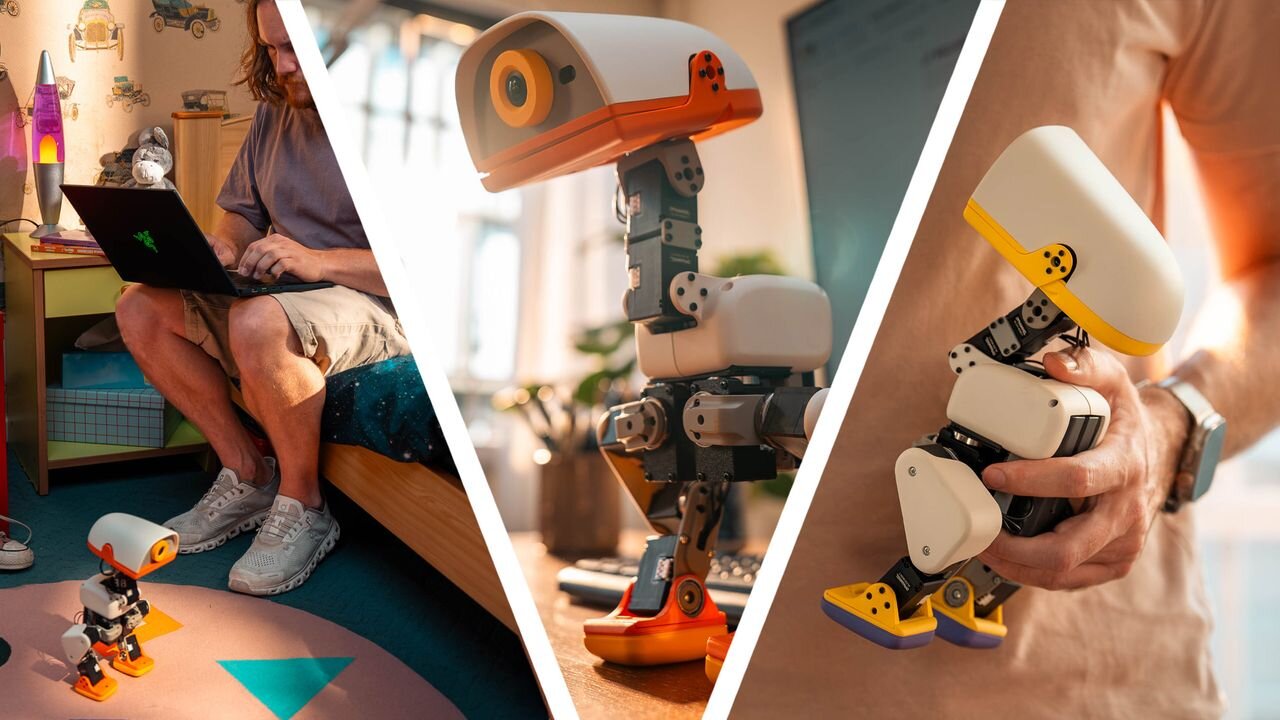
Microduck is Pollen Robotics' new programmable robot
It looks like a cute robo-duck, and has some adorable, pre-baked interactions
It's up for pre-order priced at $399, and it should ship in time for Christmas
If the measure of a successful robot is cuteness, Microduck could be the most successful bot in ages. Unveiled this week by Pollen Robotics (a division of AI company Hugging Face — yes, that Hugging Face ), Microduck is a 25-centimeter-tall educational robot that appears to arrive with surprising mobility, balance, and personality.
Pre-orders, which kicked off today (August 27) promise a $399 (that's the introductory price), roughly 1.7lb pre-built duck-like robot complete with a mouth that doubles as a gripper, a voice —duck calls, it seems — 15 degrees of freedom (basically a measure of the number of ways all the motors let it move), and motors that let it walk, waddle, move its head and, thanks to a pair of IMUs (inertial movement unit), stay upright even when pushed around.
(Image credit: Pollen Robotics)
There's a single-eye camera paired with a Lidar system for navigating its environment and, perhaps, recognizing its owner. Pollen Robotics has yet to specify the camera's megapixels. There are also speakers for voice, and microphones for it to hear. The robot runs on a relatively low-power Rockchip RK3566 ARM chip that's backed by 1GB of RAM and 32GB of on-board storage. There's on-board Wi-Fi, Bluetooth, NFC, and a smallish 2,600mAh battery that promises roughly one hour of operation.
These are not killer specs, but the teaser videos show a highly engaged and undeniably adorable little bot. I was particularly taken with how it can recover and stand back up after a fall (or being pushed over). Microduck will arrive with a lot of pre-programmed interactions, but much of the cuteness may come via its open-source platform and your programming skills.
The Microduck kit will ship with an SDK that includes virtual training environments, along with training scripts and tools, and "a tested sim-to-real workflow." The idea, obviously, is that while you might grow to love Microducks' baked-in personality, it's what you can build with your kids that will really matter. This is an educational robot, after all.
It's almost familiar
Pollen Robotics
Pollen Robotics
It's also worth mentioning Microduck's obvious resemblance to another extremely cute, though entirely unattainable robot: Disney's and Star Wars' BDX Droid . Both robots are bipedal with a somewhat squat posture and cute, oversized heads, and as with the BDX-Droid, it's hard to believe the Microsoduck can stay upright. But that's where the similarities end. That semi-autonomous/remote-controlled BDX Droid is much larger, probably far more expensive, and is currently only wandering around Disney World. Plus, there are currently no plans to bring it to consumers.
The $399 Microduck is just the base package, and Pollen Robotics also plans to ship an optional charger pack for $39, a dev pack that includes spare motors, cables, and batteries for $119, and an accessory pack that includes a laser pointer (perhaps for Microduck to chase), roller skates(!) that Microduck can wear and ride, and 10 NFC tags. One wonders if those tags might be used to trigger certain Microduck actions.
We have a huge news to share today!Today we are unveiling the first truly accessible RL robot - welcome MicroduckA 25 cm tiny open-source biped with 15 actuators and packed with sensors (camera, speaker, LiDAR, NFC, bluetooth, wifi, etc) that you train yourself with… pic.twitter.com/2SO4HgqxY3 August 27, 2026
Microduck is Pollen Robotics' second edu-robot, the first being the Reach Mini, an almost equally cute but more or less stationary desk companion robot. Pollen Robotics claims it sold 10,000 units.
Microduck's success will likely depend on just how many of those endearing qualities are on display out of the box, and how much we have to code ourselves. Initially, you can fake some of it, since Microduck can be remote-controlled with a gaming controller; but the real fun happens when it starts to respond in unexpected ways.
The other X factor is how many people are willing to pay almost $400 for a plastic and semi-autonomous robot duck. I know I'm intrigued, and wouldn't mind trying to program it to create the duck-bot of my dreams.
Microduck is expected to ship by Christmas, and is available in Cream, Graphite. Lavender, and Sky.