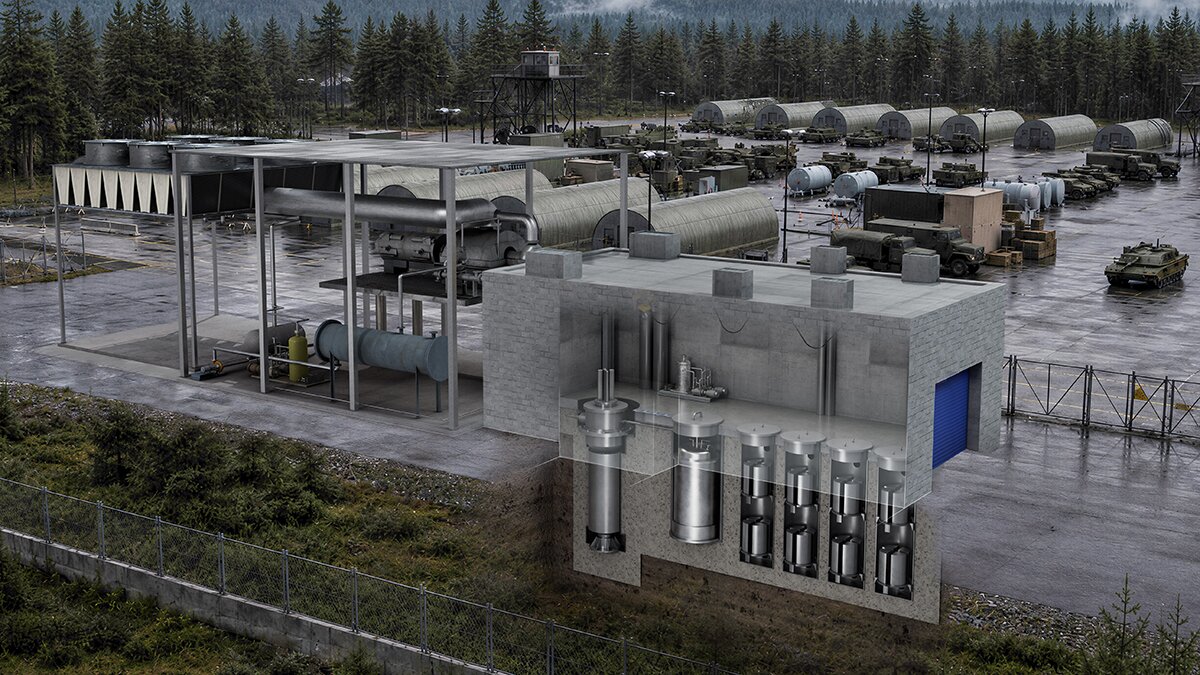
The Army is investing billions of dollars to bring nuclear power to military bases, selecting five companies to build nuclear microreactors at installations across the U.S., the service announced Wednesday in collaboration with the Pentagon’s Defense Innovation Unit.
Antares Nuclear will develop a microreactor — or microreactors — at Fort Bragg, North Carolina; BWXT Advanced Technologies at Fort Campbell, Kentucky; General Atomics Electronagnetic Systems at Fort Hood, Texas; Radiant Industries at Fort Benning, Georgia; and Westinghouse Government Services at Fort Drum, New York. The service said it expects to field more than 20 microreactors across Department of Defense installations.
The agreements, worth up to $2.2 billion combined, mark a step in the Army’s Janus program, an initiative that aims to introduce microreactors to power installations independently rather than relying on civilian electrical grids. The Army introduced the program in 2025 after an executive order called for the military to speed up its integration of nuclear power, with the goal of having an operational reactor at a military base by Sept. 30, 2028.
“Awarding these contracts accelerates our ability to deliver safe, reliable baseload power directly to our installations,” Secretary of the Army Dan Driscoll said in a release. “We are building the energy resilience necessary to project combat power globally, without relying on potentially vulnerable external grids.”
The reactors will be contractor-owned and operated, the Army said, adding that vendors will only be paid if they hit technical milestones. Each installation will remain on the commercial power grid, officials said at a Wednesday media briefing, and the reactors are not intended to power the base completely.
The Janus program follows the Pentagon’s 2022 announcement of “Project Pele,” which sought to develop a portable 40-ton nuclear reactor that could generate one to five megawatts of power.
None of the base’s future reactors use highly enriched — or weapon’s grade — uranium, according to Jeff Waksman, principal deputy assistant secretary of the Army for Installations, Energy and Environment. In the briefing, he said the push toward nuclear energy stemmed from the nation’s growing awareness of security risks and reliance on fossil fuel.
“Unlike in prior conflicts, we now know that our domestic electric grid is potentially at risk in a conflict,” he said during the briefing. “We also know that we will not necessarily be able to move fossil fuels easily wherever we need them to go. Right now, all critical infrastructure that the Army has is backed up by some form of liquid fossil fuel, primarily diesel.”
Outside of the continental U.S., the threat remains, he said, as U.S. interests often rely on international ships.
“We’re often dependent. In a lot of our Pacific islands, we’re dependent on foreign-shipped fuel from foreign-flagged vessels, and that doesn’t give us a lot of comfort if there were to be a future conflict,” he continued.
Nuclear waste will not be stored on bases long-term, Waksman said.
The effort comes as the U.S. is currently at war with Iran, with both countries insisting that the Strait of Hormuz, in which around one-fifth of the global oil supply passes, is under their respective control. The war has driven up energy costs worldwide.
Installations were chosen based on a multilayered analysis including mission-set, power grid feasibility, environmental concerns and safety, according to Brandon Cockrell, deputy assistant secretary of the Army for Energy & Sustainability. He also nodded to the bases’ role in deploying troops.
“It’s really difficult to look across the five and not draw the immediate conclusion that this is a direct link to power projection,” he said, adding that such a component was part of the assessment. “This is because we have to be able to project power. We have to be able to meet the Army’s mission if there is any vulnerabilities in the grid.”
In Nov. 2025, the Army said it was also considering Fort Wainwright, Holston Army Ammunition Plant, Joint Base Lewis-McChord and Redstone Arsenal.
Energy resiliency has become an increasingly important facet of technology development across the Army, which has pitted three contractors against each other to build a light tactical vehicle capable of producing large amounts of energy to power counter-drone systems, electronic warfare and directed energy weapons.
The Army did not disclose the contract amounts for each nuclear microreactor company. Radiant, which has a contract tied to a Georgia base, disclosed that it secured an agreement totaling $750 million for 15 Kaleidos nuclear microreactors, which are currently undergoing testing at the Idaho National Laboratory DOME facility.
In a Wednesday release, the company said that the 1-megawatt microreactors would be transportable and “plug-in ready.”
General Atomics, which is tied to a Texas base, advanced its Tactical Energy System, or GA-TES, that has a baseline output of 5 megawatts and can scale up to 20 megawatts, a Wednesday announcement said. The GA-TES is transportable by rail or truck.