Hollywood & Entertainment How Cold War Trauma And ‘70s Cinema Inspired Reagan-Gorbachev Drama ‘The Brink Of War’ By Josh Weiss ,
Forbes contributors publish independent expert analyses and insights. Josh Weiss is a writer covering the nexus of pop culture and Judaism. Follow Author Aug 14, 2026, 03:29pm EDT --:-- / --:-- This voice experience is generated by AI. Learn more . This voice experience is generated by AI. Learn more . Michael Russell Gunn vividly remembers the look on his parents’ faces when the Berlin Wall finally fell in November 1989.
“What I was seeing was relief,” he recently told me over Zoom. “They had been living with this threat of nuclear armageddon their whole lives, and here’s the wall coming down. It was a really impactful moment.”
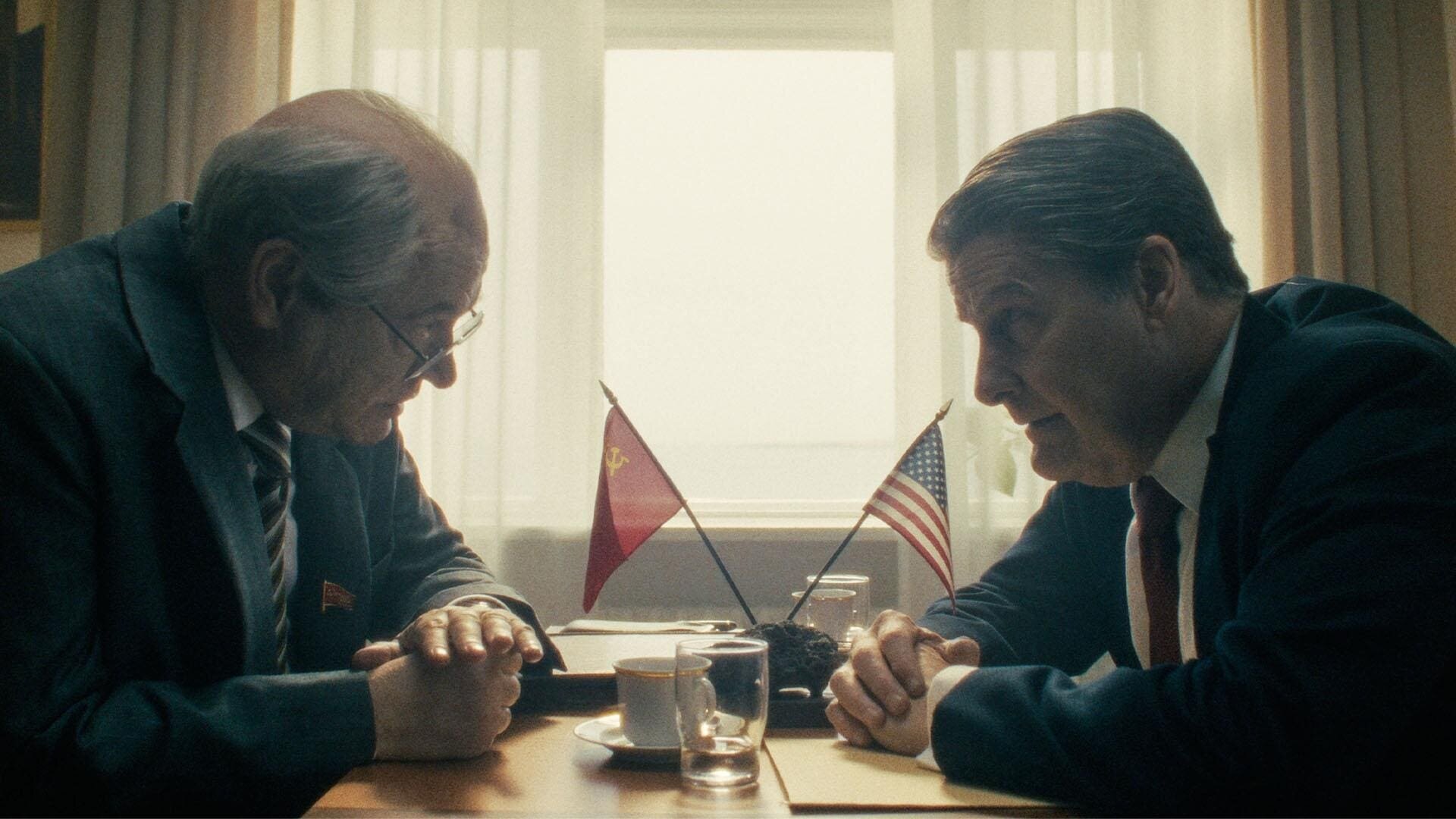
Decades later, he channeled that formative recollection into the screenplay for his second feature film, The Brink of War (now playing). The movie dramatizes the October 1986 nuclear deescalation summit between U.S. President Ronald Reagan ( Jeff Daniels ) and Soviet General Secretary Mikhail Gorbachev ( Jared Harris ) at Höfði house in Reykjavík, Iceland.
The pair came extremely close to reaching a deal that would have completely rid the world of nuclear weapons after just two days of deliberations, but talks collapsed at the last minute. Nevertheless, the summit successfully laid the groundwork for the implementation of two major disarmament agreements: the Intermediate-Range Nuclear Forces Treaty (1987) and Strategic Offensive Arms Reductions Treaty (1991).
Gunn was inspired to pursue the project after a fateful meeting with former Secretary of State George Shultz (played in the movie by J.K. Simmons ), who was present for the historical conclave between the late-stage Cold War leaders.
“[Schultz] walked me into the conference room at the Hoover Institution, and there’s this oil painting of Reagan and Gorbachev in the room together,” Gunn remembered. “As a filmmaker, as a visual person, that was very striking: two superpowers sitting in this tiny room."
Schultz provided him with the declassified transcript of the conversation, which, unsurprisingly exemplified the deep ideological rift that kept the capitalist and communist superpowers at one another’s throats since the end of World War II.
“Here were these two titans of history, at some points yelling at one another about their two different systems,” Gunn explained. “The political systems, the economic systems, how they viewed the world, human rights—all these things. And so, it became inherently dramatic to me.”
His final shooting script remained largely unchanged, save for one reference to the infamous Chernobyl accident , which occurred six months before the summit took place. Still fresh off his turn as Kurchatov Institute of Atomic Energy Deputy Director Valery Legasov in HBO’s Emmy Award-winning miniseries based on the disaster, Harris kindly requested the line be removed, “which I was happy to do,” Gunn said.
President Reagan, of course, died in 2004 at the age of 93 from Alzheimer’s-related complications. Gorbachev, however, lived until 2022, dying at age 91 after a long illness. Sadly, Gunn was unable to speak with the man prior to his death.
“The Putin regime is not necessarily a fan of Gorbachev,” said the director. “It was very clear that the Soviet archives, Gorbachev, and [other] figures in the Soviet system were not accessible. So I mostly had to do reading. I did the best reading I possibly could to find out the Soviet side of it, and learn about Gorbachev.”
Even so, it all came down to the idea of two men conversing from opposite ends of a table, which doesn’t exactly scream cinematic dynamism.
“I had to do something to plus that up,” conceded Gunn. “The first thing was casting, trying to find the very best actors I could possibly find to hold the attention of the audience. The second thing was how do you film it? How do you shoot it and make that compelling?”
As such, he insisted principal photography take place on the ground in Iceland at the actual Höfði house, with Daniels and Harris sitting “in the actual chairs Reagan and Gorbachev sat in,” he revealed. “It was tough on the sound team, because the chairs are pretty creaky these days, but it was inherently dramatic to watch them in that space.”
Gunn also teamed with Polish cinematographer Magdalena Górka ( Paranormal Activity 3 , Marvel Studios’ Echo ), who grew up behind the Iron Curtain in the final decade of the Cold War and brought an invaluable perspective to the film.
“I immediately knew when I received it that this would be my next movie,” she said over a separate Zoom call. “It’s a very personal story for me. I was 12 when the Berlin Wall fell. The history was part of my growing up."
Despite Gorbachev being famous for his policy of “Glasnost,” an effort to soften and reform the harsh, draconian aspects of the Soviet apparatus, he still maintained a number of oppressive systems until the USSR imploded in '91. He’s not the saintly peacemaker many Westerners think him to be, as Górka reminded the cast and crew.
“That was really profound for her to share, because it brought a sense of realism and seriousness to it,” Gunn said. “We’re making a movie, we’re having fun we're lucky to be there, but she brought a level of seriousness to it every day that was like, 'No, I lived this.’”
The world press was famously kept outside Höfði house, unable to listen in on the momentous negotiations. “It became a joke in the world press that it was the most famous doorknob in the world because that’s all they had to shoot,” Gunn remarked. Wanting to capture that sense of distance between the journalists and a watershed moment in history, he and Górka utilized long lenses and smash zooms as a way to recall the political and paranoid thrillers of the 1970s (think Francis Ford Coppola’s The Conversation and Alan J. Pakula’s All the President’s Men ).
“We really wanted to have a voyeuristic point-of-view...