This is one outlet's own report from Deutsche Welle — the article as it was filed. Other outlets are covering the same event; open the full story to compare every source side by side.
Danube water levels: Hungary, Romania cut nuclear output
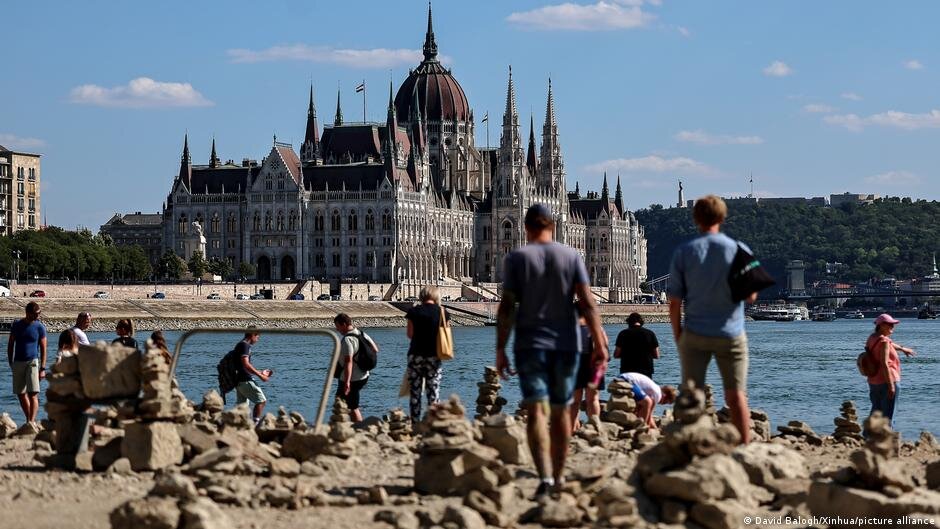
Historically low water levels along Europe's second-longest river have led Hungary and Romania to reduce output at key nuclear plants. Danube tourism and river cargo have also been severely affected by Europe's heatwave.
https://p.dw.com/p/5I04x Advertisement Hungary and Romania have drastically reduced output at their nuclear power plants due to insufficient water flow from the Danube river, which has sunk to historically low levels.
Hungary's Paks nuclear plant, located 120 kilometers (74.5 miles) south of the capital, Budapest , cut output by 50% at reactor 2 on Thursday morning.
The plant operates four Russian-built reactors with a combined capacity of 2 gigawatts. Output had already been cut by 254 megawatts on reactor 1 on Monday, before reactor 3 powered down on Wednesday.
Down river in Romania, one of two reactors at the Cernavoda nuclear plant, 160 kilometers east of Bucharest , was shut down earlier this week due to lower water levels.
The Romanian Energy Ministry was set to shut down the plant's second reactor on Thursday due to "unfavorable developments in hydraulic conditions" – but ultimately managed to keep it operating overnight.
Water from the Danube is vital for cooling operations at nuclear power plants along Europe's second-longest river (2,857 kilometers, after the Volga which meanders 3,790 kilometers through Russia ).
In Budapest, Hungary's national water authority measured the Danube's gauge level at 23 centimeters (9 inches) on Wednesday morning, well below the previous record low of 33 centimeters (13 inches) set in 2018.
And it's not just nuclear power plants which are affected; river traffic from cargo ships to tourist cruises has also been put on hold.
In Hungary, the low water level has forced popular cruise ships, where passengers usually disembark for sightseeing in Budapest, to dock further upriver, while cargo ships have stopped operating nearly entirely, according to the country's Ministry of Transport and Investment.
In neighboring Romania, the water level along parts of the Danube is already one meter (three feet) below the navigable minimum.
"This is an exceptional situation," Adrian Maizel, from the administration monitoring traffic on the Danube, told the AFP news agency, adding that dredging efforts were underway to enable shipping to continue.
"We are making efforts to maintain a navigable channel as much as possible – albeit a narrower one – so that navigation is not completely blocked," he explained.
In Bulgaria , where the Danube forms a border with Romania, police on Tuesday evacuated 186 tourists from a cruise ship that had run aground near the port city of Vidin.
And in Serbia , hundreds of small boats and dozens of cargo ships were marooned on the dried out river bank near the northern city of Novi Sad, where the water in the Danube had withdrawn up to 20 meters (65 feet) away from the river's usual shore.
"The summer season is over now, as far as boat rides are concerned," Radovan Segrt, a house boat owner who runs river excursions on his vessel, told the Associated Press (AP).
Back in Budapest, the receding water levels have exposed the base pillars of the city's famous Margaret Bridge, where authorities discovered a Second World War era bomb last week.
"The bare rocks, the dry sand bars around the bridge pillars ... it's shocking to see how things were before and how they are now," photographer Gabor Kertesz told AP. "Where will this lead, what will happen? We don't know that yet, but this must be the result of climate change."
Indeed, the plunging Danube water levels across eastern Europe come as the continent continues to endure one of its hottest summers on record.
In the west of the continent, French and Spanish authorities area battling unprecedented wildfires while Germany is bracing itself for another heatwave, with temperatures in some regions expected to approach 40°C (104°F) again this week, according to the German Meteorological Service (DWD).
Berlin's Robert Koch Institute (RKI), the federal government agency responsible for disease control and prevention, said on Thursday that 9,800 people had died due to heat-related conditions this summer – more than in any entire year since 2016.
The RKI attributed over 5,000 of those fatalities to the severe heatwave in the second half of June, where temperatures hit 40°C in several parts of the country.
New heat wave could worsen France, Spain fires To view this video please enable JavaScript, and consider upgrading to a web browser that supports HTML5 video
Don't let the algorithm hide the news. If you rely on our team for trusted reporting, please take a moment to select us as your Preferred Source on Google , so you'll always see our verified news first.
AIPROPX is an independent multi-source news index — we track, compare, and connect coverage from across the web into one place you won't find anywhere else.