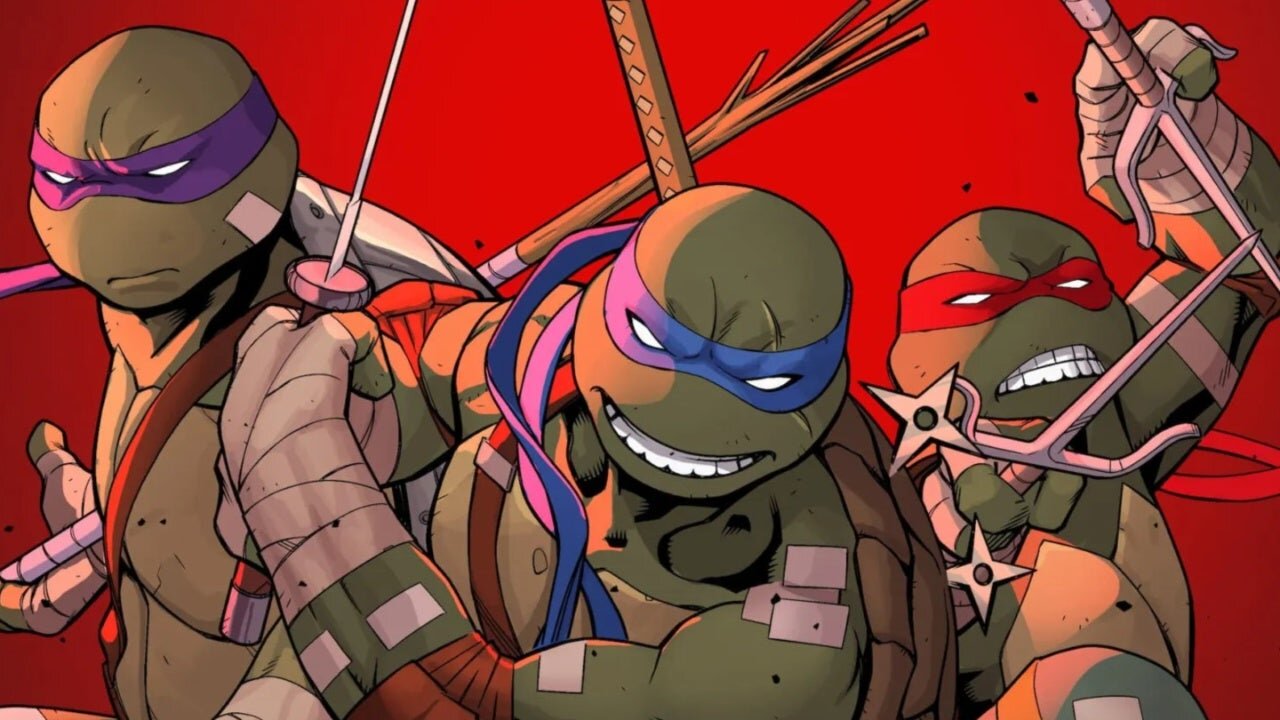
2027 is already shaping up to be a monumental year for IDW Publishing's Teenage Mutant Ninja Turtles line. The company made two big reveals at Comic-Con. First, current TMNT writer Gene Luen Yang will be ending his story with issue #24, paving the way for new writer Matthew Rosenberg (Astonishing X-Men) and artist Juann Cabal (All-New Wolverine) to take over the series with TMNT #25. Second, they confirmed that the third and final volume in the TMNT: The Last Ronin trilogy will debut in 2027, with the entire creative team returning to wrap up this futuristic saga.
IGN had a chance to speak with both Yang and Rosenberg at Comic-Con, where the duo talked about their shared love of the franchise and how Yang will be handing off the series in the months to come. Read on to learn more.
Rosenberg is coming on board the series at a particularly fruitful time. IDW had a lot of success with the 2024 relaunch, which kicked off with writer Jason Aaron and a rotating team of artists . Rosenberg notes that this assignment is a chance to lend his own take to the franchise while trying to do something genuinely different from what his predecessors did.
"There's a lot of runs I love, but the thing I'm really excited about is that in the past two years, a large group of my favorite comic creators have had the book between Jason Aaron and Juan Ferreyra and Gene's run," Rosenberg tells IGN. "It's so exciting. And I think the thing I love the most was seeing what Jason did was different from what Sophie Campbell was doing or anyone else was doing. And then seeing what Gene did was like a reinvention again, but all still true to it."
Rosenberg continues, "For me, I wanted to study what Gene was doing and then be like, 'But he changed the game, so I have to do that. I can't just run with that.' And that's really fun to me, to be like, ,I want to honor everything he's done because I love it, but also don't want to do a cover band of it.'"
For Yang, working on a book like TMNT means accepting that nothing lasts forever and that eventually he'll need to pass the baton to the next set of creators.
"You know when you're working on a property as big as the Ninja Turtles that it doesn't belong to you," Yang says. "It's sort of a melting pot of creative energy. And I felt really lucky and a little bit intimidated that I was following Jason Aaron's run. I thought what he did was just phenomenal. The amount of energy that came out of his run was incredible. And one of the gifts that he left for me was he brought Splinter back. I think it was the last issue. So that was something that we got to run with, Freddie [Williams II] and I."
Yang also notes that one of the best things about the TMNT franchise is how it allows for such different takes and swings in tone. The original Mirage comics are very different from the 1987 animated series or the contemporary movies, but they're all authentically TMNT.
I'm a huge fan of the Turtles from when I was a kid," Yang says. "And I remember encountering the old black and white Mirage comics in my 6th grade classroom. One of the kids had, I think, maybe a third print of #2 or something. And then I also remember watching the cartoon and seeing that contrast between the grittiness of [Kevin] Eastman and [Peter] Laird's comic and then the colorfulness of the cartoon. And both of those are fundamentally Turtles. I think one of the things that makes the Turtles special is that there are characters that work in nearly any genre. Like you can put them in a sci-fi story or a horror story or martial arts action or like a family comedy and it still can be Turtles. So I felt like with Jason Aaron's run, what he did was he kind of leaned into some of that Mirage energy."
Yang continues, "What I did for inspiration was I read those early Mirage comics. And what I noticed was, I think the energy that Jason Aaron might have been drawing on was in the first few issues. But shortly after that, things get a little bit crazy and a little bit wild. You have talking triceratops and aliens calling out of guns and that sort of thing. So we wanted it to feel a little bit wild and out of control as well. One of the things that I think makes the IDW version of TMNT special is that it ties into Japanese culture and Japanese mythology a little bit more closely. So for my run, I wanted to add the color and the weirdness that kind of happened in those Mirage comics, even though they're black and white. Color in terms of story. And I wanted to do that by kind of leaning into Japanese mythology."
One of the benefits of Rosenberg being tapped to write the series is that he's a native New Yorker. He teases that the city itself is very much a character in his run. We're going to see the Turtles navigate a lot of real-world landmarks in his first arc, which pits the Turtles against a gauntlet of foes in one very chaotic 24-hour period.
"I'm going to start them in the Bronx, start them in Pelham, and they're just going to be in a trip through New York," Rosenberg says. "And the thing about the Turtles that's great is that you can have them fighting in the sewers, fighting on rooftops, but also they're fun. They're teenagers. They're joking and they're distracted and they're not. There are all these things that they're adventurous when they're kids. It's a great chance to show the city as a battleground, but also show the city that they love. And that's what I'm trying to do is in the middle of a fight. My first arc is basically a fight. It's one night. It's the worst night of the Turtles' lives. But in that, there's a lot of who they are. You need to show who they are."
Rosenberg adds, "And so we're figuring out what we can do. There's a...