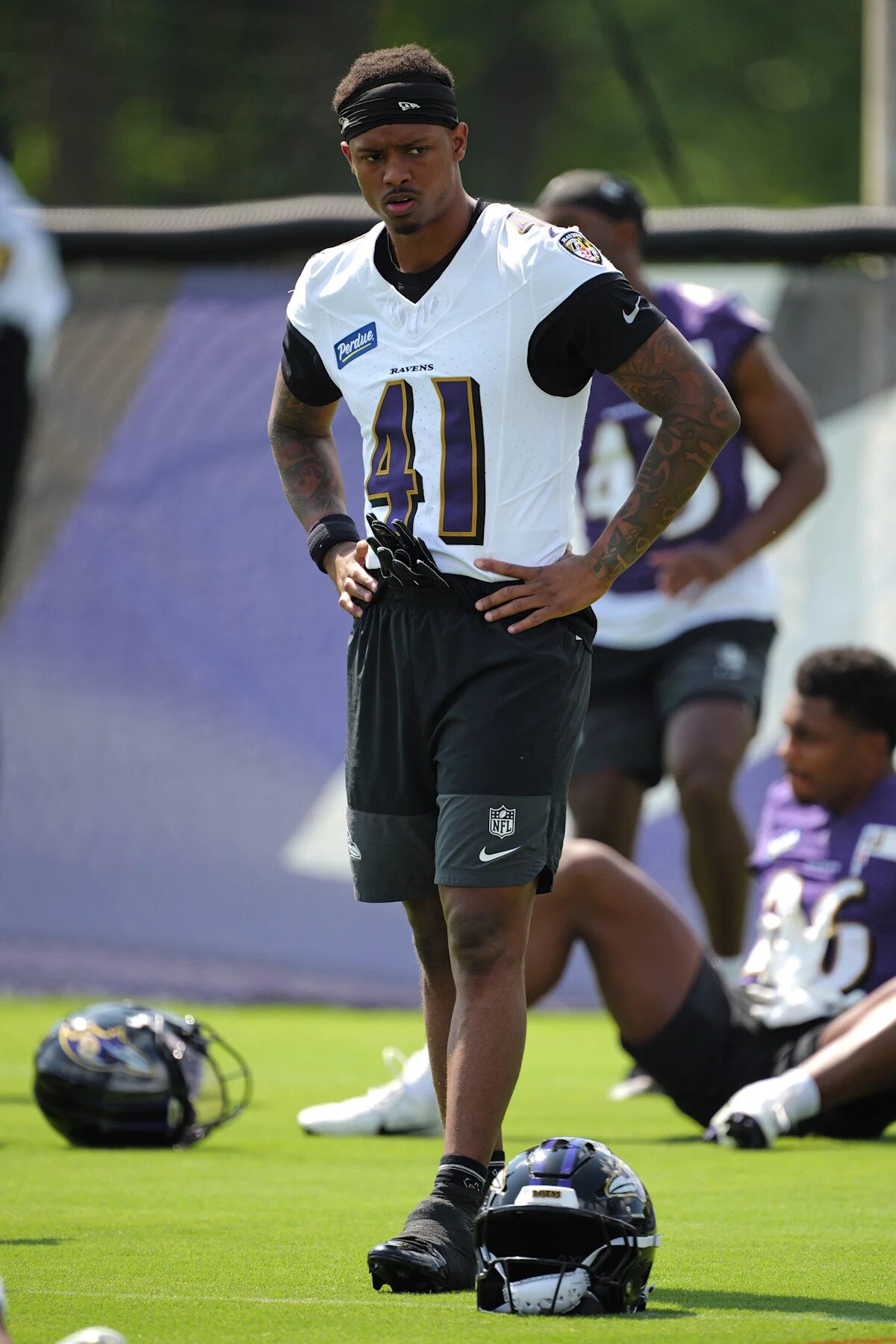
The Ravens will open their preseason against the Philadelphia Eagles on Saturday night at M&T Bank Stadium, providing Jesse Minter’s coaching staff with its first opportunity to evaluate the roster under game conditions.
Lamar Jackson and several established starters will not play, shifting the focus toward rookies, developmental prospects and veterans competing for larger roles. Baltimore’s 2026 draft class should receive extensive work, while several undrafted players will attempt to move closer to securing roster or practice-squad spots.
Here is one Raven from every position group to watch against Philadelphia.
Quarterback: Joe Fagnano
Tyler Huntley is established as Jackson’s primary backup, making the competition behind him the larger preseason storyline. Fagnano has spent the offseason learning Declan Doyle’s system, but Baltimore’s decision to sign Austin Reed after placing Skylar Thompson on injured reserve creates new competition. Fagnano must demonstrate command of the huddle, quick decision-making and dependable ball placement. Every opportunity matters because the Ravens could carry only two quarterbacks on the initial roster.
Running back: Adam Randall
Randall is one of Baltimore’s most intriguing rookies after transitioning from wide receiver to running back. His 6-foot-3, 240-pound frame gives the Ravens another powerful option behind Derrick Henry, while his receiving background could create matchup opportunities. Randall must show patience and vision as a runner, but pass protection and ball security will be equally important. A complete performance could help him gain ground on Rasheen Ali in the competition for the No. 3 role.
Wide receiver: Ja’Kobi Lane
Lane’s collection of highlight-reel catches has created legitimate expectations. The third-round pick offers the size and catch radius Baltimore has lacked at receiver, but the preseason will test whether his practice production can translate against unfamiliar defenders. Route precision, blocking and special-teams contributions will matter alongside his receiving totals. Lane has an opportunity to strengthen his case for the No. 3 role behind Zay Flowers and Rashod Bateman.
Tight end: Matt Hibner
Baltimore rebuilt its tight end room behind Mark Andrews after Isaiah Likely and Charlie Kolar departed in free agency. Hibner’s athleticism and receiving ability make him a candidate to contribute immediately, but he must prove that he can handle the position’s complete workload. The fourth-round pick will be evaluated as a blocker, route runner and special-teams contributor while competing with Josh Cuevas and veteran Durham Smythe for snaps.
Offensive line: Vega Ioane
Minter confirmed that Ioane will receive playing time against Philadelphia, giving the first-round pick his first NFL test. The projected starting right guard must continue developing chemistry with right tackle Roger Rosengarten and Baltimore’s competing centers. Ioane entered the league with a reputation as a powerful run blocker, but the opener will also test his balance, communication and ability to recognize defensive movement in pass protection.
Defensive line: Rayshaun Benny
Benny enters a deep defensive line room that includes Nnamdi Madubuike, Travis Jones and Calais Campbell. That depth increases the importance of his preseason opportunities. The seventh-round pick must show that he can hold his ground against the run, maintain gap discipline and provide some interior pressure. A productive game would help Benny establish himself as a developmental player worth keeping on the initial roster.
Outside linebacker: Zion Young
Young should have an immediate place in Baltimore’s edge rotation, but Saturday provides his first opportunity to show how large that role could become. The second-round pick’s power and run defense were among his strongest college traits. The Ravens will also want to see whether he can build an effective pass-rush plan and finish plays in the backfield. His discipline against Philadelphia’s running game will be as important as any potential sack.
Inside linebacker: Trenton Simpson
Teddye Buchanan remains on the physically unable to perform list while recovering from a knee injury, allowing Simpson to work beside Roquan Smith. Simpson played his best football after Buchanan was injured last season and enters 2026 in a contract year. The opener gives him an opportunity to demonstrate improved instincts, coverage ability and command of Minter’s defense. A strong performance could make it difficult to reduce Simpson’s role when Buchanan returns.
Cornerback: Chandler Rivers
Injuries to Nate Wiggins and Marlon Humphrey should create additional opportunities for Baltimore’s reserve cornerbacks. Rivers has earned praise during camp and possesses the versatility to play inside or outside despite standing 5-foot-10. The fifth-round pick must show disciplined coverage technique, reliable tackling and the ability to contribute on special teams. Philadelphia’s crowded receiver room should provide Rivers with a meaningful early challenge.
Safety: Jahquez Robinson
Baltimore’s top three safety roles belong to Kyle Hamilton, Malaki Starks and Jaylinn Hawkins, leaving the remaining candidates to compete for reserve and special-teams duties. Robinson has the size to play physically near the line of scrimmage, but the undrafted rookie must communicate cleanly and avoid assignment errors in coverage. His ability to tackle in space and contribute across multiple special-teams units could determine whether he remains in the roster conversation.
Special teams: Ryan Eckley
Eckley has a clear opportunity to become Baltimore’s punter after averaging 48.5 yards per attempt during his final season at Michigan State. The sixth-round pick will be evaluated on more than distance. Hang time, directional placement, operation speed, and his work as a holder are critical parts of the job. A clean performance against Philadelphia would ...