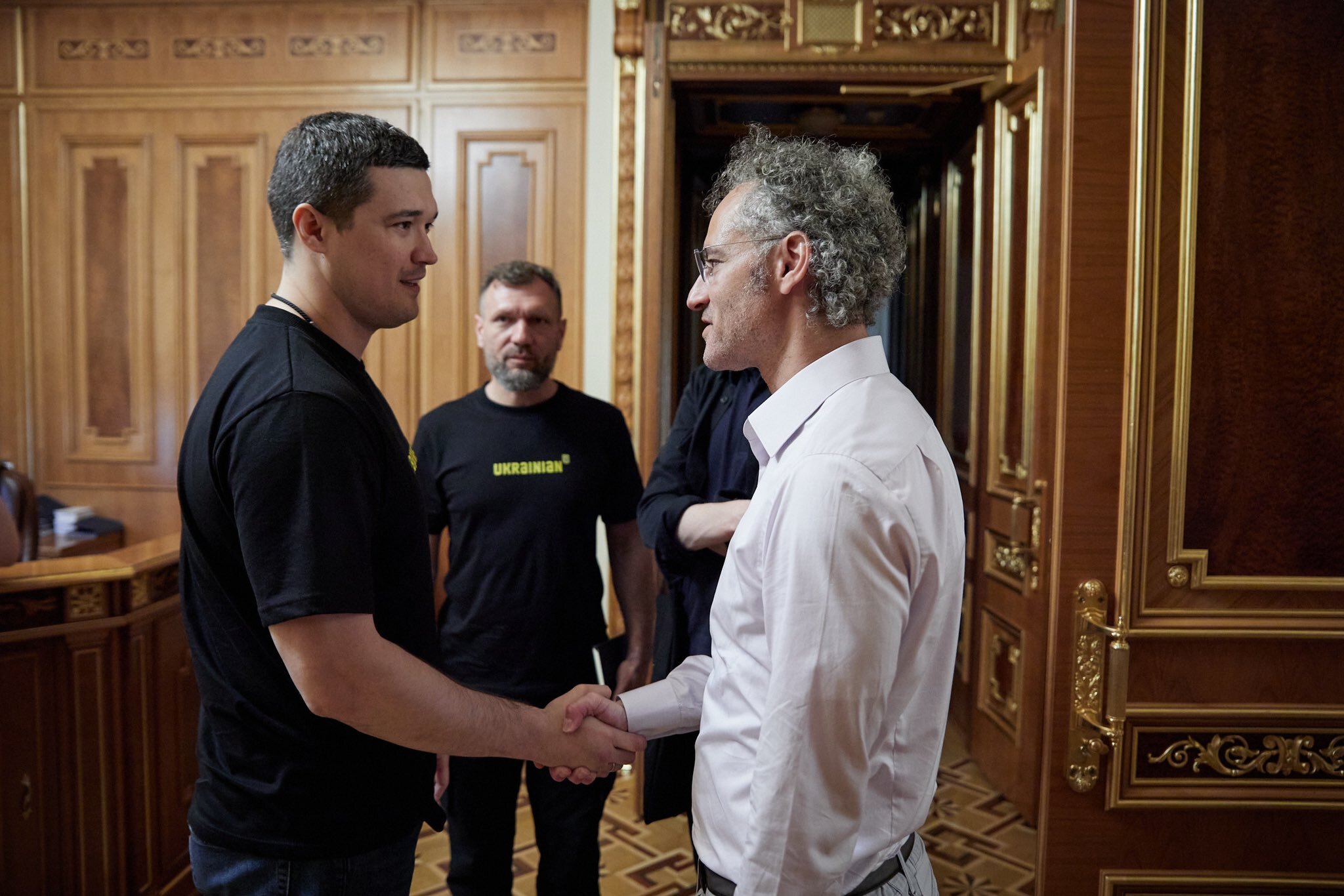
KYIV, Ukraine — Ukraine’s recently ousted defense minister Mykhailo Fedorov is teaming up with Palantir CEO Alex Karp to launch a new defense company focused on developing technology that will “ultimately make the world safer,” the duo announced on Tuesday.
The former minister left office in July but had said little about his future outside of government until last weekend, when he confirmed that he would not be returning to government and that he would instead begin focusing on several new projects — including building a major defense investment fund and advising the Italian Ministry of Defense.
“During the full-scale war, our team gained unique experience working with defense technologies in Ukraine and seeing firsthand how technology is transforming modern warfare,” Fedorov said in a press release.
“Now we want to use this experience to build technologies that will strengthen Ukraine, help our allies and ultimately make the world safer.”
Karp’s backing could mean billions in investment for Fedorov and Ukraine’s defense industry.
Palantir posted 93% year-over-year revenue growth last quarter, and Karp has watched the company’s valuation soar past $440 billion — up nearly 28-fold from its 2020 stock market debut. Roughly half of its total revenue comes from U.S. government contracts.
Fedorov built his reputation as Ukraine’s tech-first defense chief in part on his backing of Delta, Ukraine’s state-of-the-art battlefield management system that fuses drone feeds, radar and field data into a layered dashboard that can be used to oversee the front in real time or learn from a battle’s lessons afterwards.
“Ukraine’s Delta common operating system, their modular open system architecture command and control system, is absolutely incredible,” outgoing U.S. Army Secretary Dan Driscoll , who resigned from his role this week, told the U.S. Senate in May.
U.S. Army systems, meanwhile, remain “compartmentalized, isolated and ineffective against modern threats,” he said.
The American equivalent of Delta is Palantir’s Maven Smart System, which uses Anthropic’s AI model to similarly combine real-world data and intelligence analysis into a single powerful tool for battle planning and briefing.
Karp was among the first Western tech executives to travel to Kyiv after Russia’s 2022 invasion, and Palantir’s tech has since been deployed by more than half a dozen Ukrainian government agencies.
Ukraine’s Brave1 Dataroom, a joint project between the defense ministry and Palantir launched earlier this year, runs on Palantir’s infrastructure and lets Ukrainian companies train AI models — including target-detection systems for countering Shahed-type drones — on real combat data.
“We’ve worked together for a half decade,” Karp said in a joint video with Fedorov announcing the partnership. “I have been absolutely inspired by what you and the Ukrainians have pulled off, and very... delighted that we could play a part.”
Karp reportedly reached out to Fedorov almost as soon as news of his dismissal broke over the summer.
Fedorov told reporters at the time that Karp had called to propose “we do something together,” though he said he asked to revisit the conversation later.
Ukrainian President Volodymyr Zelenskyy abruptly dismissed Fedorov from his position in July, despite the former minister’s widespread popularity among civilians and soldiers alike for his tech-first military strategies and aggressive initiatives aimed at tackling some of the government’s toughest wartime challenges.
His departure set off weeks of nationwide protests demanding his reinstatement.
Fedorov said in Tuesday’s press release that despite his new international ventures, “Ukraine will be the priority for me.”