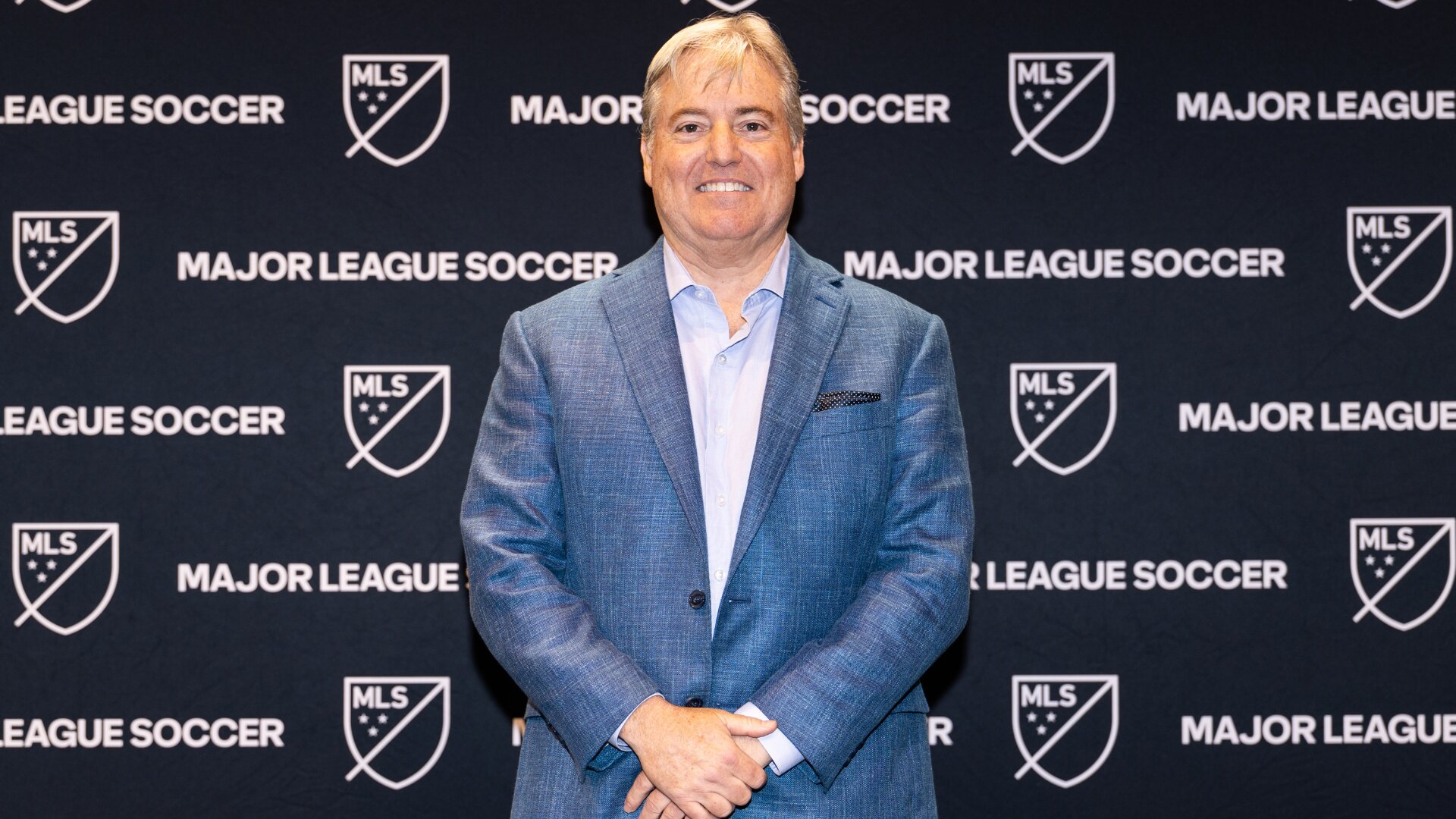
NEW YORK – Don Garber and Larry Berg will always have one thing in common: each was unveiled as the incoming MLS commissioner on the same day, though the 27 years in between the announcements is much more important than the shared anniversary.
"This is really not a time to look back on what's happened over the last 28 to 31 years of the League," Garber said on Tuesday as he prepared to pass the torch to Berg, who officially won the votes to succeed the longtime MLS leader on Monday. "It really is about the future, the future path that we'll be on."
Berg, a private equity professional who has been a co-owner of LAFC since the team was founded in 2014 (Berg will divest from LAFC before taking over as MLS commissioner on New Year's Day), will inherit a league that is very different from the one Garber did in 1999. MLS solved questions about financial viability long ago, while the sport of soccer boasted a healthy number of supporters in the U.S. long before this summer's World Cup. Layers and layers of infrastructure are in place, to the point that Garber called lifelong soccer fan Berg a "byproduct" of the decades of investment that transformed American soccer from a fractured, malnourished ecosystem to a fully professional operation.
How the league "takes it from here," to borrow a phrase from the post-World Cup marketing campaign Garber referenced twice on Tuesday, has been the root of the existential question Berg inherits. MLS is in the midst of a relevancy problem. It feels cloistered away from the most notable American sports leagues and amongst global soccer leagues, yet to break through fully in either sense despite the strides it has made in the early decades of Garber's tenure and the prominence of several high-caliber stars like Inter Miami's Lionel Messi.
Berg outlined the bare bones of how he plans to answer those questions on Tuesday, his pitch built around quality of play and building consensus amongst the ownership groups who employed him.
"Simply put, the foundation has been built," Berg noted. "Now it's our responsibility to build on it and that's what excites me most. I didn't accept this role to protect what we've already accomplished. I accepted it because I believe this league is ready for its next chapter…The platform is in place. The infrastructure is in place. The opportunity is in front of us. Now it's time to pull the right levers, make the right decisions and build on everything that's been created."
Bennett Rosenthal, a fellow LAFC co-owner and the co-chair of the succession committee, said Berg has a list of "greatest hits," a polite way of saying the incoming commissioner has had a long-term vision for the league, and has a habit of being repetitive about it. The greatest hits are built around a lofty promise that Berg will have to live up to as he charts MLS' next chapter.
"Obviously the foundation's terrific but I think it all starts with quality on the field," Berg said.
Berg argued that quality of play is the key that will unlock MLS' relevance issue, a pesky problem that branches out into a wide variety of problems he believes need fixing.
"[It] means roster investment model in part and that's something that the owners need to decide collectively," Berg said. "I think if I do that well, we will have more transfer revenue and we'll have more media money and that'll all lead to better product on the field and that'll become a flywheel because it leads to more transfers and more revenue and more more media money, but that's job one."
Berg was formerly the co-chair of the sporting competition committee, so the fact that he got into the weeds of MLS' complex roster rules came as little surprise, especially after the board of governors reportedly heard a proposal on revisions during MLS All-Star Week in Charlotte, N.C. last week.
"I'm really excited at the opportunity to have my fingers all over that even that much more," Berg said. "We call it choose your own adventure, different things, and it's my job to take all these things in and come up with a plan going forward and sometimes it's just a question of being a little bit creative and I have that experience in private equity to try to bring people together and try to make certain trade-offs. We've done it … with our current roster investment model in terms of choosing a [designated player] or choosing more roster investment or choosing a U-22 [Initiative Player] so people can decide what they want to do."
The incoming commissioner also emphasized the importance of youth development, a favorite topic in American soccer circles as the game's various stakeholders mull how to rise up the ranks in the men's game and maintain elite status on the women's side. MLS' decades-old investment in academies is one of the league's greatest success stories, regularly producing talent that feeds both the U.S. and Canadian men's national teams, including a batch of players that spend the majority of their professional club careers in Europe's top leagues. Even then, Berg feels there is room for improvement.
"Youth development in MLS is very near and dear to my heart," he said. "I feel like we have the clay, we've built the foundation. Almost every team has an academy. Most teams have an MLS Next Pro team. Every year, we have more and more emerging stars that are coming through. The U.S. men's national team, about 75% of them have roots in MLS, similar for the Canadian national team so the good news is we're starting from a really good spot but I also feel like we can do a lot more. I feel like we can get more players more minutes at a younger age, play at the highest level, continue to feed the national teams, continue to make this a soccer nation, ultimately win trophies, whether that be Copa [America] or the Olympics or World Cups so I feel really strongly that that's a place we absolutely need to dig in and focus on and we owe it to all the young players."
Berg will assume MLS' helm months before it under...