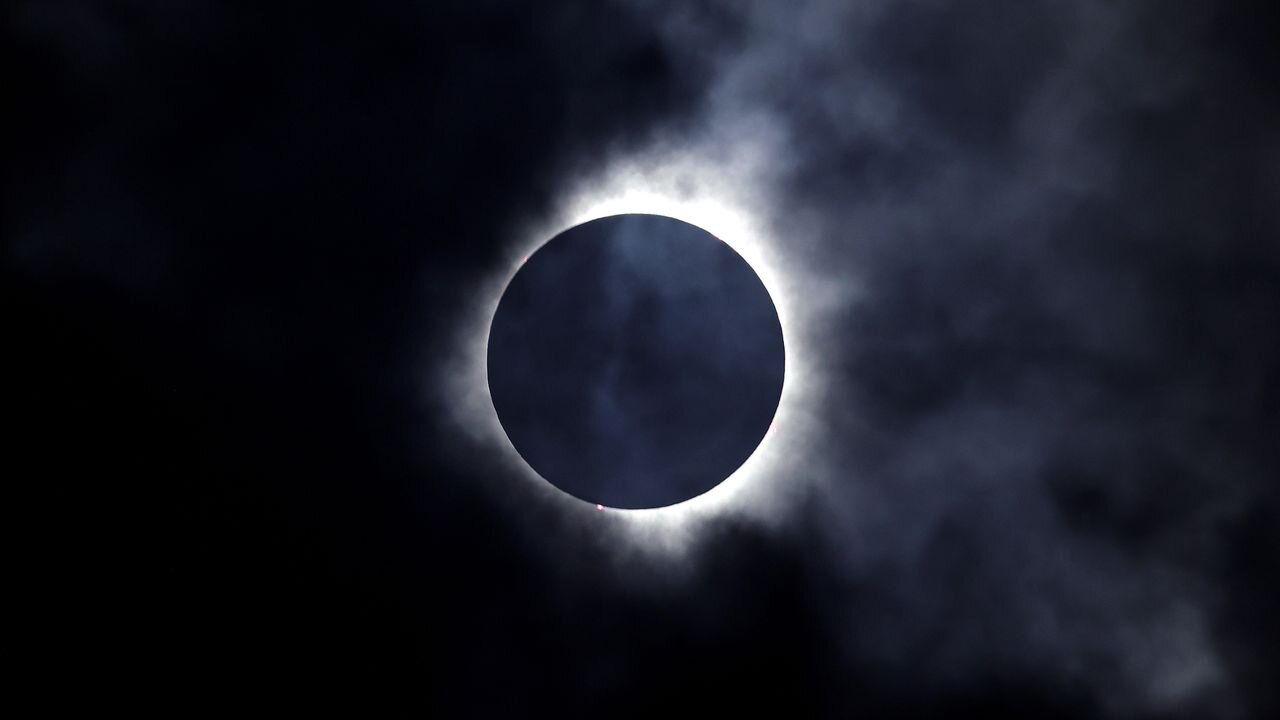
Are you ready for the eclipse? Whether you're bound for the path of totality or set to see a partial eclipse from Europe, Canada or the northeast U.S. on Wednesday, Aug. 12, there's a dirty word eclipse chasers hate to utter during an eclipse season, and yet become completely obsessed with — clouds.
Related: Total solar eclipse 2026 — Everything you need to know
We all start behaving as though Earth's atmosphere owes us something. After spending years studying the climate and where it is most likely along a path of totality to have a clear sky, we're in position and can now do almost nothing about it save for drive or sail a few miles. We refresh cloud forecasts. We compare satellite imagery. We point at scraps of blue sky as if we can persuade them to remain so at a specific time. By the time the moon is almost on the sun, we've spent the best part of a week staring at our phones and fretting.
The received wisdom is that you must have a perfect view of a total solar eclipse , and that if you don't, you've failed because you didn't do your research or take evasive action. Never mind that many who end up under a blue sky then spend the entire time behind a camera. The desire for a clear sky and a clean horizon is obvious — particularly if you're in the path of totality — and yet it's entirely possible that clouds will be present, very possibly in the places expected to be clear. That's exactly what happened on April 8, 2024, when the favored state of Texas was cloudy while wintry Maine and New Brunswick had a bluebird day.
Having seen many total, annular and partial solar eclipses, I have come to believe something slightly heretical: you do not need a perfectly clear-sky view of a total or partial solar eclipse to matter. Sometimes one clear second is enough. Whisper it, but clouds add a lot of drama not just to an eclipse, but to photos of it, too.
Beginners often assume an eclipse is only "successful" if they see the sun's corona throughout totality. Some even rank eclipses in advance according to how long totality lasts. It's all an illusion. If a gap opens in the cloud for a short time and the corona appears, that is not a consolation prize. That is the thing itself. The same goes for a glimpse of a partially eclipsed sun if that's what's heading your way.
So don't fret the eclipse — check weather forecasts and do your best to find a clear sky, but when nature takes over, don't fight it or get upset by it. Cherish whatever you get. You only need a one-second window — and even that is not in your control.
What's happening
Path of the total solar eclipse over Iceland Created using MapHub.net. Source: Esri, Maxar, GeoEye, Earthstar Geographics, CNES/Airbus DS, USDA, USGS, AeroGRID, IGN, and the GIS User Community
Path of total solar eclipse over Spain Created using MapHub.net. Source: Esri, Maxar, GeoEye, Earthstar Geographics, CNES/Airbus DS, USDA, USGS, AeroGRID, IGN, and the GIS User Community
Entire path of the total solar eclipse on Aug. 12, 2026. Created using MapHub.net. Source: Esri, Maxar, GeoEye, Earthstar Geographics, CNES/Airbus DS, USDA, USGS, AeroGRID, IGN, and the GIS User Community
Entire path of the total solar eclipse on Aug. 12, 2026. Created using MapHub.net. Source: Esri, Maxar, GeoEye, Earthstar Geographics, CNES/Airbus DS, USDA, USGS, AeroGRID, IGN, and the GIS User Community
On Aug. 12, the moon's shadow crosses eastern Greenland, western Iceland and northern Spain, with a small part of Portugal also near the action. From inside the narrow path of totality, the sun will be completely covered for up to 2 minutes 18 seconds. If that's your destination, get excited — and be prepared. During totality, stay present. An eclipse is short enough that distraction becomes a genuine hazard to observing. A one-second look can be enough, but only if you are really paying attention.
Outside of the path of totality, a much wider partial solar eclipse will be visible across the U.K., Europe, parts of North America and northwest Africa.
A partial solar eclipse can make for a striking photograph. Here you can also see some large sunspots on the surface of the sun. (Image credit: Josh Dury Photo Media)
The U.K. gets one of the more striking consolation prizes: a very deep partial eclipse late in the day. Across much of Britain, around nine-tenths of the sun will be covered, with the deepest views toward the west and southwest. London, Manchester and Glasgow are all in the roughly 91% range, while Cardiff and Belfast do slightly better. Maximum eclipse takes place around 7:05 to 7:13 p.m. BST, when the sun will be low in the west-northwest. That low sun is the detail many people will miss. This is not an eclipse to watch from behind a row of houses, trees or office blocks. A beach, cliff top, hill or open field may make the difference between seeing a thin solar crescent and seeing nothing at all. But having a clear western horizon means clear weather is needed not just where you are, but where you're looking — possibly a 100 miles away to the northwest. That will be even more of an issue in eastern Spain and the Balearic Islands, from where the total solar eclipse will occur when the sun and moon are just a couple of degrees above the horizon.
North America gets a smaller event, but not a meaningless one. The farther northeast you are, the better — though a partial eclipse probably isn't something to travel far to see more of. It's best to take what's coming your way. In the U.S., northern Maine sees the deepest partial eclipse, while Boston, New York, Philadelphia and parts of New England see a smaller bite taken from the sun after lunch. Canada does better, especially in the east and north. Newfoundland sees more than half the sun covered, while the rest of Atlantic Canada has a much better show than most of the U.S.
Wherever you are, remember that it is never safe to look directly at the sun without proper eclipse glasses or certified solar filters. Thin cloud...