This is one outlet's own report from ScienceDaily — the article as it was filed. Other outlets are covering the same event; open the full story to compare every source side by side.
A solar eclipse, the Perseid meteor shower, brilliant Venus, and a deep partial lunar eclipse will make August an unusually eventful month for skywatchers.
Aug. 12: A total solar eclipse crosses northern Russia, Greenland, Iceland, northern Spain, and part of Portugal. A partial eclipse will be visible from parts of the United States. The New Moon also occurs on this date.
Aug. 12 and 13: The Perseid meteor shower reaches its peak under exceptionally dark skies.
Aug. 14 through 16: Venus reaches its greatest eastern elongation and glows low in the western sky after sunset.
Aug. 27 and 28: A partial lunar eclipse will be visible across much of North and South America, along with parts of Europe and Africa.
A Solar Eclipse Crosses the Northern Hemisphere
A solar eclipse, one of the year's most popular meteor showers, a dazzling evening appearance by Venus, and a lunar eclipse will fill August with memorable celestial events.
On Aug. 12, the path of a total solar eclipse will sweep across northern Russia, Greenland, Iceland, and northern Spain. A small section of Portugal will also fall within the path of totality.
Observers in parts of the United States, stretching from Alaska to North Carolina, will see a partial eclipse instead. From these locations, the Moon will cover only a small portion of the Sun, with the amount of coverage depending on where the observer is located.
Proper eye protection is essential whenever any part of the Sun remains visible. Viewers should use certified eclipse glasses or another approved solar viewing device. Ordinary sunglasses do not provide enough protection.
Never look at the Sun through binoculars, a telescope, or a camera unless a solar filter designed for the front of the instrument is securely attached.
Dark Skies for the Perseid Meteor Shower
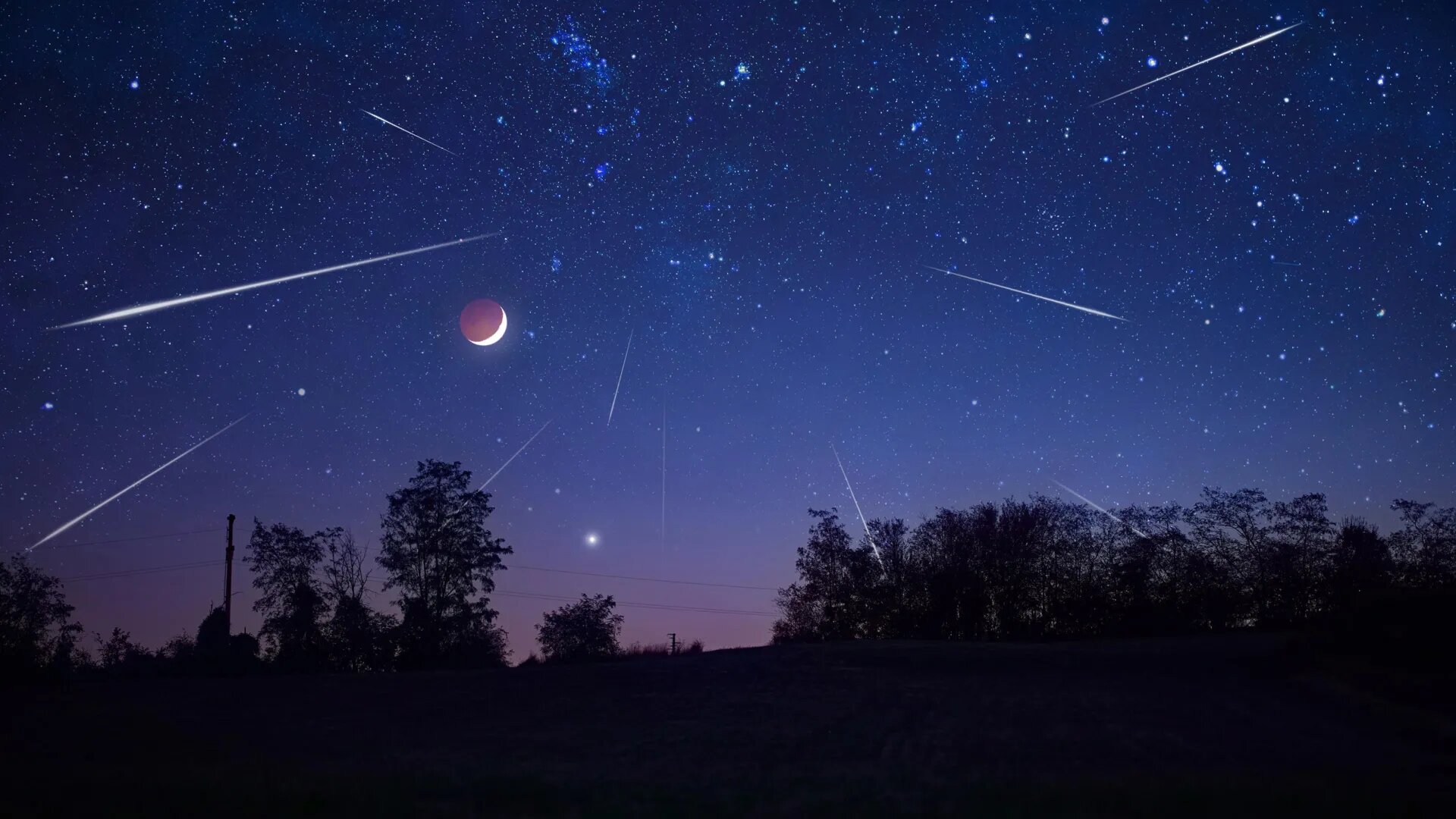
Later on Aug. 12, the Perseid meteor shower will begin its peak, continuing into the early morning of Aug. 13. Because the New Moon also arrives on Aug. 12, moonlight will not interfere, creating ideal dark conditions for spotting meteors.
The Perseids return each year as Earth travels through a trail of debris released by Comet Swift-Tuttle. Tiny particles of comet material enter the atmosphere at tremendous speed, heat up, and produce bright streaks across the sky.
Once darkness falls, look toward the northeast and wait for the constellation Perseus to rise above the horizon. The meteors appear to come from this part of the sky, but they can streak across almost any direction, so viewers should scan a wide area overhead.
For the clearest view, choose a dark location with an open horizon, remain outside as the night progresses, and allow about 30 minutes for your eyes to adjust to the darkness.
From Aug. 14 through 16, Venus reaches its greatest eastern elongation. This marks the planet's widest visible separation from the Sun during its current appearance in the evening sky.
Shortly after sunset, Venus will be easy to find low in the west. It will appear brighter than every nearby star. Through a telescope, the planet will look almost half illuminated, resembling a miniature lunar phase.
On the night of Aug. 27, extending into Aug. 28 in some time zones, the Full Moon will pass through Earth's shadow and create a partial lunar eclipse. The event will be visible from much of North and South America, as well as portions of Europe and Africa.
At the eclipse's maximum point, about 93% of the Moon's diameter will lie within Earth's dark central shadow, known as the umbra. The Moon will not become completely covered, but most of its surface may appear dramatically dimmed. The shadowed portion could also develop a rusty or copper colored tint.
Unlike a solar eclipse, a lunar eclipse can be viewed safely without eye protection. Binoculars or a small telescope can provide a closer look as the curved edge of Earth's shadow moves across the lunar surface.
Here are the phases of the Moon for August.
Materials provided by NASA's Jet Propulsion Laboratory . Note: Content may be edited for style and length.
World’s First Photonic Time Crystal Can Reshape Light in Trillionths of a Second
New Stroke Treatment Turns Brain Cavities Into Repair Hubs
Astronomers Find Ancient Black Holes Shining With the Power of a Trillion Suns
New Research Questions Decades of Low-Fat Dairy Advice
Stay informed with ScienceDaily's free email newsletter, updated daily and weekly. Or view our many newsfeeds in your RSS reader:
Keep up to date with the latest news from ScienceDaily via social networks:
Tell us what you think of ScienceDaily -- we welcome both positive and negative comments. Have any problems using the site? Questions?
AIPROPX is an independent multi-source news index — we track, compare, and connect coverage from across the web into one place you won't find anywhere else.