This is one outlet's own report from Tehran Times — the article as it was filed. Other outlets are covering the same event; open the full story to compare every source side by side.
West Bank escalation raises concerns within Israel
TEHRAN – The West Bank is witnessing a sharp escalation in Israeli aggression, settlement expansion, and a high level of military battalions placing mounting pressure on the regime.
The West Bank reached a renewed peak in Israeli aggression following clashes near Nablus. These were preceded by ongoing developments on both the government and settlement fronts, including land confiscations and the widespread establishment of settlement outposts across the West Bank.
Accompanying these were terrorist actions by settlers, including incursions, arson attacks, and other assaults on Palestinian villages.
The terrorism carried out by settlers and their official leaders has intensified following the steps taken by members of the regime’s cabinet, such as the terrorist minister, Itamar Ben Gvir’s visit to the Al-Aqsa Mosque compound. Another terrorist: Finance Minister Bezalel Smotrich has also called for punitive operations against villages surrounding Nablus and other areas of the West Bank.
The situation in the West Bank has generated concern within the regime’s security and military establishment, particularly the military, which must operate on two fronts: securing the expanding settlement enterprise and its ongoing security needs while protecting settlers against possible Palestinian responses, all at a time when it is facing a deepening manpower crisis.
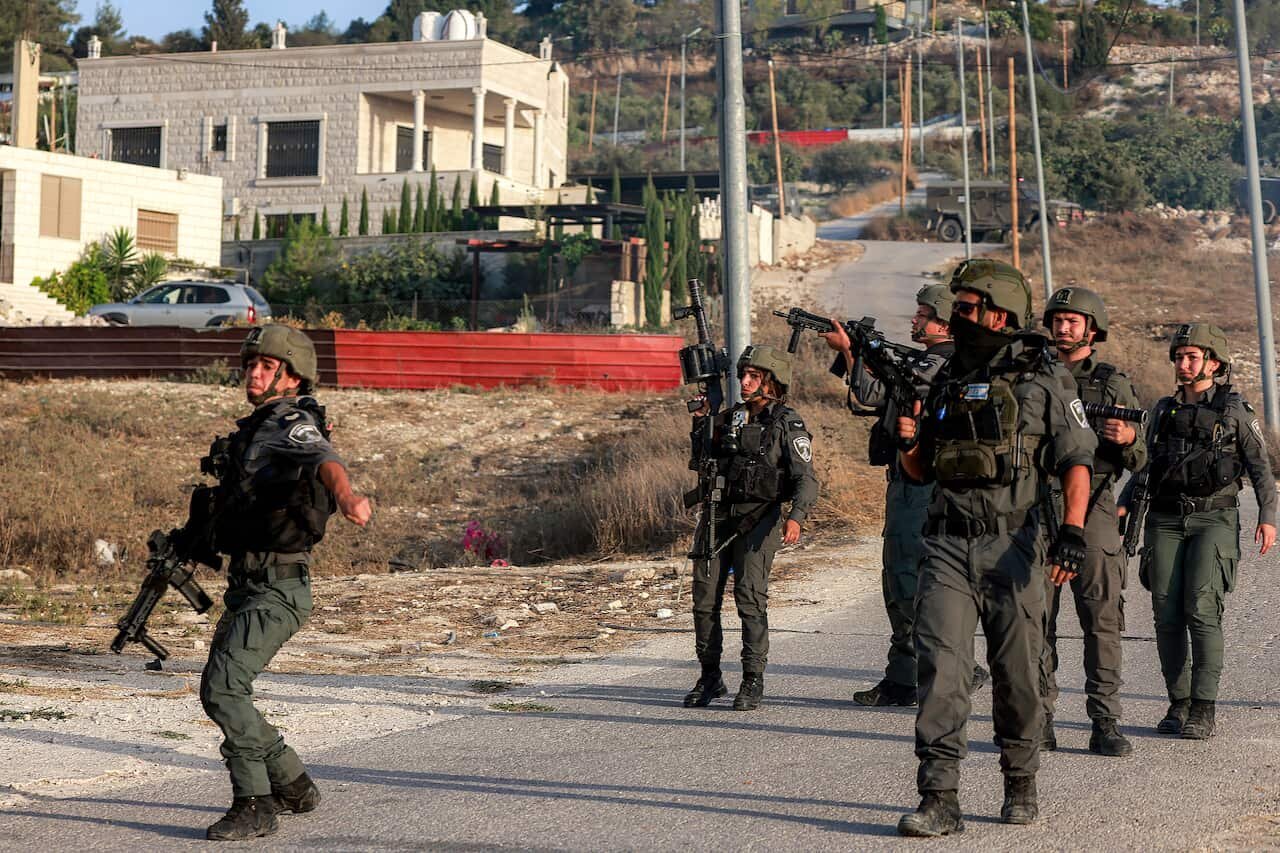
The Israeli Occupation Forces (IOF) have announced that it currently has approximately 24 battalions deployed in the West Bank, including ten reserve battalions, reinforced by additional paratrooper units, a level of deployment not seen since 2020.
This illegal deployment comes as the IOF faces personnel shortages and declining attendance rates among reserve units, among other factors, largely due to cumulative exhaustion.
The illegal expansion of settlement outposts, 80 outposts and 126 new settlement farms over the past two years, has played a central role in increasing the level of “friction,” according to the assessment of the head of the Shin Bet, who holds an extremist pro-settlement outlook.
This has forced the IOF to disperse its forces across extensive and scattered areas in order to provide security.
Numerous reports agree that acts of Palestinian resistance such as shootings and lone-attacker assaults, like the recent Nablus incident, quickly evolve into cycles of retaliatory violence by settlers. This requires immediate IOF intervention, compelling the IOF to carry out broad punitive measures, including house demolitions and the imposition of closures, thereby increasing both its logistical and manpower burdens.
Former commander of the IOF’s Central Command, Major General Nitzan Alon, previously warned that “the reality in the West Bank is extremely dangerous and could lead us into highly serious security confrontations. It could also bring us to a strategic reality resembling an apartheid state through the construction of settlement corridors stretching from west to east, fragmenting any Palestinian territorial continuity across the central mountain ridge and other areas.”
Military commentators have also cited security assessments, including the smuggling of drones from Jordan or across the border, further complicating what they describe as the IOF’s “defensive mission.”
Accordingly, the IOF is preparing scenarios involving a major escalation that could include the use of drones, similar to those it has previously encountered by Hezbollah in southern Lebanon.
A number of experts and commentators agree that the region “stands on the brink of an explosion” and that the IOF is being steadily worn down in the West Bank as settlement outposts continue to expand.
This has turned the area into a quagmire requiring continuous reinforcements at the expense of other fronts. This strain coincides with the IOF’s aggression in Gaza, including the assassination of Hamas leaders, and activities in Lebanon described as a “pilot zone” while concerns remain over the possibility of a renewed Lebanese front, particularly amid tensions involving Iran.
On the other hand, several senior members of the ruling right-wing coalition face accusations of deliberately inflaming the situation to advance their ideological agendas and electoral interests at the expense of the regime’s security and the IOF’s operational capacity.
Figures within the government, including Ben Gvir and Smotrich, regard escalation in the West Bank as an opportunity to dismantle the Palestinian Authority, impose full control over the territory, and divert attention from the failures of October 7 ahead of the October 2026 elections by exploiting the ongoing security emergency.
From another angle of the Hebrew media analysis, some military observers argue that the escalation in the West Bank is also affecting the regime’s other fronts. Alongside preparations for the possibility of a large-scale attack on Iran, whether American, Israeli, or both, the escalation in the West Bank serves as a distraction by tying down elite military units, including regular battalions, that could otherwise be assigned to primary fronts.
The IOF's personnel shortage is also reflected in its difficulty managing the security of unauthorized settler excursions into Lebanon, Syria, and Gaza, further dispersing its efforts and increasing operational burdens.
Media coverage has also reflected concerns over the outbreak of a “Third Intifada,” potentially supported by the smuggling of weapons and drones and accompanied by escalating cycles of retaliation. Such a scenario could force the occupying regime to redeploy forces from Gaza or Lebanon to reinforce the West Bank, thereby weakening deterrence on those fronts.
Hamas stated that the escalation of resistance activities in the West Bank is evidence of the failure of the IOF’s efforts to subdue the Palestinian people and deter them from defending their land and holy sites.
Hamas official Mahmoud Mardawi praised the steadfastness of the peop...
AIPROPX is an independent multi-source news index — we track, compare, and connect coverage from across the web into one place you won't find anywhere else.