This is one outlet's own report from Forbes — the article as it was filed. Other outlets are covering the same event; open the full story to compare every source side by side.
Gaming ‘House Of The Dragon’ Completely Botched Its Season 3 Finale Battle By Erik Kain ,
Forbes contributors publish independent expert analyses and insights. I write about TV shows, movies, video games, entertainment & culture. Follow Author Aug 11, 2026, 02:41pm EDT --:-- / --:-- This voice experience is generated by AI. Learn more . This voice experience is generated by AI. Learn more . House of the Dragon is one of those peculiar shows that I almost always have mixed feelings about . It’s something I look forward to watching each week, and something that I always walk away from at least mildly dissatisfied. All the prestige drama is there in spades: Talented actors, lavish costumes and sets, terrific cinematography and one of the most enrapturing musical scores on TV thanks to the magical compositions of Ramin Djawadi.
But it’s the writing where House of the Dragon becomes wobbly, and it’s not always obvious. Showrunner Ryan Condal and his team of writers are obviously talented. There’s nothing particularly bad in the dialogue, for instance, and at times it’s excellent. There are no glaring plot-holes. It’s the little things that are missing, or the ways that the writers of the TV series have made strange and unnecessary changes to the book that start to pile up and make what ought to be a top-tier prestige fantasy something merely wearing the costume of a top-tier prestige fantasy. It looks like a duck and it walks like a duck, but it is not a duck.
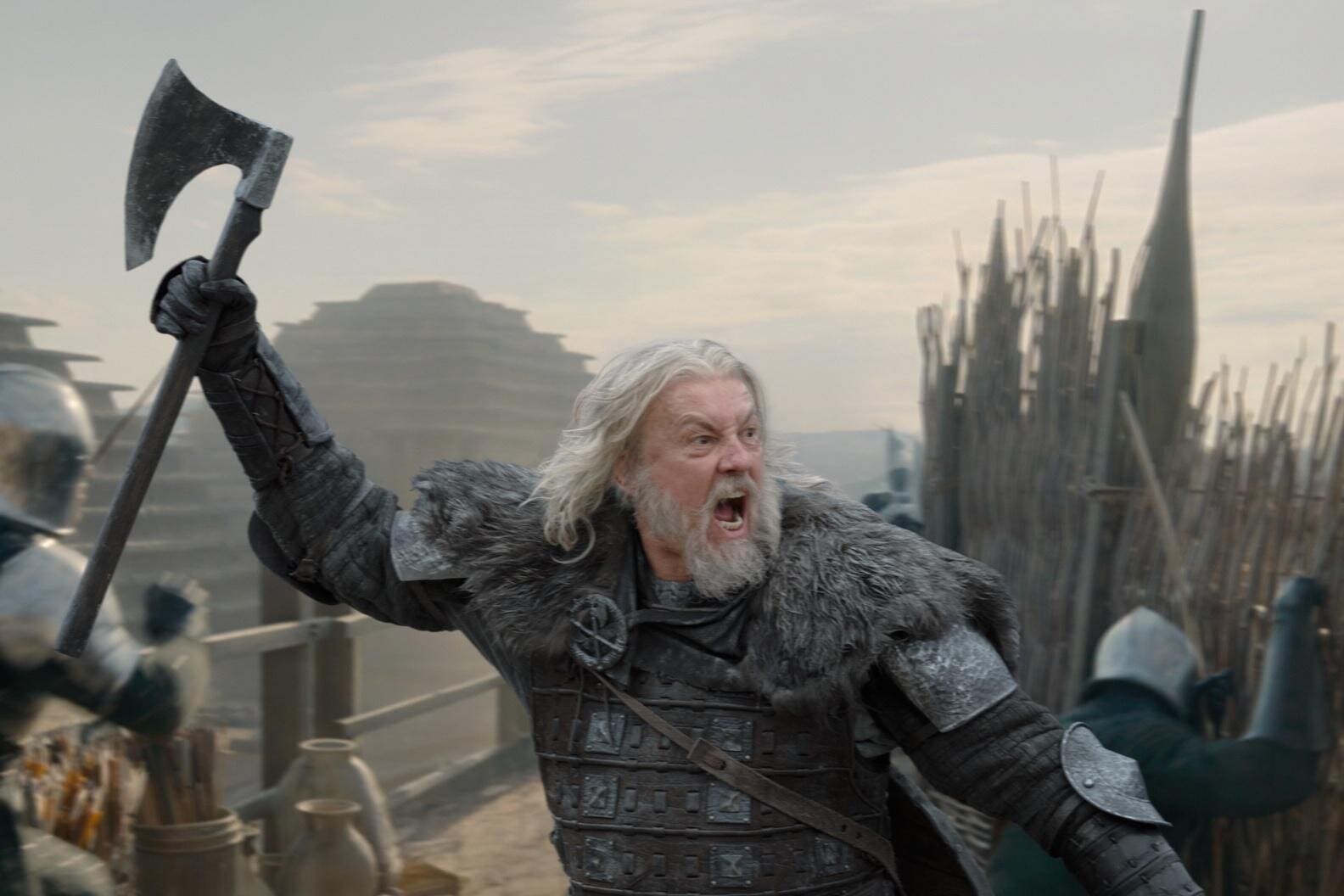
Nothing illustrates this better than the Battle of Tumbleton, the centerpiece of the Season 3 finale ; a sequence that plays out in a beautiful symphony of violence and bloodshed and fire but, on closer inspection, runs the book almost exactly backwards.
One of the most significant changes from the text (the show is inspired rather loosely at this point by a section of George R.R. Martin’s fictional history of the Targaryen dynasty, Fire & Blood ) is the close friendship between Rhaenyra (Emma D’Arcy) and Alicent (Olivia Cooke). In the book, this was never a friendly or affectionate relationship, but in the show they’ve taken a rather different approach, and one that seemed reasonable at first. In Season 1, the writers decided to make these two characters the same age (rather than have Alicent be the elder) and best friends (or “BFFs” as they were known in Westeros in those days of Viserys I’s rule).
In the first season, this worked remarkably well. Alicent marrying Rhaenyra’s father was a betrayal that created real drama and tension. It ought to have built into a genuinely friends-to-enemies kind of rancor, which would have slotted into the source material rather perfectly, with just a bit of extra backstory and an extra dagger in the back. Instead, the show hemmed and hawed, dragging out their friendship through all manner of bitter feuds until, in Season 3, Alicent has been reduced to a mere pawn for Rhaenyra, sent off to assassinate her own son – something book Alicent would never do.
The prophecy is another invention, and one I’ll have to address separately as it deserves its own post, but its persistence as a central story element produced my least favorite moment in the Season 3 finale, which I mostly thought was quite excellent .
Which brings me back to Tumbleton. The more I thought about the battle, the more something felt off about the entire thing. As entertaining as it was, did it actually make sense? I knew that the show had essentially condensed elements of two different battles at Tumbleton into one, but how much was changed exactly? It had been some time since I’d read the book, so I went back and checked.
It turns out the entire thing is upside down.
The writers made a great choice in giving Lord Ormund (James Norton) a larger role this season than he has in the book, where he’s often just referred to as a commander of the vast Hightower army. In the show he’s a schemer and a plotter, planting seeds of chaos in King’s Landing and convincing Ulf the White (Tom Bennett) to turn coat and join the Greens. That was a marvelous choice, giving Ulf the final nudge. The betrayal has substance it lacked in the book, and the show has its villain for Season 3. What makes less sense is having the Greens occupy Tumbleton and Rhaenyra hellbent on taking it back.
In the book, Tumbleton is a small fortified town that stands between Oldtown and King’s Landing. In other words, it’s a good place for Rhaenyra’s forces to hunker down and keep the invading army from reaching the capital. They are outnumbered two to one, but they have Ulf the White on Silverwing and Hugh Hammer (Kieran Bew) on Vermithor — two mighty dragons against Daeron's much smaller Tessarion.
The Blacks hold Tumbleton, and even though the cunning Lord Ormund has slipped his own men secretly into their midst, with two dragons on their side it seems that even the overwhelming forces of the Greens will not prevail. Then Ulf and Hugh turn on their own, betraying Rhaenyra and engulfing her army and the town in flames. Almost nobody escapes. Those who surrender are beheaded. All manner of atrocities follow as the town is burned and pillaged. The only real similarity at this point is that the great berserker of the North, Roddy the Ruin (Tommy Flanagan), kills Lord Ormund and is himself killed in one of the most intense and exciting moments in the entire episode. Roddy’s arm is even lopped off, just like in the book, before the pair of them are consumed by dragonfire (not in the book!)
And in the book, Daemon (Matt Smith) is many leagues away, flying Caraxes alongside Nettles on Sheepstealer, hunting Aemond and Vhagar. The show has told this battle backwards, and more puzzlingly still, it has Ulf not merely turning coat but going rogue and turning on the Greens as well.
This makes sense in the context of the show – Ormund beat and humiliated him worse than Daemon or Rhaenyra ever did, and did it only moments before putting the hungover “knight” on his dragon – bu...
AIPROPX is an independent multi-source news index — we track, compare, and connect coverage from across the web into one place you won't find anywhere else.