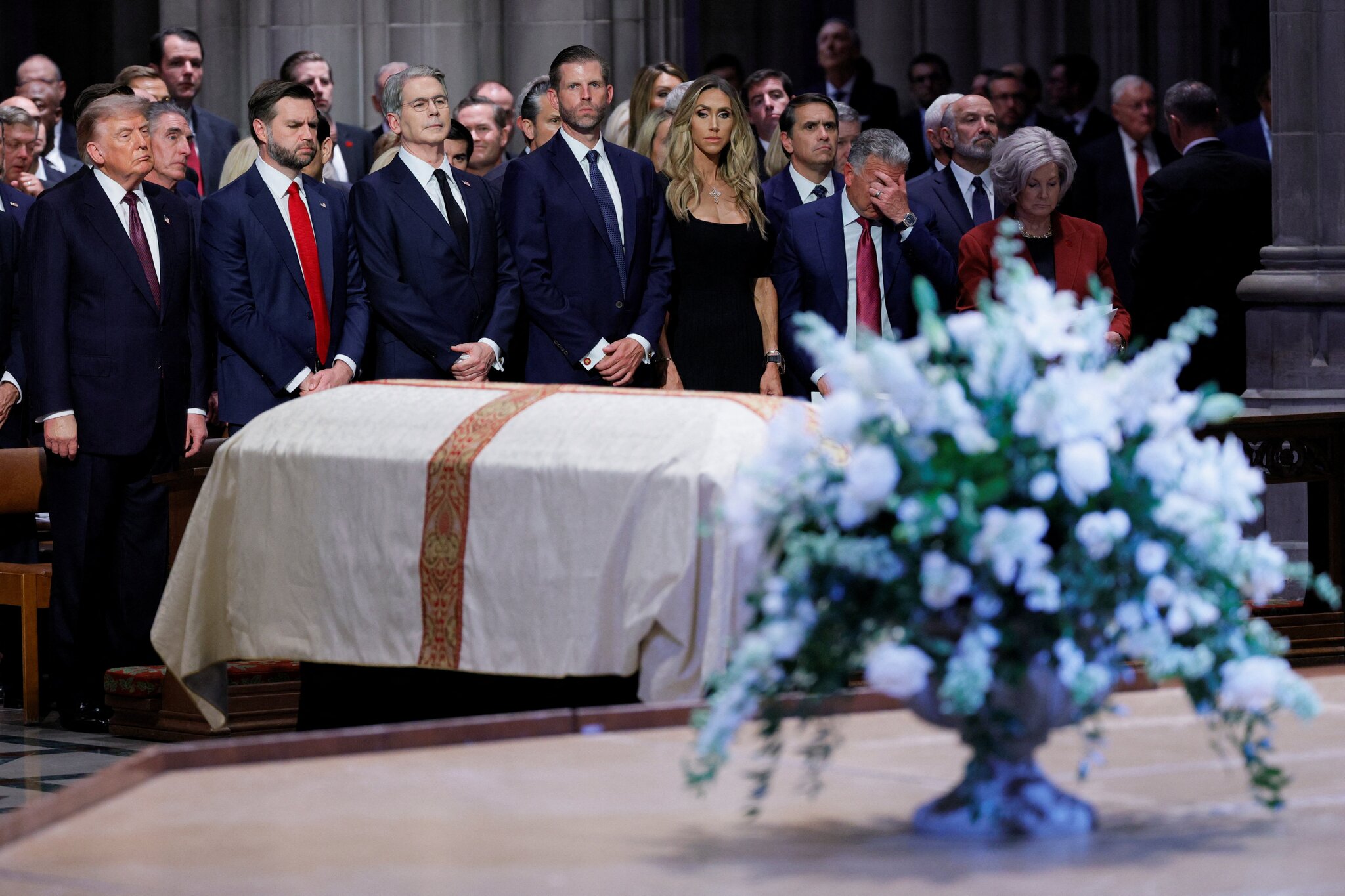
Sen. Lindsey Graham's memorial brought together presidents, prime ministers, senators and more. The day began at the Capitol, where the late congressman and senator served for 30 years and became known as a foreign policy hawk, a key presence on the Senate Judiciary Committee and ultimately, a strong ally of President Trump. Geoff Bennett spoke with Gavin Jackson of South Carolina ETV. Geoff Bennett: Senator Graham's memorial today brought together presidents, prime ministers, senators, and Cabinet officials. The day started at the Rotunda at the U.S. Capitol, where the late congressman and senator served for 30 years and became known as a foreign policy hawk, a key presence on the Senate Judiciary Committee, and ultimately a strong ally of President Trump. President Trump and Graham's niece remembered him during today's funeral service. President Donald Trump: By the strength of his steadfast convictions, the force of his magnetic personality and the goodness of his noble soul, Lindsey rose from a small town in rural South Carolina, a place he loves so much, to become a constant fixture of American politics at the highest level, and a force to be reckoned with all over the world. Emillie Boggs Roberts, Niece of Lindsey Graham: Lindsey was without a doubt a family man. His world revolved around my mother, his family, and those he considered such, like his lifelong friends, colleagues, staff, and the citizens of South Carolina. Geoff Bennett: Gavin Jackson from public media station South Carolina ETV was at the funeral service today and joins us from outside the National Cathedral. Gavin, thank you for being with us. So, take us inside the cathedral. What struck you the most about the service today? Gavin Jackson, South Carolina ETV: Yes, Geoff, I think what struck me the most about the service today was maybe what folks couldn't see at home or what was happening before the service even started, when you had, like you were saying, these international dignitaries there, including Ukrainian president Volodymyr Zelenskyy, as well as Prime Minister of Israel Benjamin Netanyahu. They were mingling. They were talking. I know that happens at a lot of these major events in Washington too, but it was almost fitting for the late Senator Lindsey Graham to essentially host an international confab as his last going away memorial, in a sense, as part of this day one of day two, two-part day series of him being remembered not just here in Washington, but back home in South Carolina tomorrow. So to have folks from back home in South Carolina -- I saw the Senate majority leader, Shane Massey, there back home in South Carolina, to these international figures. It was very fascinating to see that contrast, and then also to hear from the president, who, of course, Trump and Graham have both had a very fascinating friendship over the years. Anyone knows that, especially when they both ran for president back in 2016. And he referenced that in his remarks too. One of the funnier moments during that eulogy for the president talking about how he gave away the senator's number, his personal cell phone number that he had for 20-some years on the campaign trail during this heated times. And he had to change that phone number, but then, of course, moving forward the two became close friends, and he said Lindsey had kept calling me for the past 10 years now. So I think it was a bit of a lighthearted moment, and I think Senator Graham would have appreciated not just all the dignitaries there that he's worked with over the years, but also just the lighthearted nature of today's service. He probably could have enjoyed a few more jokes at his own expense, though. Geoff Bennett: You covered Senator Graham for years. How do you reconcile the arcs from John McCain's wingman to Donald Trump's harshest critic, ultimately, as we know, to Donald Trump's strongest ally in the U.S. Senate? Which was the real Lindsey Graham? Gavin Jackson: Well, I think the real Lindsey Graham was the one that kept fighting for South Carolina and delivering for South Carolina. These other parts of his career were tangential to that because he wanted to get things done. And in order to get things done, he had to adapt. A lot of people talk about that he didn't -- maybe wasn't strong enough after January 6, despite his words on the Senate floor. And he came back around to working closely with President Trump going forward to get him reelected, being his top cheerleader. So, in doing that, he got to advance not only his agenda for South Carolina, but also his agenda for the nation, as well as the international stage. Of course, national security was a huge factor for Senator Graham, and he wanted to see that take place. He wanted to push his agenda. We're seeing that play out right now with what happened in the Middle East, of course, with what's going on in Iran. And that's what actually counted for Lindsey Graham to advance that agenda, to get the right people in place to pay attention to his world view and to push his foreign policy. Yes, it was much different than the days of John McCain and Lieberman, of course, the Three Amigos there too, but he had to adapt. This party has changed. His party has changed. In order to be relevant in this party, he had to change as well. Geoff Bennett: Darline Graham was there today mourning the brother who raised her. She now occupies his former Senate seat. That special primary in South Carolina is two weeks away. What does the campaign look like right now? Gavin Jackson: It's pretty much wide open right now. We just saw filing close for the campaign end today. So we have about a dozen candidates who are vying to be the next Republican nominee for the Senate seat to go on and face Democrat Annie Andrews in November, as well as some other candidates on the ballot. Right now, it's wide open. Like we were saying, Darline Graham was appointed to fulfill the remainder of her brother's term and then turned around an...