This is one outlet's own report from Forbes — the article as it was filed. Other outlets are covering the same event; open the full story to compare every source side by side.
Forbes contributors publish independent expert analyses and insights. Ken Silverstein analyzes the Energy Transition, AI and Geopolitics Follow Author Aug 09, 2026, 08:45am EDT --:-- / --:-- This voice experience is generated by AI. Learn more . This voice experience is generated by AI. Learn more . Summary Malawi, an African nation, faced severe 18-hour blackouts after Tropical Storm Ana destroyed a major hydropower dam in 2022, crippling its grid and highlighting reliance on intermittent solar and expensive diesel. A new 20-megawatt lithium battery system, funded by a $20 million grant, now acts as "life support." It stores excess solar power during the day, discharging it during peak evening demand, reducing daily load shedding from eight to two hours and cutting diesel use. While not a full electrification solution, this project offers a vital model for climate-exposed economies to modernize power systems. Its technical documentation is being shared with other African countries, demonstrating how battery storage can stabilize fragile grids against future climate impacts. Malawi's Energy Minister calls it crucial for sustaining their energy revolution.
On a cloudy afternoon in Lilongwe, the sun disappears behind a bank of clouds, and with it goes a fifth of the country's electricity supply. That is what solar power does when nothing backs it up. For much of the past four years, the African nation of Malawi had nothing standing behind it. In January 2022, Tropical Storm Ana tore through the Kapichira Dam, ripping roughly 129 megawatts of hydropower off the national grid in a single stroke. What followed were blackouts stretching up to 18 hours a day—a gap that expensive diesel generators could not fill.
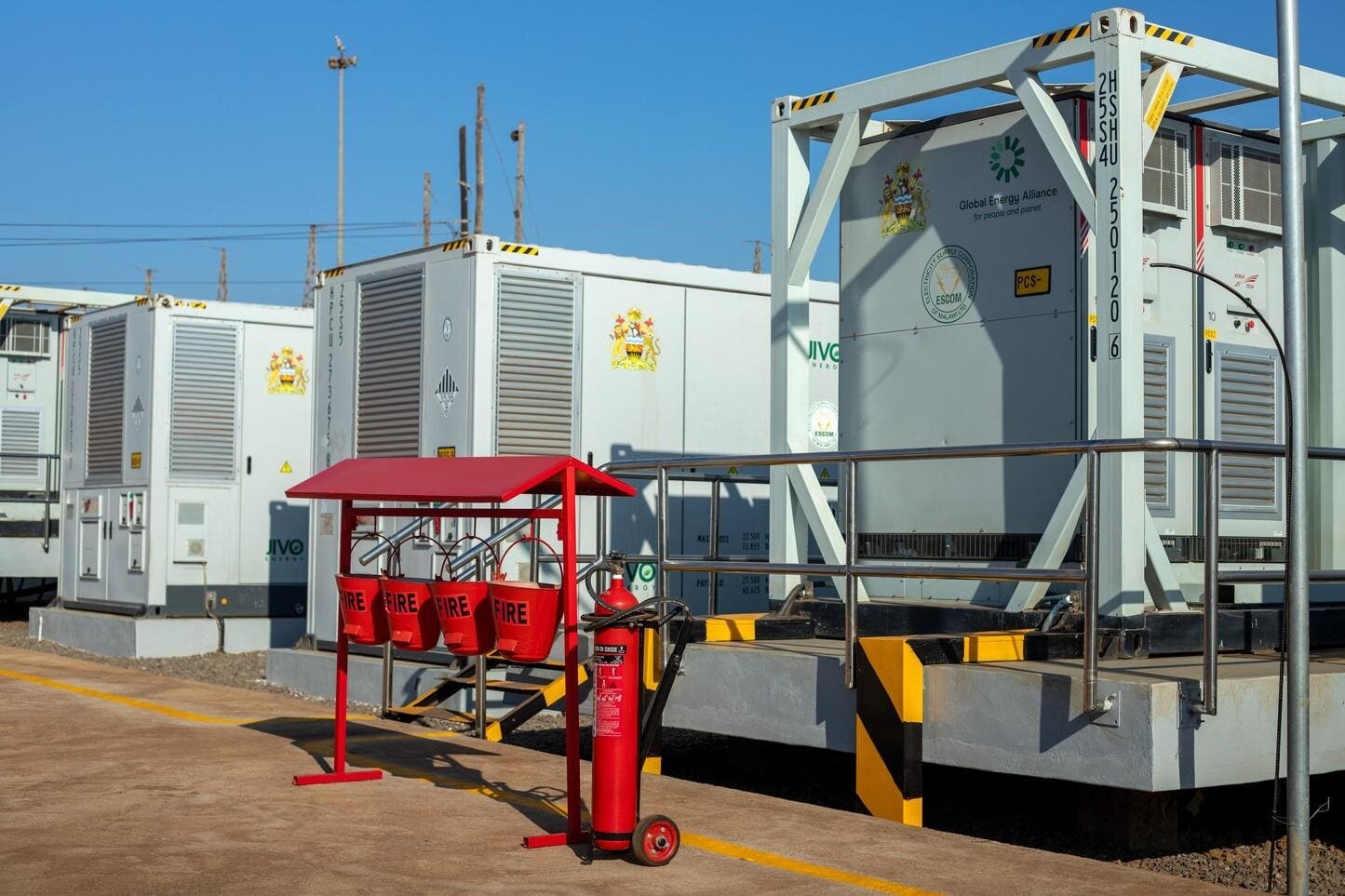
Now, a lithium battery system about the size of a few shipping containers, installed at Kanengo outside Lilongwe, is doing much of what that lost dam used to do. It is not a novel technology; American utilities have been bolting batteries onto their grids for years as a routine upgrade. But in Malawi, the same hardware is functioning less like an upgrade and more like life support, and that distinction offers a preview of how small, climate-exposed economies might modernize their power systems without waiting years for the next giant plant to come online.
"For decades, we have been at the mercy of the clock and the weather," Malawi's Minister of Energy, Dr. Jean Mathanga, told a crowd last month to officially commission the country's first grid-scale battery storage system. "Solar power may have sparked our energy revolution, but battery storage will sustain it."
The numbers behind that line explain why it isn't hyperbole. Only about 25% of Malawi's population has access to electricity at all. Nearly all the power that does exist comes from hydropower dams concentrated in the cyclone-prone south, hundreds of miles from demand in the capital.
Diesel, the traditional backstop, runs $3 to $3.50 a liter in a landlocked country where securing the dollars or euros to import it can take months. And the 2022 damage to Kapichira wiped out close to 30% of the country's hydropower capacity overnight, according to Malawian officials and independent estimates—the kind of loss that, in a grid this size, doesn't just dim the lights but threatens to collapse the whole system.
That is the gap the new battery bank is built to fill. The facility, a 20-megawatt, 40-megawatt-hour system, was funded by a $20 million grant from the Global Energy Alliance for People and Planet and built in partnership with Escom, Malawi's national utility. It charges during the day using excess power from the roughly 100 megawatts of solar capacity Malawi has added in recent years, and discharges in the evening when demand peaks.
That is solar energy that previously went to waste because there was no way to store it. In doing so, it also performs a quieter but arguably more important job: regulating the frequency and voltage swings that solar's intermittency introduces, the same stabilizing role the lost hydropower plant used to play.
"It's like a power bank, if I may say," Sinosi Maliyano, Escom Malawi's chief operations officer, said in an interview, describing how the system charges during the day and discharges at night. Maliyano said the effect has been immediate: load shedding that once ran roughly four hours in the morning and four in the evening has dropped to about two hours total since the battery came online.
With less shedding needed overall, Escom has also reworked its rationing schedule to put households first and ask industry to wait. That also means it doesn’t need to fire up expensive diesel fuel generators as often—a savings that matters in a country also short on the foreign currency needed to buy that fuel.
But is a battery bank in one small country a model, or an outlier?
Carol Koech, the Global Energy Alliance’s vice president for Africa, was candid about the limits of what has actually been proven. Malawi is now planning three more battery storage projects, she said, hoping to attract private capital to fund them. Asked which investors, and how much money, she told me: "That's not yet defined." By her own description, the Kanengo project is "a small step"— a reliability fix, not an electrification program, and not yet a financing template anyone can point to.
That caveat is worth sitting with, because it cuts against the industry’s tendency to declare victory at ribbon-cuttings. Malawi’s battery bank does not, on its own, get more people connected to the grid. Indeed, electrification will still require the slower, costlier work of extending lines and building out off-grid solar for rural areas, something a $150 million World Bank-backed program is meant to tackle separately. And the follow-on projects Koech describes exist only on paper.
Yet even a small step lands differently in a grid this fragile. A ...
AIPROPX is an independent multi-source news index — we track, compare, and connect coverage from across the web into one place you won't find anywhere else.